
12 Chinese Zodiac Animals: Complete Stroke Order Guide (鼠牛虎兔龙蛇马羊猴鸡狗猪)

HanziStroke TeamNative Chinese speakers & language educators
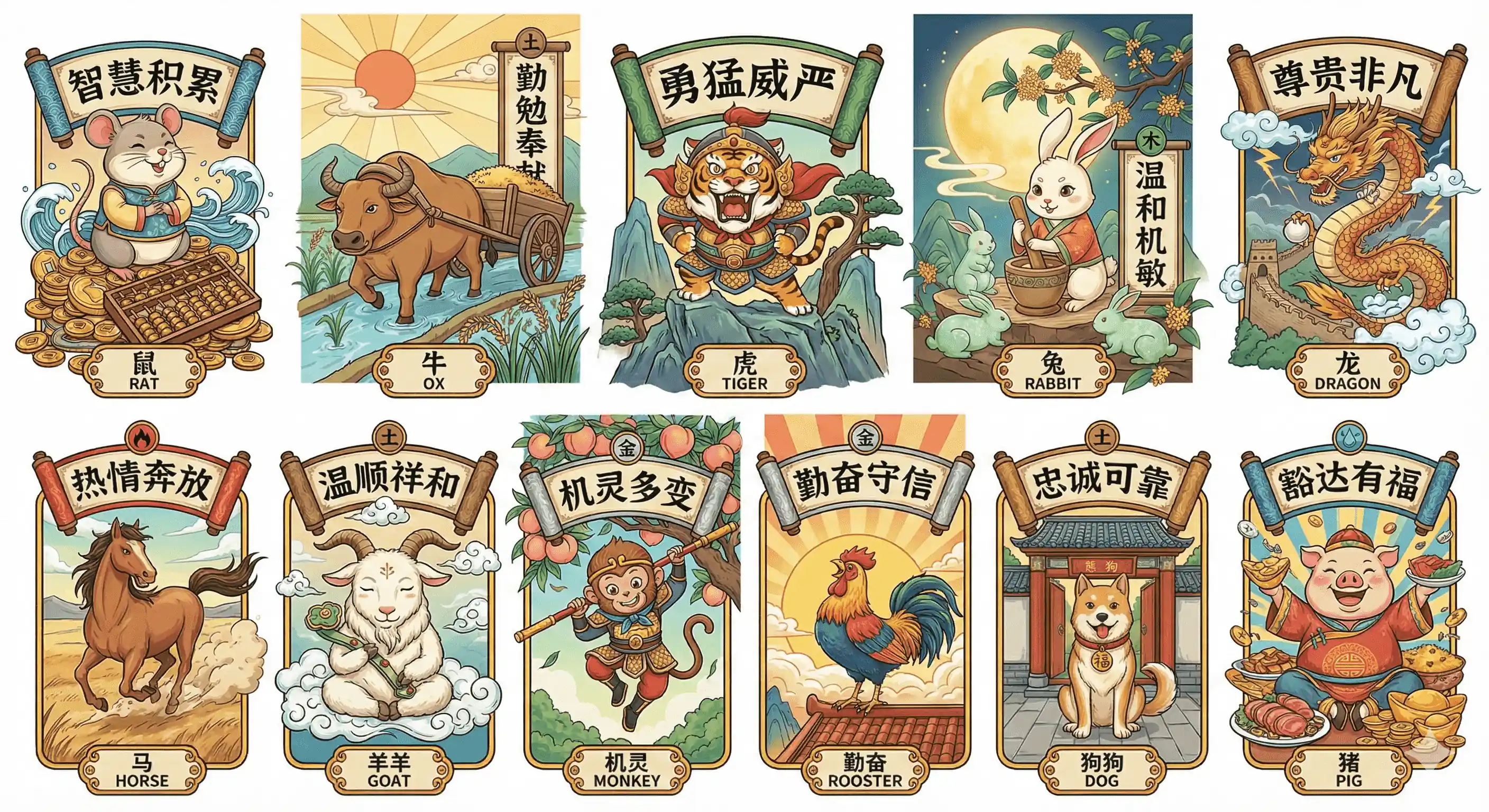
Master all 12 Chinese Zodiac characters with step-by-step stroke order animations. Learn how to write 鼠牛虎兔龙蛇马羊猴鸡狗猪 (Rat, Ox, Tiger, Rabbit, Dragon, Snake, Horse, Goat, Monkey, Rooster, Dog, Pig), discover their cultural meanings, personality traits, and find your zodiac sign by birth year.
What You'll Learn:
✓ Stroke-by-stroke animations for all 12 zodiac characters
✓ Birth year calculator to find your animal sign (1924-2044)
✓ Cultural meanings and personality traits
✓ Chinese phrases and idioms using zodiac characters
✓ Free printable worksheets for handwriting practice
What You'll Learn:
✓ Stroke-by-stroke animations for all 12 zodiac characters
✓ Birth year calculator to find your animal sign (1924-2044)
✓ Cultural meanings and personality traits
✓ Chinese phrases and idioms using zodiac characters
✓ Free printable worksheets for handwriting practice
Table of Contents
What is the Chinese Zodiac? (生肖 Shēngxiào)
The Chinese Zodiac (生肖 shēngxiào, literally "birth likeness") is a 12-year cycle where each year corresponds to an animal sign. Unlike Western astrology based on months, Chinese zodiac is determined by lunar calendar birth year.
The 12 Animals in Order:
鼠 (shǔ) Rat → 牛 (niú) Ox → 虎 (hǔ) Tiger → 兔 (tù) Rabbit → 龙 (lóng) Dragon → 蛇 (shé) Snake → 马 (mǎ) Horse → 羊 (yáng) Goat → 猴 (hóu) Monkey → 鸡 (jī) Rooster → 狗 (gǒu) Dog → 猪 (zhū) Pig
Why These 12 Animals?
Legend says the Jade Emperor held a race to determine the zodiac order. The clever Rat rode on Ox's back and jumped ahead at the finish line, explaining why Rat is first despite Ox's strength!
Cultural Significance: Your zodiac animal influences personality traits, compatibility, and even career advice in traditional Chinese culture. It's common to ask "你属什么?" (nǐ shǔ shénme? - What's your zodiac sign?) when meeting someone.
The 12 Animals in Order:
鼠 (shǔ) Rat → 牛 (niú) Ox → 虎 (hǔ) Tiger → 兔 (tù) Rabbit → 龙 (lóng) Dragon → 蛇 (shé) Snake → 马 (mǎ) Horse → 羊 (yáng) Goat → 猴 (hóu) Monkey → 鸡 (jī) Rooster → 狗 (gǒu) Dog → 猪 (zhū) Pig
Why These 12 Animals?
Legend says the Jade Emperor held a race to determine the zodiac order. The clever Rat rode on Ox's back and jumped ahead at the finish line, explaining why Rat is first despite Ox's strength!
Cultural Significance: Your zodiac animal influences personality traits, compatibility, and even career advice in traditional Chinese culture. It's common to ask "你属什么?" (nǐ shǔ shénme? - What's your zodiac sign?) when meeting someone.
1. 鼠 (Shǔ) - Rat
Meaning: Rat - the clever leader of the zodiac.
How to Write 鼠: 13 strokes total. Top section: 臼 (mortar), bottom section shows a rat's body. Despite being complex, the character beautifully captures a rat's agile form.
Stroke Count: 13 | HSK Level: 6 | Radical: 鼠 (rat)
Birth Years: 1924, 1936, 1948, 1960, 1972, 1984, 1996, 2008, 2020, 2032, 2044
Personality Traits: People born in Rat years are intelligent, adaptable, quick-witted, and resourceful. They're natural problem-solvers who excel at seizing opportunities.
Famous Rat Year People: Prince Charles (1948), Scarlett Johansson (1984)
Lucky Colors: Blue, gold, green | Lucky Numbers: 2, 3
Common Phrases:
• 鼠目寸光 (shǔ mù cùn guāng) - Short-sighted (lit. "rat eye inch light")
• 胆小如鼠 (dǎn xiǎo rú shǔ) - Timid as a mouse
Master 鼠 (shǔ) stroke order

How to Write 鼠: 13 strokes total. Top section: 臼 (mortar), bottom section shows a rat's body. Despite being complex, the character beautifully captures a rat's agile form.
Stroke Count: 13 | HSK Level: 6 | Radical: 鼠 (rat)
Birth Years: 1924, 1936, 1948, 1960, 1972, 1984, 1996, 2008, 2020, 2032, 2044
Personality Traits: People born in Rat years are intelligent, adaptable, quick-witted, and resourceful. They're natural problem-solvers who excel at seizing opportunities.
Famous Rat Year People: Prince Charles (1948), Scarlett Johansson (1984)
Lucky Colors: Blue, gold, green | Lucky Numbers: 2, 3
Common Phrases:
• 鼠目寸光 (shǔ mù cùn guāng) - Short-sighted (lit. "rat eye inch light")
• 胆小如鼠 (dǎn xiǎo rú shǔ) - Timid as a mouse
Master 鼠 (shǔ) stroke order
2. 牛 (Niú) - Ox
Meaning: Ox - symbol of diligence and reliability.
How to Write 牛: Only 4 strokes! Perfect for beginners. The character depicts an ox head from the front view with horns. First stroke: left-falling (撇), second: horizontal, third: vertical, fourth: horizontal.
Stroke Count: 4 | HSK Level: 2 | Radical: 牛 (ox)
Birth Years: 1925, 1937, 1949, 1961, 1973, 1985, 1997, 2009, 2021, 2033, 2045
Personality Traits: Ox people are hardworking, dependable, methodical, and patient. They value honesty and prefer steady progress over quick wins.
Famous Ox Year People: Barack Obama (1961), George Clooney (1961)
Lucky Colors: White, yellow, green | Lucky Numbers: 1, 9
Common Phrases:
• 牛气冲天 (niú qì chōng tiān) - Full of vim and vigor
• 九牛一毛 (jiǔ niú yī máo) - A drop in the ocean (lit. "one hair from nine oxen")
• 吹牛 (chuī niú) - To brag (colloquial)
Learn 牛 (niú) stroke order

How to Write 牛: Only 4 strokes! Perfect for beginners. The character depicts an ox head from the front view with horns. First stroke: left-falling (撇), second: horizontal, third: vertical, fourth: horizontal.
Stroke Count: 4 | HSK Level: 2 | Radical: 牛 (ox)
Birth Years: 1925, 1937, 1949, 1961, 1973, 1985, 1997, 2009, 2021, 2033, 2045
Personality Traits: Ox people are hardworking, dependable, methodical, and patient. They value honesty and prefer steady progress over quick wins.
Famous Ox Year People: Barack Obama (1961), George Clooney (1961)
Lucky Colors: White, yellow, green | Lucky Numbers: 1, 9
Common Phrases:
• 牛气冲天 (niú qì chōng tiān) - Full of vim and vigor
• 九牛一毛 (jiǔ niú yī máo) - A drop in the ocean (lit. "one hair from nine oxen")
• 吹牛 (chuī niú) - To brag (colloquial)
Learn 牛 (niú) stroke order
3. 虎 (Hǔ) - Tiger
Meaning: Tiger - king of beasts, symbol of bravery.
How to Write 虎: 8 strokes. Top: 虍 (hǔ tóu - tiger head radical), bottom: 几 (jī - table). The character structure evokes a tiger's powerful stance.
Stroke Count: 8 | HSK Level: 4 | Radical: 虍 (tiger)
Birth Years: 1926, 1938, 1950, 1962, 1974, 1986, 1998, 2010, 2022, 2034, 2046
Personality Traits: Tigers are brave, confident, competitive, and natural leaders. They love challenges and aren't afraid to take risks.
Famous Tiger Year People: Leonardo DiCaprio (1974), Lady Gaga (1986)
Lucky Colors: Blue, gray, orange | Lucky Numbers: 1, 3, 4
Common Phrases:
• 虎虎生威 (hǔ hǔ shēng wēi) - Full of power and energy
• 龙争虎斗 (lóng zhēng hǔ dòu) - Fierce competition (dragons and tigers fighting)
• 如虎添翼 (rú hǔ tiān yì) - Like a tiger with wings (even more powerful)
Practice 虎 (hǔ) stroke-by-stroke

How to Write 虎: 8 strokes. Top: 虍 (hǔ tóu - tiger head radical), bottom: 几 (jī - table). The character structure evokes a tiger's powerful stance.
Stroke Count: 8 | HSK Level: 4 | Radical: 虍 (tiger)
Birth Years: 1926, 1938, 1950, 1962, 1974, 1986, 1998, 2010, 2022, 2034, 2046
Personality Traits: Tigers are brave, confident, competitive, and natural leaders. They love challenges and aren't afraid to take risks.
Famous Tiger Year People: Leonardo DiCaprio (1974), Lady Gaga (1986)
Lucky Colors: Blue, gray, orange | Lucky Numbers: 1, 3, 4
Common Phrases:
• 虎虎生威 (hǔ hǔ shēng wēi) - Full of power and energy
• 龙争虎斗 (lóng zhēng hǔ dòu) - Fierce competition (dragons and tigers fighting)
• 如虎添翼 (rú hǔ tiān yì) - Like a tiger with wings (even more powerful)
Practice 虎 (hǔ) stroke-by-stroke
4. 兔 (Tù) - Rabbit
Meaning: Rabbit - gentle, quick, and fortunate.
How to Write 兔: 8 strokes. Top: ⺈ (knife radical variant), middle: 口 (mouth), bottom: 儿 (legs). Shows a rabbit's long ears and jumping legs.
Stroke Count: 8 | HSK Level: 5 | Radical: ⺈ (knife)
Birth Years: 1927, 1939, 1951, 1963, 1975, 1987, 1999, 2011, 2023, 2035, 2047
Personality Traits: Rabbit people are gentle, compassionate, artistic, and diplomatic. They prefer harmony and have excellent taste.
Famous Rabbit Year People: Angelina Jolie (1975), Michael Jordan (1963)
Lucky Colors: Red, pink, purple, blue | Lucky Numbers: 3, 4, 6
Cultural Note: The Jade Rabbit (玉兔 yù tù) lives on the moon in Chinese mythology, pounding medicine for the Moon Goddess Chang'e.
Common Phrases:
• 兔死狐悲 (tù sǐ hú bēi) - Fellow feeling (when the rabbit dies, the fox grieves)
• 守株待兔 (shǒu zhū dài tù) - Waiting for opportunities without effort
Master 兔 (tù) stroke order

How to Write 兔: 8 strokes. Top: ⺈ (knife radical variant), middle: 口 (mouth), bottom: 儿 (legs). Shows a rabbit's long ears and jumping legs.
Stroke Count: 8 | HSK Level: 5 | Radical: ⺈ (knife)
Birth Years: 1927, 1939, 1951, 1963, 1975, 1987, 1999, 2011, 2023, 2035, 2047
Personality Traits: Rabbit people are gentle, compassionate, artistic, and diplomatic. They prefer harmony and have excellent taste.
Famous Rabbit Year People: Angelina Jolie (1975), Michael Jordan (1963)
Lucky Colors: Red, pink, purple, blue | Lucky Numbers: 3, 4, 6
Cultural Note: The Jade Rabbit (玉兔 yù tù) lives on the moon in Chinese mythology, pounding medicine for the Moon Goddess Chang'e.
Common Phrases:
• 兔死狐悲 (tù sǐ hú bēi) - Fellow feeling (when the rabbit dies, the fox grieves)
• 守株待兔 (shǒu zhū dài tù) - Waiting for opportunities without effort
Master 兔 (tù) stroke order
5. 龙 (Lóng) - Dragon
Meaning: Dragon - the most auspicious zodiac animal, symbol of power and luck.
How to Write 龙: Only 5 strokes (simplified)! Traditional 龍 has 16 strokes. The simplified form still captures the dragon's serpentine body and power.
Stroke Count: 5 (simplified) / 16 (traditional) | HSK Level: 2 | Radical: 龙 (dragon)
Birth Years: 1928, 1940, 1952, 1964, 1976, 1988, 2000, 2012, 2024, 2036, 2048
Personality Traits: Dragons are charismatic, ambitious, enthusiastic, and natural-born leaders. They're perfectionists who inspire others.
Famous Dragon Year People: John Lennon (1940), Bruce Lee (1940), Rihanna (1988)
Lucky Colors: Gold, silver, gray | Lucky Numbers: 1, 6, 7
Cultural Significance: Dragon years see baby booms in Chinese communities! Dragons are considered the luckiest zodiac sign.
Common Phrases:
• 龙飞凤舞 (lóng fēi fèng wǔ) - Dragons flying, phoenixes dancing (graceful calligraphy)
• 望子成龙 (wàng zǐ chéng lóng) - Hoping one's child will become a dragon (succeed greatly)
• 龙马精神 (lóng mǎ jīng shén) - Spirit of dragon and horse (vigorous vitality)
Learn 龙 (lóng) simplified stroke order

How to Write 龙: Only 5 strokes (simplified)! Traditional 龍 has 16 strokes. The simplified form still captures the dragon's serpentine body and power.
Stroke Count: 5 (simplified) / 16 (traditional) | HSK Level: 2 | Radical: 龙 (dragon)
Birth Years: 1928, 1940, 1952, 1964, 1976, 1988, 2000, 2012, 2024, 2036, 2048
Personality Traits: Dragons are charismatic, ambitious, enthusiastic, and natural-born leaders. They're perfectionists who inspire others.
Famous Dragon Year People: John Lennon (1940), Bruce Lee (1940), Rihanna (1988)
Lucky Colors: Gold, silver, gray | Lucky Numbers: 1, 6, 7
Cultural Significance: Dragon years see baby booms in Chinese communities! Dragons are considered the luckiest zodiac sign.
Common Phrases:
• 龙飞凤舞 (lóng fēi fèng wǔ) - Dragons flying, phoenixes dancing (graceful calligraphy)
• 望子成龙 (wàng zǐ chéng lóng) - Hoping one's child will become a dragon (succeed greatly)
• 龙马精神 (lóng mǎ jīng shén) - Spirit of dragon and horse (vigorous vitality)
Learn 龙 (lóng) simplified stroke order
6. 蛇 (Shé) - Snake
Meaning: Snake - symbol of wisdom and mystery.
How to Write 蛇: 11 strokes. Left: 虫 (chóng - insect radical), right: 它 (tā - it/other). The insect radical indicates a creature that crawls.
Stroke Count: 11 | HSK Level: 5 | Radical: 虫 (insect)
Birth Years: 1929, 1941, 1953, 1965, 1977, 1989, 2001, 2013, 2025, 2037, 2049
Personality Traits: Snake people are wise, mysterious, intuitive, and sophisticated. They're deep thinkers who plan carefully.
Famous Snake Year People: Audrey Hepburn (1929), Taylor Swift (1989)
Lucky Colors: Black, red, yellow | Lucky Numbers: 2, 8, 9
Cultural Note: In Chinese culture, snakes (蛇 shé) are called "小龙" (xiǎo lóng - little dragons), linking them to good fortune.
Common Phrases:
• 画蛇添足 (huà shé tiān zú) - Draw a snake and add feet (overdoing something)
• 打草惊蛇 (dǎ cǎo jīng shé) - Beat grass to startle snakes (alert someone unintentionally)
Practice 蛇 (shé) stroke order

How to Write 蛇: 11 strokes. Left: 虫 (chóng - insect radical), right: 它 (tā - it/other). The insect radical indicates a creature that crawls.
Stroke Count: 11 | HSK Level: 5 | Radical: 虫 (insect)
Birth Years: 1929, 1941, 1953, 1965, 1977, 1989, 2001, 2013, 2025, 2037, 2049
Personality Traits: Snake people are wise, mysterious, intuitive, and sophisticated. They're deep thinkers who plan carefully.
Famous Snake Year People: Audrey Hepburn (1929), Taylor Swift (1989)
Lucky Colors: Black, red, yellow | Lucky Numbers: 2, 8, 9
Cultural Note: In Chinese culture, snakes (蛇 shé) are called "小龙" (xiǎo lóng - little dragons), linking them to good fortune.
Common Phrases:
• 画蛇添足 (huà shé tiān zú) - Draw a snake and add feet (overdoing something)
• 打草惊蛇 (dǎ cǎo jīng shé) - Beat grass to startle snakes (alert someone unintentionally)
Practice 蛇 (shé) stroke order
7. 马 (Mǎ) - Horse
Meaning: Horse - freedom, energy, and progress.
How to Write 马: Only 3 strokes (simplified) - perfect for absolute beginners! Traditional 馬 has 10 strokes. The simplified form shows a horse's flowing mane.
Stroke Count: 3 (simplified) / 10 (traditional) | HSK Level: 1 | Radical: 马 (horse)
Birth Years: 1930, 1942, 1954, 1966, 1978, 1990, 2002, 2014, 2026, 2038, 2050
Personality Traits: Horse people are energetic, independent, warm-hearted, and love freedom. They're optimistic and enjoy social interactions.
Famous Horse Year People: Genghis Khan (1162), Paul McCartney (1942), Emma Watson (1990)
Lucky Colors: Yellow, green, purple | Lucky Numbers: 2, 3, 7
2026 Significance: Fire Horse years (like 2026) occur once every 60 years and are especially powerful! Learn more about 2026 Fire Horse
Common Phrases:
• 马到成功 (mǎ dào chéng gōng) - Immediate success (success arrives on horseback)
• 一马当先 (yī mǎ dāng xiān) - Taking the lead
• 龙马精神 (lóng mǎ jīng shén) - Full of vim and vigor
Master 马 (mǎ) stroke order - easiest zodiac character!

How to Write 马: Only 3 strokes (simplified) - perfect for absolute beginners! Traditional 馬 has 10 strokes. The simplified form shows a horse's flowing mane.
Stroke Count: 3 (simplified) / 10 (traditional) | HSK Level: 1 | Radical: 马 (horse)
Birth Years: 1930, 1942, 1954, 1966, 1978, 1990, 2002, 2014, 2026, 2038, 2050
Personality Traits: Horse people are energetic, independent, warm-hearted, and love freedom. They're optimistic and enjoy social interactions.
Famous Horse Year People: Genghis Khan (1162), Paul McCartney (1942), Emma Watson (1990)
Lucky Colors: Yellow, green, purple | Lucky Numbers: 2, 3, 7
2026 Significance: Fire Horse years (like 2026) occur once every 60 years and are especially powerful! Learn more about 2026 Fire Horse
Common Phrases:
• 马到成功 (mǎ dào chéng gōng) - Immediate success (success arrives on horseback)
• 一马当先 (yī mǎ dāng xiān) - Taking the lead
• 龙马精神 (lóng mǎ jīng shén) - Full of vim and vigor
Master 马 (mǎ) stroke order - easiest zodiac character!
8. 羊 (Yáng) - Goat/Sheep
Meaning: Goat/Sheep - gentleness, kindness, and harmony.
How to Write 羊: 6 strokes. The character depicts a goat's head with horns from the front. Top: ⺶ (horns), bottom shows the face.
Stroke Count: 6 | HSK Level: 5 | Radical: 羊 (sheep)
Birth Years: 1931, 1943, 1955, 1967, 1979, 1991, 2003, 2015, 2027, 2039, 2051
Personality Traits: Goat people are gentle, sympathetic, artistic, and peace-loving. They're creative souls who value harmony and family.
Famous Goat Year People: Steve Jobs (1955), Bill Gates (1955)
Lucky Colors: Green, red, purple | Lucky Numbers: 3, 4, 9
Language Note: Chinese uses the same character for both goat and sheep. Context determines which animal is meant.
Common Phrases:
• 亡羊补牢 (wáng yáng bǔ láo) - Mend the pen after sheep are lost (better late than never)
• 羊入虎口 (yáng rù hǔ kǒu) - Sheep entering tiger's mouth (walking into danger)
• 三羊开泰 (sān yáng kāi tài) - Three rams bring prosperity (New Year blessing)
Learn 羊 (yáng) stroke order

How to Write 羊: 6 strokes. The character depicts a goat's head with horns from the front. Top: ⺶ (horns), bottom shows the face.
Stroke Count: 6 | HSK Level: 5 | Radical: 羊 (sheep)
Birth Years: 1931, 1943, 1955, 1967, 1979, 1991, 2003, 2015, 2027, 2039, 2051
Personality Traits: Goat people are gentle, sympathetic, artistic, and peace-loving. They're creative souls who value harmony and family.
Famous Goat Year People: Steve Jobs (1955), Bill Gates (1955)
Lucky Colors: Green, red, purple | Lucky Numbers: 3, 4, 9
Language Note: Chinese uses the same character for both goat and sheep. Context determines which animal is meant.
Common Phrases:
• 亡羊补牢 (wáng yáng bǔ láo) - Mend the pen after sheep are lost (better late than never)
• 羊入虎口 (yáng rù hǔ kǒu) - Sheep entering tiger's mouth (walking into danger)
• 三羊开泰 (sān yáng kāi tài) - Three rams bring prosperity (New Year blessing)
Learn 羊 (yáng) stroke order
9. 猴 (Hóu) - Monkey
Meaning: Monkey - cleverness, curiosity, and playfulness.
How to Write 猴: 12 strokes. Left: 犭 (quǎn páng - dog/animal radical), right: 侯 (hóu - marquis/nobility). Phono-semantic structure.
Stroke Count: 12 | HSK Level: 5 | Radical: 犭 (animal)
Birth Years: 1932, 1944, 1956, 1968, 1980, 1992, 2004, 2016, 2028, 2040, 2052
Personality Traits: Monkey people are clever, curious, mischievous, and innovative. They're quick learners who love solving puzzles and entertaining others.
Famous Monkey Year People: Leonardo da Vinci (1452), Tom Hanks (1956), Ryan Gosling (1980)
Lucky Colors: White, blue, gold | Lucky Numbers: 4, 9
Cultural Icon: The Monkey King (孙悟空 Sūn Wùkōng) from Journey to the West is one of China's most beloved legendary characters.
Common Phrases:
• 猴年马月 (hóu nián mǎ yuè) - Monkey year, horse month (meaning "never" - a very rare time)
• 杀鸡儆猴 (shā jī jǐng hóu) - Kill the chicken to scare the monkey (make an example)
Practice 猴 (hóu) stroke order

How to Write 猴: 12 strokes. Left: 犭 (quǎn páng - dog/animal radical), right: 侯 (hóu - marquis/nobility). Phono-semantic structure.
Stroke Count: 12 | HSK Level: 5 | Radical: 犭 (animal)
Birth Years: 1932, 1944, 1956, 1968, 1980, 1992, 2004, 2016, 2028, 2040, 2052
Personality Traits: Monkey people are clever, curious, mischievous, and innovative. They're quick learners who love solving puzzles and entertaining others.
Famous Monkey Year People: Leonardo da Vinci (1452), Tom Hanks (1956), Ryan Gosling (1980)
Lucky Colors: White, blue, gold | Lucky Numbers: 4, 9
Cultural Icon: The Monkey King (孙悟空 Sūn Wùkōng) from Journey to the West is one of China's most beloved legendary characters.
Common Phrases:
• 猴年马月 (hóu nián mǎ yuè) - Monkey year, horse month (meaning "never" - a very rare time)
• 杀鸡儆猴 (shā jī jǐng hóu) - Kill the chicken to scare the monkey (make an example)
Practice 猴 (hóu) stroke order
10. 鸡 (Jī) - Rooster
Meaning: Rooster - punctuality, confidence, and hard work.
How to Write 鸡: 7 strokes (simplified). Traditional 雞 has 18 strokes! Left: 又 (yòu - again), right: 鸟 (niǎo - bird radical). The simplified form is much easier to write.
Stroke Count: 7 (simplified) / 18 (traditional) | HSK Level: 4 | Radical: 鸟 (bird)
Birth Years: 1933, 1945, 1957, 1969, 1981, 1993, 2005, 2017, 2029, 2041, 2053
Personality Traits: Rooster people are hardworking, resourceful, courageous, and talented. They're natural performers who take pride in their appearance.
Famous Rooster Year People: Beyoncé (1981), Roger Federer (1981)
Lucky Colors: Gold, brown, yellow | Lucky Numbers: 5, 7, 8
Cultural Symbol: The rooster's crow heralds dawn, symbolizing new beginnings and driving away evil spirits.
Common Phrases:
• 闻鸡起舞 (wén jī qǐ wǔ) - Rise and dance upon hearing the rooster (diligence and determination)
• 鸡犬不宁 (jī quǎn bù níng) - Even chickens and dogs have no peace (great turmoil)
• 金鸡独立 (jīn jī dú lì) - Golden rooster stands on one leg (yoga/tai chi pose)
Learn 鸡 (jī) simplified stroke order

How to Write 鸡: 7 strokes (simplified). Traditional 雞 has 18 strokes! Left: 又 (yòu - again), right: 鸟 (niǎo - bird radical). The simplified form is much easier to write.
Stroke Count: 7 (simplified) / 18 (traditional) | HSK Level: 4 | Radical: 鸟 (bird)
Birth Years: 1933, 1945, 1957, 1969, 1981, 1993, 2005, 2017, 2029, 2041, 2053
Personality Traits: Rooster people are hardworking, resourceful, courageous, and talented. They're natural performers who take pride in their appearance.
Famous Rooster Year People: Beyoncé (1981), Roger Federer (1981)
Lucky Colors: Gold, brown, yellow | Lucky Numbers: 5, 7, 8
Cultural Symbol: The rooster's crow heralds dawn, symbolizing new beginnings and driving away evil spirits.
Common Phrases:
• 闻鸡起舞 (wén jī qǐ wǔ) - Rise and dance upon hearing the rooster (diligence and determination)
• 鸡犬不宁 (jī quǎn bù níng) - Even chickens and dogs have no peace (great turmoil)
• 金鸡独立 (jīn jī dú lì) - Golden rooster stands on one leg (yoga/tai chi pose)
Learn 鸡 (jī) simplified stroke order
11. 狗 (Gǒu) - Dog
Meaning: Dog - loyalty, honesty, and protection.
How to Write 狗: 8 strokes. Left: 犭 (quǎn páng - dog radical), right: 句 (jù - sentence). The dog radical immediately tells you this character relates to canines.
Stroke Count: 8 | HSK Level: 2 | Radical: 犭 (dog)
Birth Years: 1934, 1946, 1958, 1970, 1982, 1994, 2006, 2018, 2030, 2042, 2054
Personality Traits: Dog people are loyal, honest, responsible, and brave. They have strong sense of justice and make trustworthy friends.
Famous Dog Year People: Madonna (1958), Michael Jackson (1958)
Lucky Colors: Red, green, purple | Lucky Numbers: 3, 4, 9
Cultural Saying: "狗是人类最好的朋友" (gǒu shì rénlèi zuì hǎo de péngyǒu) - Dogs are mankind's best friends.
Common Phrases:
• 鸡犬升天 (jī quǎn shēng tiān) - Even chickens and dogs ascend to heaven (benefit from association)
• 狗急跳墙 (gǒu jí tiào qiáng) - A cornered dog will jump over a wall (desperate measures)
• 狗年旺旺 (gǒu nián wàng wàng) - Prosperous Dog Year (旺 wàng is also the sound dogs make!)
Master 狗 (gǒu) stroke order

How to Write 狗: 8 strokes. Left: 犭 (quǎn páng - dog radical), right: 句 (jù - sentence). The dog radical immediately tells you this character relates to canines.
Stroke Count: 8 | HSK Level: 2 | Radical: 犭 (dog)
Birth Years: 1934, 1946, 1958, 1970, 1982, 1994, 2006, 2018, 2030, 2042, 2054
Personality Traits: Dog people are loyal, honest, responsible, and brave. They have strong sense of justice and make trustworthy friends.
Famous Dog Year People: Madonna (1958), Michael Jackson (1958)
Lucky Colors: Red, green, purple | Lucky Numbers: 3, 4, 9
Cultural Saying: "狗是人类最好的朋友" (gǒu shì rénlèi zuì hǎo de péngyǒu) - Dogs are mankind's best friends.
Common Phrases:
• 鸡犬升天 (jī quǎn shēng tiān) - Even chickens and dogs ascend to heaven (benefit from association)
• 狗急跳墙 (gǒu jí tiào qiáng) - A cornered dog will jump over a wall (desperate measures)
• 狗年旺旺 (gǒu nián wàng wàng) - Prosperous Dog Year (旺 wàng is also the sound dogs make!)
Master 狗 (gǒu) stroke order
12. 猪 (Zhū) - Pig
Meaning: Pig - generosity, honesty, and abundance.
How to Write 猪: 11 strokes. Left: 犭 (quǎn páng - animal radical), right: 者 (zhě - one who). Traditional form 豬 uses 豕 (pig radical) instead.
Stroke Count: 11 | HSK Level: 5 | Radical: 犭 (animal)
Birth Years: 1935, 1947, 1959, 1971, 1983, 1995, 2007, 2019, 2031, 2043, 2055
Personality Traits: Pig people are generous, compassionate, diligent, and optimistic. They enjoy life's pleasures and are blessed with good fortune.
Famous Pig Year People: Arnold Schwarzenegger (1947), Hillary Clinton (1947)
Lucky Colors: Yellow, gray, brown, gold | Lucky Numbers: 2, 5, 8
Cultural Note: Pigs symbolize wealth and prosperity in Chinese culture. A plump pig represents abundance and success!
Common Phrases:
• 猪笼入水 (zhū lóng rù shuǐ) - Pig basket enters water (Cantonese saying for "money pouring in")
• 猪朋狗友 (zhū péng gǒu yǒu) - Pig and dog friends (bad company, though the animals are beloved!)
• 金猪报喜 (jīn zhū bào xǐ) - Golden pig brings good news
Learn 猪 (zhū) stroke order

How to Write 猪: 11 strokes. Left: 犭 (quǎn páng - animal radical), right: 者 (zhě - one who). Traditional form 豬 uses 豕 (pig radical) instead.
Stroke Count: 11 | HSK Level: 5 | Radical: 犭 (animal)
Birth Years: 1935, 1947, 1959, 1971, 1983, 1995, 2007, 2019, 2031, 2043, 2055
Personality Traits: Pig people are generous, compassionate, diligent, and optimistic. They enjoy life's pleasures and are blessed with good fortune.
Famous Pig Year People: Arnold Schwarzenegger (1947), Hillary Clinton (1947)
Lucky Colors: Yellow, gray, brown, gold | Lucky Numbers: 2, 5, 8
Cultural Note: Pigs symbolize wealth and prosperity in Chinese culture. A plump pig represents abundance and success!
Common Phrases:
• 猪笼入水 (zhū lóng rù shuǐ) - Pig basket enters water (Cantonese saying for "money pouring in")
• 猪朋狗友 (zhū péng gǒu yǒu) - Pig and dog friends (bad company, though the animals are beloved!)
• 金猪报喜 (jīn zhū bào xǐ) - Golden pig brings good news
Learn 猪 (zhū) stroke order
How to Calculate Your Chinese Zodiac Sign
Finding your zodiac animal is simple! The Chinese Zodiac follows a 12-year cycle, so your birth year determines your animal sign.
Quick Calculation Method:
1. Take your birth year (e.g., 1990)
2. Divide by 12 and note the remainder
3. Match the remainder to the zodiac:
• Remainder 0 = Monkey (猴)
• Remainder 1 = Rooster (鸡)
• Remainder 2 = Dog (狗)
• Remainder 3 = Pig (猪)
• Remainder 4 = Rat (鼠)
• Remainder 5 = Ox (牛)
• Remainder 6 = Tiger (虎)
• Remainder 7 = Rabbit (兔)
• Remainder 8 = Dragon (龙)
• Remainder 9 = Snake (蛇)
• Remainder 10 = Horse (马)
• Remainder 11 = Goat (羊)
Important Note: If you were born in January or early February, check the exact Chinese New Year date for your birth year! The zodiac year starts on Chinese New Year (between January 21 - February 20), NOT January 1st.
Example: Born on January 15, 2000? Chinese New Year 2000 was February 5, so you're actually a Rabbit (1999), not a Dragon (2000)!
Easy Way: Use our Free Chinese Zodiac Calculator - just enter your birth date, and it automatically accounts for the lunar calendar!
Quick Calculation Method:
1. Take your birth year (e.g., 1990)
2. Divide by 12 and note the remainder
3. Match the remainder to the zodiac:
• Remainder 0 = Monkey (猴)
• Remainder 1 = Rooster (鸡)
• Remainder 2 = Dog (狗)
• Remainder 3 = Pig (猪)
• Remainder 4 = Rat (鼠)
• Remainder 5 = Ox (牛)
• Remainder 6 = Tiger (虎)
• Remainder 7 = Rabbit (兔)
• Remainder 8 = Dragon (龙)
• Remainder 9 = Snake (蛇)
• Remainder 10 = Horse (马)
• Remainder 11 = Goat (羊)
Important Note: If you were born in January or early February, check the exact Chinese New Year date for your birth year! The zodiac year starts on Chinese New Year (between January 21 - February 20), NOT January 1st.
Example: Born on January 15, 2000? Chinese New Year 2000 was February 5, so you're actually a Rabbit (1999), not a Dragon (2000)!
Easy Way: Use our Free Chinese Zodiac Calculator - just enter your birth date, and it automatically accounts for the lunar calendar!
Practice Writing All 12 Zodiac Characters
Now that you've learned each zodiac animal individually, try writing all 12 characters together:
Complete Zodiac Sequence (十二生肖 shí èr shēngxiào):
First Four (1-4):
Rat - Ox - Tiger - Rabbit
Middle Four (5-8):
Dragon - Snake - Horse - Goat
Last Four (9-12):
Monkey - Rooster - Dog - Pig
Beginner-Friendly Characters (Start here!):
• 马 (mǎ) - 3 strokes - Horse
• 牛 (niú) - 4 strokes - Ox
• 龙 (lóng) - 5 strokes - Dragon
• 羊 (yáng) - 6 strokes - Goat
Intermediate Level:
• 虎 (hǔ) - 8 strokes - Tiger
• 兔 (tù) - 8 strokes - Rabbit
• 狗 (gǒu) - 8 strokes - Dog
Advanced Characters:
• 蛇 (shé) - 11 strokes - Snake
• 猪 (zhū) - 11 strokes - Pig
• 猴 (hóu) - 12 strokes - Monkey
• 鼠 (shǔ) - 13 strokes - Rat
Practice Tip: Generate a custom worksheet with all 12 zodiac characters using our Free Worksheet Generator. Perfect for mastering stroke order!
Complete Zodiac Sequence (十二生肖 shí èr shēngxiào):
First Four (1-4):
Rat - Ox - Tiger - Rabbit
Middle Four (5-8):
Dragon - Snake - Horse - Goat
Last Four (9-12):
Monkey - Rooster - Dog - Pig
Beginner-Friendly Characters (Start here!):
• 马 (mǎ) - 3 strokes - Horse
• 牛 (niú) - 4 strokes - Ox
• 龙 (lóng) - 5 strokes - Dragon
• 羊 (yáng) - 6 strokes - Goat
Intermediate Level:
• 虎 (hǔ) - 8 strokes - Tiger
• 兔 (tù) - 8 strokes - Rabbit
• 狗 (gǒu) - 8 strokes - Dog
Advanced Characters:
• 蛇 (shé) - 11 strokes - Snake
• 猪 (zhū) - 11 strokes - Pig
• 猴 (hóu) - 12 strokes - Monkey
• 鼠 (shǔ) - 13 strokes - Rat
Practice Tip: Generate a custom worksheet with all 12 zodiac characters using our Free Worksheet Generator. Perfect for mastering stroke order!
Common Chinese Zodiac Phrases & Idioms
Master these authentic Chinese phrases using zodiac animals:
New Year Greetings by Zodiac:
• 鼠年大吉 (shǔ nián dà jí) - Great fortune in Rat Year
• 牛转乾坤 (niú zhuǎn qián kūn) - Ox turns fortune around
• 虎虎生威 (hǔ hǔ shēng wēi) - Tiger's mighty power
• 兔年行大运 (tù nián xíng dà yùn) - Great luck in Rabbit Year
• 龙马精神 (lóng mǎ jīng shén) - Spirit of dragon and horse
• 马到成功 (mǎ dào chéng gōng) - Immediate success
• 三羊开泰 (sān yáng kāi tài) - Three rams bring prosperity
• 猴年大吉 (hóu nián dà jí) - Great fortune in Monkey Year
• 金鸡报晓 (jīn jī bào xiǎo) - Golden rooster announces dawn
• 狗年旺旺 (gǒu nián wàng wàng) - Prosperous Dog Year
• 猪年大吉 (zhū nián dà jí) - Great fortune in Pig Year
Famous Zodiac Idioms:
龙争虎斗 (lóng zhēng hǔ dòu) - Dragons and tigers fight (fierce competition)
守株待兔 (shǒu zhū dài tù) - Wait by tree stump for rabbits (waiting for easy opportunities)
如虎添翼 (rú hǔ tiān yì) - Like a tiger with wings (even more powerful)
Asking Someone's Zodiac:
• 你属什么?(nǐ shǔ shénme?) - What's your zodiac sign?
• 我属龙 (wǒ shǔ lóng) - I'm a Dragon
• 你是什么生肖?(nǐ shì shénme shēngxiào?) - What's your zodiac animal?
New Year Greetings by Zodiac:
• 鼠年大吉 (shǔ nián dà jí) - Great fortune in Rat Year
• 牛转乾坤 (niú zhuǎn qián kūn) - Ox turns fortune around
• 虎虎生威 (hǔ hǔ shēng wēi) - Tiger's mighty power
• 兔年行大运 (tù nián xíng dà yùn) - Great luck in Rabbit Year
• 龙马精神 (lóng mǎ jīng shén) - Spirit of dragon and horse
• 马到成功 (mǎ dào chéng gōng) - Immediate success
• 三羊开泰 (sān yáng kāi tài) - Three rams bring prosperity
• 猴年大吉 (hóu nián dà jí) - Great fortune in Monkey Year
• 金鸡报晓 (jīn jī bào xiǎo) - Golden rooster announces dawn
• 狗年旺旺 (gǒu nián wàng wàng) - Prosperous Dog Year
• 猪年大吉 (zhū nián dà jí) - Great fortune in Pig Year
Famous Zodiac Idioms:
龙争虎斗 (lóng zhēng hǔ dòu) - Dragons and tigers fight (fierce competition)
守株待兔 (shǒu zhū dài tù) - Wait by tree stump for rabbits (waiting for easy opportunities)
如虎添翼 (rú hǔ tiān yì) - Like a tiger with wings (even more powerful)
Asking Someone's Zodiac:
• 你属什么?(nǐ shǔ shénme?) - What's your zodiac sign?
• 我属龙 (wǒ shǔ lóng) - I'm a Dragon
• 你是什么生肖?(nǐ shì shénme shēngxiào?) - What's your zodiac animal?
Frequently Asked Questions
What's the difference between Chinese Zodiac and Western astrology?
Chinese Zodiac is based on BIRTH YEAR (12-year cycle), while Western astrology uses birth MONTH (12-month cycle). Chinese zodiac follows the lunar calendar, so the year starts between January 21 - February 20.
Is my zodiac based on my actual birthday or Chinese New Year?
Chinese New Year! If you're born before Chinese New Year, you belong to the previous year's animal. Example: Born January 20, 2000? You're a Rabbit (1999), not Dragon (2000), because CNY 2000 was February 5.
Why are some zodiac characters so complex?
Historical evolution! Characters like 鼠 (Rat, 13 strokes) retained complexity, while others simplified dramatically: 龙 (Dragon) went from 16 strokes (龍) to just 5 strokes in simplified Chinese.
Which zodiac characters are easiest for beginners?
Start with:
1. 马 (Horse) - 3 strokes
2. 牛 (Ox) - 4 strokes
3. 龙 (Dragon) - 5 strokes
These simple characters appear frequently in Chinese and are HSK Level 1-2.
Are simplified or traditional characters used for zodiac?
Both are correct! Mainland China uses simplified (龙 马 鸡), Taiwan/Hong Kong use traditional (龍 馬 雞). For cultural celebrations, either form is respectful.
What's my zodiac element (Wood, Fire, Earth, Metal, Water)?
Each animal also has an element rotating every 60 years. Example: 2024 is Wood Dragon, 2026 is Fire Horse. Elements add deeper personality analysis beyond the 12 animals.
Why is Dragon the most popular zodiac?
Dragons symbolize power, luck, and success in Chinese culture. Dragon years see baby booms because parents consider it the luckiest sign! Learn more about Dragon years
Can I practice writing zodiac characters?
Absolutely! Use our Free Worksheet Generator to create printable practice sheets with any zodiac characters. Each character includes stroke order guides.
Do zodiac animals affect compatibility?
Traditional Chinese culture considers certain zodiac pairs more compatible. For example: Rat + Ox, Tiger + Horse, Rabbit + Goat are considered harmonious pairs. However, modern interpretations vary widely.
Chinese Zodiac is based on BIRTH YEAR (12-year cycle), while Western astrology uses birth MONTH (12-month cycle). Chinese zodiac follows the lunar calendar, so the year starts between January 21 - February 20.
Is my zodiac based on my actual birthday or Chinese New Year?
Chinese New Year! If you're born before Chinese New Year, you belong to the previous year's animal. Example: Born January 20, 2000? You're a Rabbit (1999), not Dragon (2000), because CNY 2000 was February 5.
Why are some zodiac characters so complex?
Historical evolution! Characters like 鼠 (Rat, 13 strokes) retained complexity, while others simplified dramatically: 龙 (Dragon) went from 16 strokes (龍) to just 5 strokes in simplified Chinese.
Which zodiac characters are easiest for beginners?
Start with:
1. 马 (Horse) - 3 strokes
2. 牛 (Ox) - 4 strokes
3. 龙 (Dragon) - 5 strokes
These simple characters appear frequently in Chinese and are HSK Level 1-2.
Are simplified or traditional characters used for zodiac?
Both are correct! Mainland China uses simplified (龙 马 鸡), Taiwan/Hong Kong use traditional (龍 馬 雞). For cultural celebrations, either form is respectful.
What's my zodiac element (Wood, Fire, Earth, Metal, Water)?
Each animal also has an element rotating every 60 years. Example: 2024 is Wood Dragon, 2026 is Fire Horse. Elements add deeper personality analysis beyond the 12 animals.
Why is Dragon the most popular zodiac?
Dragons symbolize power, luck, and success in Chinese culture. Dragon years see baby booms because parents consider it the luckiest sign! Learn more about Dragon years
Can I practice writing zodiac characters?
Absolutely! Use our Free Worksheet Generator to create printable practice sheets with any zodiac characters. Each character includes stroke order guides.
Do zodiac animals affect compatibility?
Traditional Chinese culture considers certain zodiac pairs more compatible. For example: Rat + Ox, Tiger + Horse, Rabbit + Goat are considered harmonious pairs. However, modern interpretations vary widely.
Related Tools & Resources
Master Chinese Zodiac Writing:
🧮 Chinese Zodiac Calculator
Find your zodiac animal by birth date (accounts for lunar calendar!), see your element, and learn the character's stroke order.
📝 Free Chinese Worksheet Generator
Create custom practice sheets with all 12 zodiac characters. Perfect for handwriting practice with stroke order guides.
✍️ Chinese Name Generator
Get a personalized Chinese name based on your zodiac sign, with stroke order animations and cultural meanings.
🐴 2026 Year of the Horse Guide
Complete guide to Fire Horse year (2026) - meanings, predictions, and lucky practices.
🐴 Horse Year Blessings & Greetings
Authentic 2026 Horse Year Chinese greetings, idioms, and phrases with stroke order.
🎊 Chinese New Year Characters Guide
Learn 8 essential Spring Festival characters (福春年财 etc.) with stroke animations.
📚 HSK Level 1 Characters
All 300 HSK1 characters with animations - includes zodiac characters like 马 (horse), 牛 (ox), 龙 (dragon).
🖊️ Chinese Calligraphy for Beginners
Master proper stroke order, pen grip, and writing techniques for beautiful Chinese characters.
🧮 Chinese Zodiac Calculator
Find your zodiac animal by birth date (accounts for lunar calendar!), see your element, and learn the character's stroke order.
📝 Free Chinese Worksheet Generator
Create custom practice sheets with all 12 zodiac characters. Perfect for handwriting practice with stroke order guides.
✍️ Chinese Name Generator
Get a personalized Chinese name based on your zodiac sign, with stroke order animations and cultural meanings.
🐴 2026 Year of the Horse Guide
Complete guide to Fire Horse year (2026) - meanings, predictions, and lucky practices.
🐴 Horse Year Blessings & Greetings
Authentic 2026 Horse Year Chinese greetings, idioms, and phrases with stroke order.
🎊 Chinese New Year Characters Guide
Learn 8 essential Spring Festival characters (福春年财 etc.) with stroke animations.
📚 HSK Level 1 Characters
All 300 HSK1 characters with animations - includes zodiac characters like 马 (horse), 牛 (ox), 龙 (dragon).
🖊️ Chinese Calligraphy for Beginners
Master proper stroke order, pen grip, and writing techniques for beautiful Chinese characters.
Start Your Chinese Zodiac Writing Journey
You've discovered all 12 Chinese Zodiac animals - from the clever 鼠 (Rat) to the generous 猪 (Pig). Each character carries thousands of years of cultural wisdom and artistic beauty.
Your Next Steps:
1. Find Your Zodiac: Use our Zodiac Calculator to discover your animal sign and element.
2. Start Simple: Begin with the easiest character - 马 (Horse, 3 strokes). Practice 马 now
3. Generate Worksheets: Create personalized practice sheets with your favorite zodiac characters: Free Worksheet Generator
4. Learn Your Character: Focus on mastering YOUR zodiac animal's character. Example: Born in 1990? Master 马 (Horse) stroke order.
5. Practice Greetings: Combine characters into New Year phrases like 龙马精神 (vigorous vitality) or 马到成功 (immediate success).
Remember: Every stroke you write connects you to one of humanity's oldest continuous writing traditions. The 12 zodiac animals have guided Chinese culture for over 2,000 years - now you can write their names with authentic stroke order!
你属什么?(What's your zodiac sign?) Find out and start writing today! 🐁🐂🐅🐇🐉🐍🐎🐑🐒🐓🐕🐖
Your Next Steps:
1. Find Your Zodiac: Use our Zodiac Calculator to discover your animal sign and element.
2. Start Simple: Begin with the easiest character - 马 (Horse, 3 strokes). Practice 马 now
3. Generate Worksheets: Create personalized practice sheets with your favorite zodiac characters: Free Worksheet Generator
4. Learn Your Character: Focus on mastering YOUR zodiac animal's character. Example: Born in 1990? Master 马 (Horse) stroke order.
5. Practice Greetings: Combine characters into New Year phrases like 龙马精神 (vigorous vitality) or 马到成功 (immediate success).
Remember: Every stroke you write connects you to one of humanity's oldest continuous writing traditions. The 12 zodiac animals have guided Chinese culture for over 2,000 years - now you can write their names with authentic stroke order!
你属什么?(What's your zodiac sign?) Find out and start writing today! 🐁🐂🐅🐇🐉🐍🐎🐑🐒🐓🐕🐖
Related Articles
2026 Year of the Fire Horse: Meaning & Personality
Deep dive into the Fire Horse year — traits, luck, and blessings
Chinese New Year Traditions: 12 Spring Festival Customs
Learn the customs and characters behind Spring Festival
Wu Xing (五行): The Five Elements in Chinese
Understand the Fire, Water, Wood, Metal, Earth cycle behind the zodiac
8 Basic Strokes of Chinese Characters
Master the fundamental strokes before writing zodiac characters