
Chinese Numbers 1-100: Stroke Order, Writing & Counting Guide

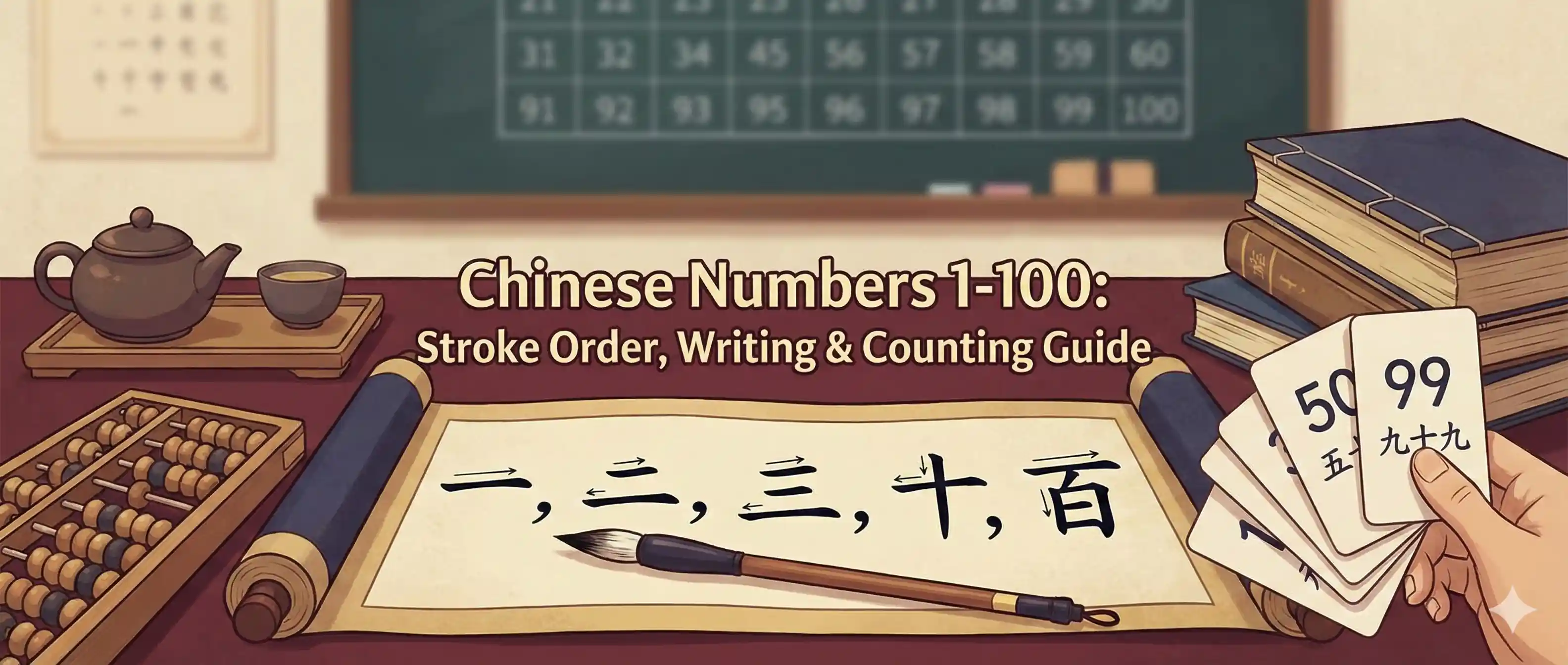
Numbers are often the first thing you learn in any language — and Chinese makes it surprisingly easy. The good news? You only need to master 10 characters to count from 1 to 99, and the combination rules are completely logical (unlike English's "eleven" and "twelve"). This guide teaches you the correct stroke order for each number character, explains the simple math behind Chinese counting, and helps you write numbers with confidence.
Numbers 1-10: The Foundation
These 10 characters are the building blocks for all Chinese numbers. Master their stroke order first, and you'll be able to write any number.
| Number | Character | Pinyin | Strokes | Meaning |
|---|---|---|---|---|
| 1 | 一 | yī | 1 | one |
| 2 | 二 | èr | 2 | two |
| 3 | 三 | sān | 3 | three |
| 4 | 四 | sì | 5 | four |
| 5 | 五 | wǔ | 4 | five |
| 6 | 六 | liù | 4 | six |
| 7 | 七 | qī | 2 | seven |
| 8 | 八 | bā | 2 | eight |
| 9 | 九 | jiǔ | 2 | nine |
| 10 | 十 | shí | 2 | ten |
Writing Tips:
- •一, 二, 三: Write horizontal strokes from left to right, keeping them level and evenly spaced
- •四: The most complex of the basic numbers — practice the enclosed structure
- •五: Start with the top horizontal stroke, not the vertical
- •十: Write the horizontal stroke first, then the vertical stroke through the center
Start Practicing: Click any character above to see its animated stroke order and practice writing it correctly.
Numbers 11-99: Simple Combination Rules
Unlike English with its irregular "eleven, twelve, thirteen," Chinese numbers follow pure logic. Once you know 1-10, you can count to 99 instantly.
The Rules:
- •11-19: 十 + digit = 十一, 十二, 十三...
- •20, 30, 40...: digit + 十 = 二十, 三十, 四十...
- •21-99: digit + 十 + digit = 二十一, 三十五, 九十九...
Examples:
| Number | Chinese | Literal Meaning |
|---|---|---|
| 11 | 十一 (shí yī) | ten-one |
| 15 | 十五 (shí wǔ) | ten-five |
| 20 | 二十 (èr shí) | two-ten |
| 25 | 二十五 (èr shí wǔ) | two-ten-five |
| 99 | 九十九 (jiǔ shí jiǔ) | nine-ten-nine |
Compare to English:
| English | Chinese Logic |
|---|---|
| eleven (irregular) | 十一 (ten-one) |
| twelve (irregular) | 十二 (ten-two) |
| twenty (irregular) | 二十 (two-ten) |
| twenty-one | 二十一 (two-ten-one) |
See the pattern? Chinese is much more logical!
Hundreds, Thousands & Beyond
For larger numbers, you just need a few more characters. The combination logic stays the same.
Key Characters:
- •Important: Chinese uses 万 (wàn, 10,000) as a counting unit, which doesn't exist in English. This means:
- •10,000 = 一万 (yī wàn) — "one ten-thousand"
- •100,000 = 十万 (shí wàn) — "ten ten-thousands"
- •1,000,000 = 一百万 (yī bǎi wàn) — "one hundred ten-thousands"
Examples:
| Number | Chinese | Breakdown |
|---|---|---|
| 100 | 一百 | one-hundred |
| 258 | 二百五十八 | two-hundred-five-ten-eight |
| 1,000 | 一千 | one-thousand |
| 3,456 | 三千四百五十六 | three-thousand-four-hundred-five-ten-six |
| 10,000 | 一万 | one-wan |
| 50,000 | 五万 | five-wan |
Writing Practice: Start with 百 and 千 — they appear frequently in prices, addresses, and dates.
Zero: The Special Case
The character for zero, 零 (líng), has 13 strokes — making it the most complex number character. But it's essential for phone numbers, addresses, and certain number combinations.
When to Use 零:
- •Phone numbers: 138-0000-5678 is read digit by digit with 零 for each 0
- •Room/apartment numbers: Room 101 = 一零一 (yī líng yī)
- •Years: 2025 = 二零二五 (èr líng èr wǔ)
- •Middle zeros in numbers: 101 = 一百零一 (yī bǎi líng yī)
The 零 Rule for Compound Numbers:
| Number | Chinese | Note |
|---|---|---|
| 101 | 一百零一 | Need 零 for the missing tens place |
| 110 | 一百一十 | No 零 needed (tens place has value) |
| 1001 | 一千零一 | 零 replaces missing hundreds AND tens |
| 1010 | 一千零一十 | 零 for missing hundreds |
Tip: When there are consecutive zeros in the middle of a number, you only say 零 once.
Practice: 零 is complex but worth mastering. Click to see the stroke order animation.
Ordinal Numbers: First, Second, Third
To say "first, second, third" in Chinese, simply add 第 (dì) before any number.
Formation: 第 + number = ordinal
| Ordinal | Chinese | Pinyin |
|---|---|---|
| 1st | 第一 | dì yī |
| 2nd | 第二 | dì èr |
| 3rd | 第三 | dì sān |
| 10th | 第十 | dì shí |
| 21st | 第二十一 | dì èr shí yī |
| 100th | 第一百 | dì yī bǎi |
Common Uses:
- •第一次 (dì yī cì) — first time
- •第二天 (dì èr tiān) — second day / the next day
- •第三名 (dì sān míng) — third place
- •第一个 (dì yī gè) — the first one
第 This character has 11 strokes. The bamboo radical (⺮) on top is written first, followed by the bottom component. Click 第 to practice the correct stroke order.
Note: Unlike English, Chinese ordinals are completely regular — no "first/second/third" irregularities!
Lucky & Unlucky Numbers in Chinese Culture
Numbers carry deep cultural meaning in Chinese society. Understanding these associations helps you navigate real-life situations — from choosing a phone number to understanding why buildings skip certain floors.
Lucky Numbers:
- •八
- •Sounds like 发 (fā) meaning "prosperity" or "wealth"
- •Phone numbers, license plates, and addresses with 8 are highly valued
- •The Beijing Olympics started on 08/08/2008 at 8:08 PM
- •Business people pay premium prices for numbers containing 8
- •六
- •Associated with 顺利 (shùnlì) meaning "smooth" or "going well"
- •The phrase 六六大顺 (liù liù dà shùn) means "everything goes smoothly"
- •Popular for weddings and business openings
- •九
- •Sounds like 久 (jiǔ) meaning "long-lasting"
- •Associated with the Emperor (dragon has 9 forms, 9 sons)
- •Popular for weddings: 99 roses, 999 yuan gifts
- •September 9th is a traditional festival for elders
Unlucky Numbers:
- •四
- •Sounds like 死 (sǐ) meaning "death"
- •Many buildings skip floors with 4 (no 4th, 14th, 24th floor)
- •Phone numbers and license plates avoid 4
- •Gifts should not come in sets of 4
- •Practical Applications:
- •Choosing a phone number? Look for 8s, avoid 4s
- •Giving money as a gift? 88, 168, 888 are popular amounts
- •Hotel room numbers often skip 4, 13, and 14
Formal Numbers for Banking (大写数字)
Chinese has a set of complex "formal" or "banker's" numbers (大写数字, dàxiě shùzì) used in financial documents. These characters are harder to alter than the simple forms, preventing fraud on checks and contracts.
Standard vs. Formal Numbers:
| Number | Standard | Formal | Pinyin |
|---|---|---|---|
| 0 | 零 | 零 | líng |
| 1 | 一 | 壹 | yī |
| 2 | 二 | 贰 | èr |
| 3 | 三 | 叁 | sān |
| 4 | 四 | 肆 | sì |
| 5 | 五 | 伍 | wǔ |
| 6 | 六 | 陆 | liù |
| 7 | 七 | 柒 | qī |
| 8 | 八 | 捌 | bā |
| 9 | 九 | 玖 | jiǔ |
| 10 | 十 | 拾 | shí |
| 100 | 百 | 佰 | bǎi |
| 1000 | 千 | 仟 | qiān |
Why They Exist:
- •Consider how easy it would be to change:
- •一 (1) → 二 (2) or 三 (3) by adding strokes
- •十 (10) → 千 (1000) by adding two strokes
The formal characters are complex enough that they can't be easily modified.
- •Where You'll See Them:
- •Bank checks and money orders
- •Legal contracts and receipts
- •Official financial documents
- •Red envelopes (sometimes)
For Learners: You don't need to write these often, but recognizing them is useful when dealing with official documents in Chinese.
Practice: Write Your First Numbers
Ready to start writing? Here's a recommended practice sequence based on stroke complexity and frequency.
Beginner Practice Order:
- 1.一 (1 stroke) — The simplest character in Chinese
- 2.二 (2 strokes) — Two horizontal lines
- 3.三 (3 strokes) — Three horizontal lines
- 4.十 (2 strokes) — Cross shape, very common
- 5.八 (2 strokes) — Lucky number, simple strokes
Intermediate Practice:
- 6.七 (2 strokes) — Slightly tricky stroke order
- 7.九 (2 strokes) — Curved stroke practice
- 8.六 (4 strokes) — Introduces the dot stroke
- 9.五 (4 strokes) — Multiple stroke types
- 10.四 (5 strokes) — Enclosed structure
Advanced Practice:
- 11.百 (6 strokes) — Hundred
- 12.千 (3 strokes) — Thousand
- 13.万 (3 strokes) — Ten thousand
- 14.零 (13 strokes) — Zero (most complex)
Practice Resources:
- •Worksheet Generator — Create printable practice sheets for any number
- •HSK 1 Characters — All basic numbers are in HSK Level 1
- •Basic Strokes Guide — Master 横 (héng) and 竖 (shù) first — they're the main strokes in number characters
Daily Practice Tip: Start each day by writing 一 through 十. It takes less than 2 minutes and builds muscle memory for the fundamental strokes.
Numbers are the perfect starting point for Chinese writing — simple characters, logical combinations, and immediate practical use. Start with 一 today!
Related Resources
Continue Learning
- Master the 8 Basic Chinese Strokes
Essential foundation for character writing
- Chinese Pinyin Tones Guide
Master the 4 tones for correct pronunciation
- Common HSK 1 Stroke Order Mistakes
Fix these errors before they become habits
Practice Tools
- HSK 1 Character Dictionary
All basic numbers are in HSK Level 1
- Worksheet Generator
Create printable number practice sheets
- Start with 一 (One)
The simplest Chinese character
Ready to Write Chinese Numbers?
Start with the simplest character — 一 (yī, one) — and build from there.