
Basic Strokes of Chinese Characters: A Complete Guide

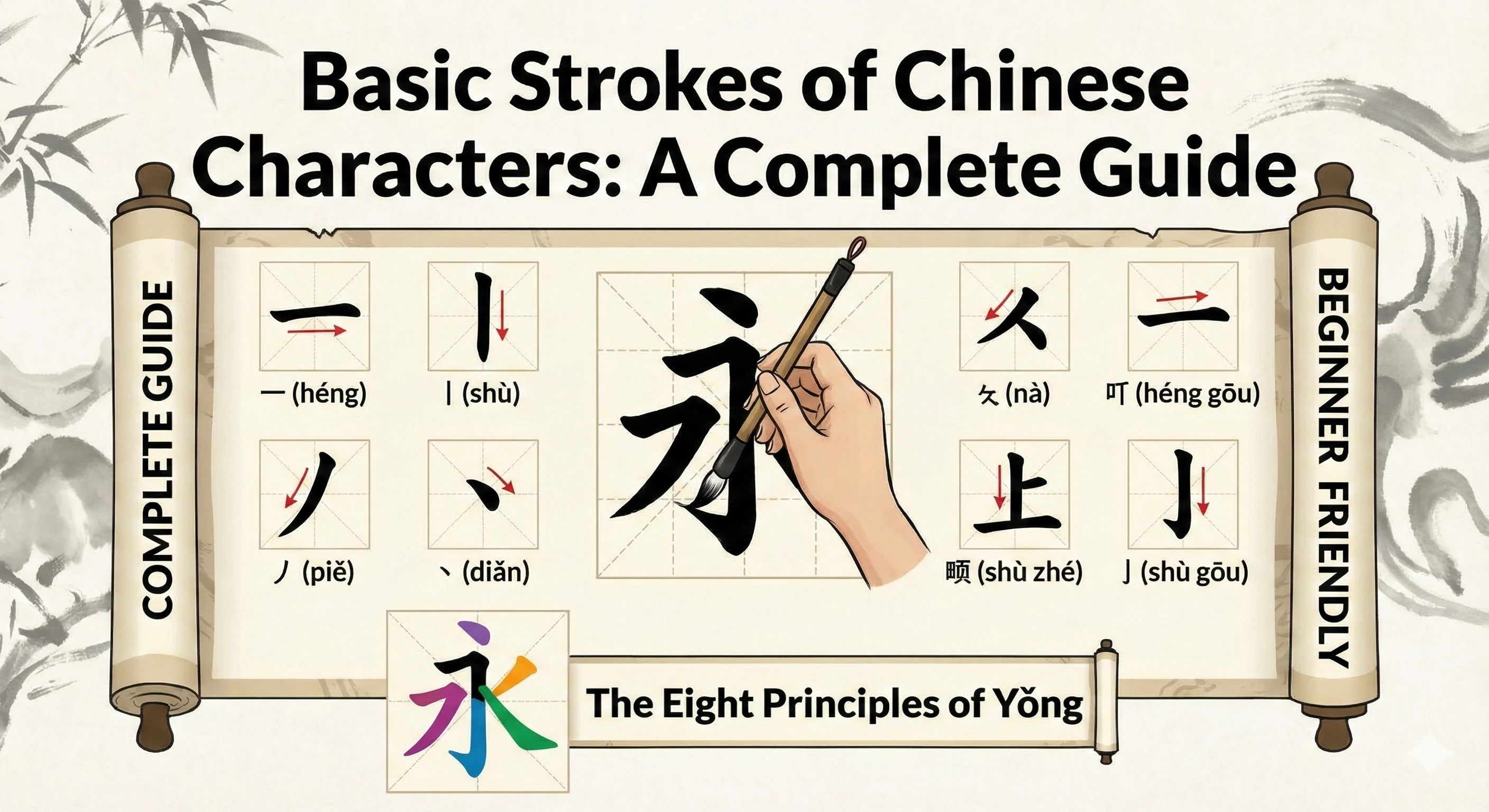
Have you ever looked at a Chinese character and felt overwhelmed? You see complex shapes, but don't know where to start? The secret to mastering Chinese writing lies in understanding the eight basic strokes that form the foundation of every character. In this comprehensive guide, we'll break down each stroke with clear examples and interactive demonstrations, giving you the tools you need to write Chinese characters with confidence.
Why Basic Strokes Matter
Every Chinese character, no matter how complex, is built from just eight fundamental strokes. Think of them as the building blocks of Chinese writing. Understanding these strokes helps you:
- •Recognize patterns in characters you've never seen before
- •Write characters more accurately and beautifully
- •Learn new characters faster by breaking them down into familiar components
- •Develop muscle memory for proper stroke formation
Mastering these basic strokes is like learning the alphabet before writing words. Once you understand them, you'll see Chinese characters in a completely new light.
The Eight Basic Strokes: A Detailed Guide
Let's explore each of the eight basic strokes in detail. For each stroke, we'll provide clear explanations, common examples, and links to interactive demonstrations where you can see the stroke in action.
1. 点 (Diǎn) - Dot Stroke
- •Writing Technique:
- •Quick press and release motion
- •Create a rounded or teardrop shape
- •The dot should have a clear beginning and end
- •Size should be proportional to other strokes
- •Common Mistakes:
- •Making it too large or too small
- •Creating a perfect circle (should be slightly teardrop-shaped)
- •Placing it in the wrong position
Key Examples:
- •点 (diǎn) - "dot/point" - This character literally means "dot" and contains multiple dot strokes, perfect for practice.
- •火 (huǒ) - "fire" - Features dot strokes that represent flames, showing how dots can add meaning to characters.
- •心 (xīn) - "heart" - Contains dot strokes that add detail and character to this important word.
2. 横 (Héng) - Horizontal Stroke
- •Writing Technique:
- •Start with a slight press at the beginning
- •Maintain even pressure in the middle section
- •End with a gentle lift, creating a subtle taper
- •Common Mistakes:
- •Writing from right to left (incorrect direction)
- •Making the stroke too slanted (should be nearly horizontal)
- •Inconsistent pressure throughout
Key Examples:
- •一 (yī) - "one" - This character IS a horizontal stroke. It's the simplest character in Chinese, perfect for practicing this fundamental stroke.
- •二 (èr) - "two" - Two horizontal strokes stacked vertically. Notice how the top stroke is slightly shorter than the bottom one.
- •三 (sān) - "three" - Three horizontal strokes. Each stroke should be evenly spaced.
3. 竖 (Shù) - Vertical Stroke
- •Writing Technique:
- •Begin with a light press at the top
- •Maintain steady, consistent pressure as you move down
- •End naturally without a sharp stop
- •Common Mistakes:
- •Writing from bottom to top (incorrect direction)
- •Making the stroke curved or wobbly (should be straight)
- •Ending too abruptly
Key Examples:
- •十 (shí) - "ten" - A perfect example combining horizontal and vertical strokes. The vertical stroke intersects the horizontal one in the middle.
- •中 (zhōng) - "middle/center" - Features a prominent vertical stroke down the center, demonstrating how vertical strokes can divide a character.
- •木 (mù) - "tree/wood" - Shows a vertical stroke as the main trunk, with horizontal and diagonal strokes branching off.
4. 撇 (Piě) - Left-Falling Stroke
- •Writing Technique:
- •Start with a press at the top
- •Gradually lighten pressure as you move down and left
- •Create a smooth, curved line (not a straight diagonal)
- •The stroke should feel like a gentle sweep
- •Common Mistakes:
- •Making it too straight (should have a curve)
- •Starting too light (should begin with pressure)
- •Ending too abruptly (should fade naturally)
Key Examples:
- •人 (rén) - "person" - This character consists of just two strokes: a left-falling stroke and a right-falling stroke, creating perfect balance.
- •大 (dà) - "big/large" - Features a prominent left-falling stroke that gives the character its dynamic appearance.
- •天 (tiān) - "sky/heaven" - Demonstrates how left-falling strokes can create movement and energy in a character.
5. 捺 (Nà) - Right-Falling Stroke
- •Writing Technique:
- •Begin lightly at the top
- •Gradually increase pressure as you move down and right
- •End with a strong, tapered finish (the "foot" of the stroke)
- •The ending should be the thickest part
- •Common Mistakes:
- •Starting too heavy (should begin light)
- •Not creating a proper "foot" at the end
- •Making it too short or too long
Key Examples:
- •人 (rén) - "person" - The right-falling stroke pairs perfectly with the left-falling stroke, creating the character's balanced structure.
- •大 (dà) - "big/large" - The right-falling stroke provides a strong foundation for the character.
- •文 (wén) - "writing/culture" - Shows how right-falling strokes can add elegance and completion to a character.
Try it yourself: 八 (bā) · 人 (rén) · 大 (dà) · 文 (wén)
撇 vs 捺 对比:
- •撇 and 捺 are mirror-image strokes that often appear together to create balance:
- •撇 (Left-falling): From top-right to bottom-left, starts heavy and ends light
- •捺 (Right-falling): From top-left to bottom-right, starts light and ends heavy (with a "foot")
Practice "人" (person) and "八" (eight) to master the rhythm of these complementary strokes.
6. 提 (Tí) - Rising Stroke
- •Writing Technique:
- •Start with pressure at the bottom left
- •Lift as you move up and to the right
- •Create an upward-slanting line
- •The stroke should feel like it's "lifting" something
- •Common Mistakes:
- •Making it too horizontal (should have an upward angle)
- •Starting too light (should begin with pressure)
- •Not maintaining consistent direction
Key Examples:
- •地 (dì) - "earth/ground" - Features rising strokes that add movement to the character.
- •打 (dǎ) - "hit/strike" - Shows how rising strokes can create action and energy.
- •提 (tí) - "lift/raise" - This character literally means "lift" and contains the rising stroke, making it perfect for understanding this stroke type.
7. 钩 (Gōu) - Hook Stroke
- •Writing Technique:
- •The hook is created at the end of another stroke
- •It should be a sharp, clear turn
- •Different types: vertical hooks, horizontal hooks, slanting hooks
- •The hook adds "completion" to the stroke
- •Common Mistakes:
- •Making the hook too large or too small
- •Not creating a sharp enough turn
- •Forgetting the hook entirely
Key Examples:
- •小 (xiǎo) - "small" - Contains vertical hooks that add character to the strokes.
- •水 (shuǐ) - "water" - Features hooks that create the flowing appearance of water.
- •手 (shǒu) - "hand" - Demonstrates how hooks can complete and strengthen strokes.
8. 折 (Zhé) - Turning Stroke
- •Writing Technique:
- •Maintain smooth transitions without breaking the stroke
- •Common types: horizontal-to-vertical, vertical-to-horizontal
- •The turn should be sharp but not abrupt
- •Practice maintaining consistent pressure through the turn
- •Common Mistakes:
- •Breaking the stroke at the turn (should be continuous)
- •Making the turn too rounded or too sharp
- •Inconsistent pressure during the turn
Key Examples:
- •口 (kǒu) - "mouth" - A perfect example of turning strokes, creating a square frame with continuous turns.
- •国 (guó) - "country" - Features multiple turning strokes that create complex structures.
- •四 (sì) - "four" - Demonstrates how turning strokes can create enclosed spaces.
How Strokes Combine: Building Complex Characters
These eight basic strokes combine in countless ways to form all Chinese characters. Understanding how they interact is essential for proper character formation.
Key Principles:
- •Stroke Order Matters: Always follow the correct sequence (top to bottom, left to right, outside to inside)
- •Proportions are Critical: Each stroke should be properly sized relative to others
- •Balance Creates Beauty: Characters should feel balanced and stable
- •Practice Individual Strokes First: Master each stroke before combining them
For more detailed guidance on stroke order rules, check out our guide on The Ultimate Guide to Chinese Handwriting.
Practical Learning Tips and Practice Methods
Now that you understand the eight basic strokes, here's how to turn this knowledge into practical skill:
- •1. Start with Individual Stroke Practice
- •Practice each stroke 10-20 times before moving to characters
- •Focus on direction, pressure, and consistency
- •Use grid paper (田字格) to maintain proper proportions
- •2. Use Our Interactive Tool
- •Watch stroke animations for each character
- •Practice tracing strokes on screen
- •Get immediate feedback on your stroke order
- •Our recommended learning flow: Understand rules → Watch animation → Trace in tool → Write on paper → Memorize
- •3. Build from Simple to Complex
- •Start with characters that use only one or two stroke types
- •Gradually work up to more complex combinations
- •Practice characters you'll actually use (like those in HSK Level 1)
- •4. Daily Practice Routine
- •Spend 15-20 minutes daily on stroke practice
- •Download our HSK writing worksheets for structured offline practice
- •Create your own custom sheets with our Chinese Worksheet Generator — enter any characters and get a printable PDF with stroke order guides
- •Focus on quality over quantity
- •Review characters you've learned regularly
- •5. Common Practice Mistakes to Avoid
- •Don't rush - take time to form each stroke correctly
- •Don't skip the basics - master simple strokes before complex ones
- •Don't practice without guidance - use our animations to check your work
For more comprehensive practice strategies, see our article on The Ultimate Guide to Chinese Handwriting.
Start Your Practice Journey Today
Understanding the eight basic strokes is your foundation for mastering Chinese writing. But knowledge alone isn't enough - you need consistent practice.
Your Action Plan:
- 1.Choose 5 characters from this article (we recommend starting with: 一, 十, 人, 口, 小)
- 2.Visit our interactive tool for each character and watch the stroke animations
- 3.Practice each character 10 times using our tracing feature
- 4.Write each character 5 times on paper, focusing on stroke quality
- 5.Track your progress by creating a free account - you'll get unlimited access to all features and can monitor your improvement over time
Ready to begin? Start with the character "一" (one) - it's the simplest character and perfect for your first practice session. Click here to view the interactive stroke animation: Practice 一 (yī) now
Remember: Every expert was once a beginner. With consistent practice using our interactive tools, you'll develop the muscle memory and confidence to write beautiful Chinese characters. Sign up for a free account today and start your journey to Chinese writing mastery!
Related Tools
Convert Chinese text to pinyin with tone marks and stroke order links
Create printable practice sheets with stroke order guides