
Chinese New Year Traditions: 12 Spring Festival Customs

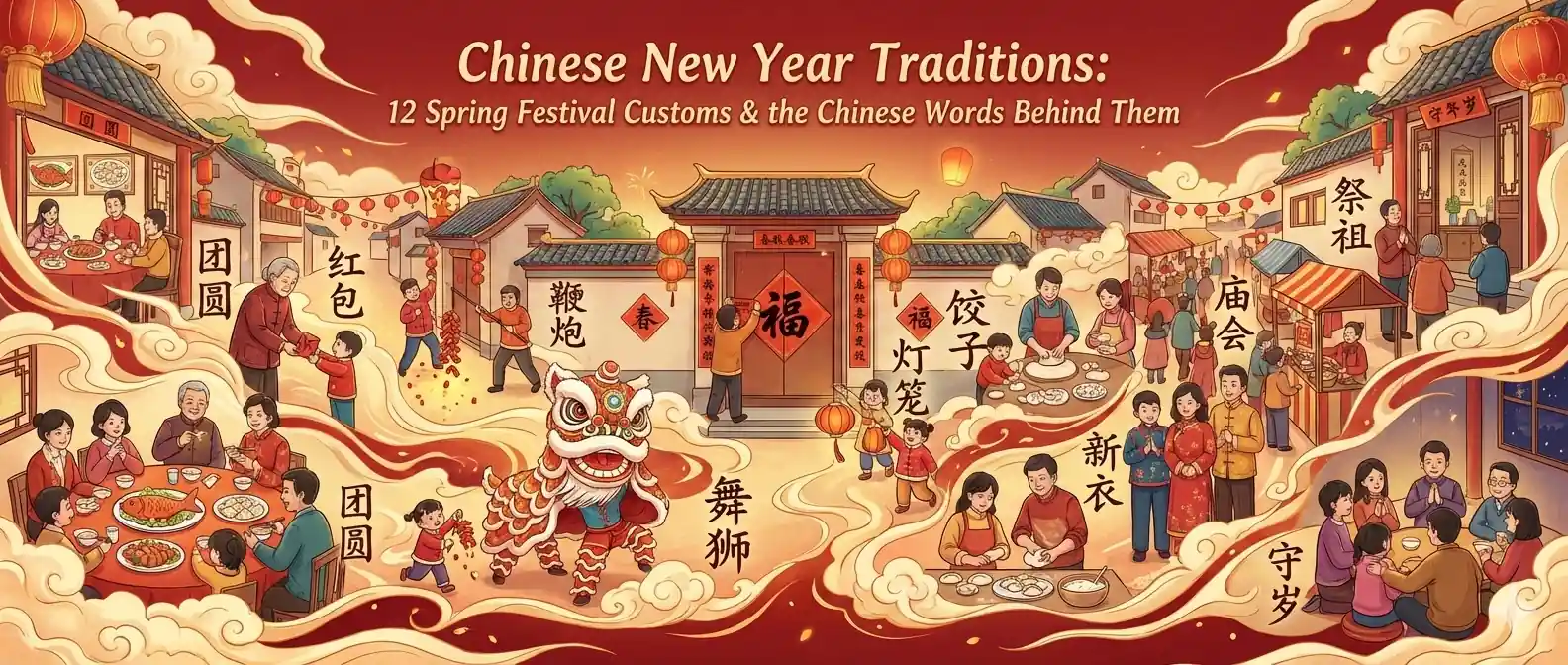
Chinese New Year (春节, Chūnjié) — also called the Spring Festival or Lunar New Year — is the most important holiday in Chinese culture. Celebrated by over 1.4 billion people worldwide, the festival spans 15 days of family gatherings, feasting, and centuries-old customs.
In this guide, you'll learn 12 essential traditions and the Chinese characters behind each one — with vocabulary, stroke order links, and example sentences so you can learn the culture and the language together.
Essential Spring Festival Characters
1. Spring Cleaning (扫尘 Sǎo Chén)
Before the New Year arrives, Chinese families thoroughly clean their homes in a tradition called 扫尘 (sǎo chén) — literally "sweeping the dust." This custom dates back over 4,000 years and symbolizes sweeping away bad luck and making room for good fortune in the coming year.
The cleaning typically happens around the 24th day of the 12th lunar month (腊月二十四, Làyuè èrshísì). Families wash windows, scrub floors, and declutter to give the home a fresh start.
Key Vocabulary:
| Word | Pinyin | Meaning | Key Characters |
|---|---|---|---|
| 扫尘 | sǎo chén | spring cleaning | 扫、尘 |
| 打扫 | dǎsǎo | to clean | 打、扫 |
| 干净 | gānjìng | clean | 干、净 |
| 腊月 | làyuè | 12th lunar month | 腊、月 |
Cultural Note: The Chinese character 尘 (chén, dust) sounds similar to 陈 (chén, old). So "sweeping the dust" is also a pun for "sweeping away the old" — out with the old, in with the new!
You should clean the house before New Year.
2. Spring Couplets (贴春联 Tiē Chūnlián)
One of the most recognizable New Year decorations is the 春联 (chūnlián) — red paper banners with calligraphy pasted on both sides of the front door. Spring couplets come in a set of three: the right side (上联, shànglián), the left side (下联, xiàlián), and a horizontal banner across the top (横批, héngpī).
The couplets feature poetic lines expressing wishes for prosperity, happiness, and good fortune. They're always written in black or gold ink on red paper — 红 (hóng, red) is the luckiest color in Chinese culture.
Key Vocabulary:
| Word | Pinyin | Meaning | Key Characters |
|---|---|---|---|
| 春联 | chūnlián | spring couplets | 春、联 |
| 贴 | tiē | to paste/stick | 贴 |
| 福 | fú | fortune/blessing | 福 |
| 红 | hóng | red | 红 |
| 上联 | shànglián | right couplet | 上 |
| 下联 | xiàlián | left couplet | 下 |
| 横批 | héngpī | horizontal banner | 横 |
The Upside-Down 福:
You'll often see the character 福 (fú, fortune) posted upside-down on doors. This is intentional! "福倒了" (fú dào le, fortune is upside-down) sounds exactly like "福到了" (fú dào le, fortune has arrived). It's a clever pun that has become a beloved tradition.
Let's put up the spring couplets!
3. New Year Shopping (办年货 Bàn Niánhuò)
In the weeks before Chinese New Year, families go on a shopping spree called 办年货 (bàn niánhuò) — stocking up on food, snacks, decorations, and gifts for the holiday. Markets and supermarkets are packed with red lanterns, candy boxes, dried fruits, and festive goods.
Common items include melon seeds (瓜子, guāzi), candied fruits, tea, liquor, new clothes for children, and gift boxes for visiting relatives.
Key Vocabulary:
| Word | Pinyin | Meaning | Key Characters |
|---|---|---|---|
| 年货 | niánhuò | New Year goods | 年、货 |
| 办 | bàn | to prepare/handle | 办 |
| 买 | mǎi | to buy | 买 |
| 准备 | zhǔnbèi | to prepare | 准、备 |
| 礼物 | lǐwù | gift | 礼、物 |
| 灯笼 | dēnglong | lantern | 灯、笼 |
Mom went to the supermarket to shop for New Year goods.
4. Reunion Dinner (年夜饭 Niányèfàn)
The 年夜饭 (niányèfàn), or New Year's Eve dinner, is the most important meal of the entire year. Also called 团圆饭 (tuányuánfàn) — "reunion dinner" — it brings the whole family together on the evening of New Year's Eve (除夕, Chúxī).
No matter how far family members have traveled, everyone tries to make it home for this dinner. It's the reason China experiences the world's largest annual human migration — 春运 (chūnyùn), the Spring Festival travel rush — with billions of trips made each year.
Key Vocabulary:
| Word | Pinyin | Meaning | Key Characters |
|---|---|---|---|
| 年夜饭 | niányèfàn | New Year's Eve dinner | 年、夜、饭 |
| 团圆 | tuányuán | reunion | 团、圆 |
| 除夕 | chúxī | New Year's Eve | 除、夕 |
| 春运 | chūnyùn | Spring Festival travel rush | 春、运 |
| 回家 | huíjiā | to go home | 回、家 |
Cultural Significance:
The word 团 (tuán) means "group" or "circle," and 圆 (yuán) means "round" or "complete." Together, 团圆 captures the Chinese ideal of the family circle being complete — everyone together, no one missing.
On New Year's Eve, our whole family eats the reunion dinner together.
5. Lucky Foods (春节食物 Chūnjié Shíwù)
Every dish on the New Year's table carries symbolic meaning. Food isn't just nourishment — it's a way to welcome good luck, wealth, and happiness into the new year.
Essential New Year Foods:
| Food | Chinese | Pinyin | Symbolism | Key Characters |
|---|---|---|---|---|
| Dumplings | 饺子 | jiǎozi | Wealth (shaped like gold ingots) | 饺、子 |
| Fish | 鱼 | yú | Surplus (年年有余) | 鱼 |
| Rice Cake | 年糕 | niángāo | Rising higher each year | 年、糕 |
| Tangyuan | 汤圆 | tāngyuán | Family togetherness | 汤、圆 |
| Spring Rolls | 春卷 | chūnjuǎn | Wealth (shaped like gold bars) | 春、卷 |
| Noodles | 面条 | miàntiáo | Longevity | 面、条 |
Why Fish?
The character 鱼 (yú, fish) sounds exactly like 余 (yú, surplus/abundance). So eating fish on New Year's Eve represents the wish 年年有余 (niánnián yǒu yú) — "may there be surplus every year." Importantly, the fish is never fully eaten — some must be left over to symbolize that abundance carries into the new year.
Why Dumplings?
饺子 (jiǎozi) are shaped like ancient Chinese gold ingots (元宝, yuánbǎo), symbolizing wealth. In northern China, families wrap dumplings together on New Year's Eve — sometimes hiding a coin inside one dumpling. Whoever finds it will have extra luck!
Why Rice Cake?
年糕 (niángāo) is a pun: 糕 (gāo, cake) sounds like 高 (gāo, high/tall). So eating niángāo means 年年高升 (niánnián gāoshēng) — "rising higher every year" in career, studies, or life.
You must eat fish during New Year — may there be abundance every year.
6. Staying Up on New Year's Eve (守岁 Shǒu Suì)
On New Year's Eve, Chinese families stay up until midnight (or later) in a tradition called 守岁 (shǒu suì) — literally "guarding the year." The custom symbolizes cherishing every moment of the passing year and welcoming the new one.
For older family members, staying up represents treasuring time. For younger members, it's believed to bring longevity to their parents. Modern families often stay up watching the 春晚 (Chūnwǎn) — the CCTV Spring Festival Gala — playing cards, chatting, and snacking on melon seeds and candy.
Key Vocabulary:
| Word | Pinyin | Meaning | Key Characters |
|---|---|---|---|
| 守岁 | shǒusuì | staying up on New Year's Eve | 守、岁 |
| 除夕夜 | chúxīyè | New Year's Eve night | 除、夕、夜 |
| 新年 | xīnnián | new year | 新、年 |
| 午夜 | wǔyè | midnight | 午、夜 |
Cultural Note: The character 岁 (suì) means both "year" and "age." So 守岁 carries a double meaning: guarding the passage of the year and watching over one's life/years.
On New Year's Eve, our whole family stays up together.
7. Firecrackers & Fireworks (放鞭炮 Fàng Biānpào)
The sound of firecrackers is synonymous with Chinese New Year. The tradition of 放鞭炮 (fàng biānpào) — setting off firecrackers — dates back over 2,000 years. At midnight on New Year's Eve, the sky lights up with fireworks and the air fills with the bang of firecrackers.
The tradition originates from the Legend of Nian (年兽, Nián Shòu) — a fearsome monster scared away by loud noises, bright lights, and the color red. Today, firecrackers represent driving away evil spirits and welcoming good fortune.
Key Vocabulary:
| Word | Pinyin | Meaning | Key Characters |
|---|---|---|---|
| 鞭炮 | biānpào | firecrackers | 鞭、炮 |
| 放 | fàng | to set off/release | 放 |
| 烟花 | yānhuā | fireworks | 烟、花 |
| 热闹 | rènao | lively/bustling | 热、闹 |
Modern Changes:
Many Chinese cities have banned or restricted firecrackers due to air pollution and safety concerns. However, the tradition continues in rural areas, and electronic firecrackers and digital fireworks have become popular alternatives.
New Year is here, let's set off firecrackers!
8. New Year Greetings (拜年 Bàinián)
On New Year's Day and the following days, Chinese people visit friends and relatives to exchange greetings — a tradition called 拜年 (bàinián). Younger people visit elders first, offering good wishes and receiving blessings (and red envelopes!) in return.
Essential Greetings:
| Greeting | Pinyin | Meaning | When to Use |
|---|---|---|---|
| 新年快乐 | xīnnián kuàilè | Happy New Year | Universal, any time |
| 恭喜发财 | gōngxǐ fācái | Wishing you prosperity | Very common, for everyone |
| 万事如意 | wànshì rúyì | May all go as you wish | General well-wishing |
| 身体健康 | shēntǐ jiànkāng | Good health | Especially for elders |
| 学习进步 | xuéxí jìnbù | Progress in studies | For students/children |
| 工作顺利 | gōngzuò shùnlì | Smooth work | For working adults |
Key Vocabulary:
| Word | Pinyin | Meaning | Key Characters |
|---|---|---|---|
| 拜年 | bàinián | New Year visit/greeting | 拜、年 |
| 恭喜 | gōngxǐ | congratulations | 恭、喜 |
| 快乐 | kuàilè | happy | 快、乐 |
How to Respond:
When someone says 恭喜发财 to you, the classic response is 同喜同喜 (tóngxǐ tóngxǐ) — "same joy to you!" or simply return the greeting.
Let's go to grandpa's house to give New Year greetings.
Related: For more Chinese greetings, see our Authentic Chinese Greetings Guide. For 2026 Horse Year-specific blessings, see Horse Year Blessings.
9. Red Envelopes (红包 Hóngbāo)
No Chinese New Year tradition is more beloved by children than 红包 (hóngbāo) — red envelopes filled with money. Also called 压岁钱 (yāsuìqián) — literally "money to suppress age/evil spirits" — red envelopes are given by married adults and elders to children and unmarried younger family members.
Key Vocabulary:
| Word | Pinyin | Meaning | Key Characters |
|---|---|---|---|
| 红包 | hóngbāo | red envelope | 红、包 |
| 压岁钱 | yāsuìqián | lucky money | 压、岁、钱 |
| 给 | gěi | to give | 给 |
| 收 | shōu | to receive | 收 |
Red Envelope Etiquette:
- •Amount: Always give even numbers (偶数, ǒushù). Avoid the number 4 (四, sì) since it sounds like 死 (sǐ, death). Lucky amounts include 88, 168, 200, 888.
- •How to give: Use both hands to present the envelope respectfully
- •How to receive: Accept with both hands and say thank you (谢谢) — never open it in front of the giver
- •Digital red envelopes: WeChat red envelopes (微信红包, Wēixìn hóngbāo) have become hugely popular, especially among younger generations
The Legend: According to tradition, a demon called 祟 (Suì) would come on New Year's Eve to touch sleeping children's heads, causing them to fall ill. Parents placed coins wrapped in red paper under children's pillows. The coins' shine scared the demon away — hence 压祟钱 became 压岁钱.
Grandpa gave me a red envelope!
10. Dragon & Lion Dances (舞龙舞狮 Wǔ Lóng Wǔ Shī)
The thundering drums and colorful performances of 舞龙 (wǔ lóng) — dragon dance — and 舞狮 (wǔ shī) — lion dance — are iconic symbols of Chinese New Year celebrations. These performances bring energy, good fortune, and joy to streets, shopping centers, and temple fairs.
Dragon Dance vs Lion Dance:
| Feature | Dragon Dance (舞龙) | Lion Dance (舞狮) |
|---|---|---|
| Performers | 10-20+ people | 2 people |
| Structure | Long dragon on poles | Lion head + body costume |
| Symbolism | Power, dignity, wisdom | Driving away evil, good luck |
| Origin | Ancient harvest rituals | Southern Chinese martial arts |
Key Vocabulary:
| Word | Pinyin | Meaning | Key Characters |
|---|---|---|---|
| 舞龙 | wǔlóng | dragon dance | 舞、龙 |
| 舞狮 | wǔshī | lion dance | 舞、狮 |
| 龙 | lóng | dragon | 龙 |
| 狮 | shī | lion | 狮 |
| 鼓 | gǔ | drum | 鼓 |
Cultural Note: The Chinese 龙 (lóng, dragon) is very different from the fire-breathing dragons of Western mythology. The Chinese dragon is a benevolent creature symbolizing power, strength, and good fortune. It brings rain for crops and is associated with the emperor and imperial authority.
During Spring Festival you can watch dragon and lion dances.
11. Spring Festival Gala (看春晚 Kàn Chūnwǎn)
Since 1983, the 春晚 (Chūnwǎn) — short for 春节联欢晚会 (Chūnjié Liánhuān Wǎnhuì, Spring Festival Gala Evening) — has been China's most-watched TV program. Broadcast by CCTV on New Year's Eve, it features hours of songs, comedy sketches, acrobatics, and dance performances.
Watching 春晚 has become a modern tradition. Families gather around the TV after dinner, chatting, snacking, and commenting on performances while counting down to midnight.
Key Vocabulary:
| Word | Pinyin | Meaning | Key Characters |
|---|---|---|---|
| 春晚 | chūnwǎn | Spring Festival Gala | 春、晚 |
| 电视 | diànshì | television | 电、视 |
| 节目 | jiémù | program/show | 节、目 |
| 看 | kàn | to watch | 看 |
| 表演 | biǎoyǎn | performance | 表、演 |
Fun Fact: The Spring Festival Gala consistently draws over 700 million viewers, making it the most-watched annual TV broadcast in the world. A popular activity is posting commentary on social media while watching — millions of comments fly during the show.
On New Year's Eve we watch the Spring Festival Gala together.
12. Lantern Festival (元宵节 Yuánxiāo Jié)
Chinese New Year officially ends on the 15th day of the first lunar month with the 元宵节 (Yuánxiāo Jié) — the Lantern Festival. This day celebrates the first full moon of the new year with colorful lantern displays, riddle-guessing games, and sweet rice balls.
Key Traditions:
赏花灯 (Shǎng Huādēng) — Admiring Lanterns
Parks and streets are decorated with elaborate lanterns of all shapes and sizes. Lantern exhibitions can feature thousands of handcrafted lanterns shaped as animals, flowers, and famous characters.
猜灯谜 (Cāi Dēngmí) — Guessing Lantern Riddles
Riddles written on paper are attached to lanterns. Visitors try to solve them — correct answers win small prizes. This tradition combines entertainment with cultural education.
吃元宵/汤圆 (Chī Yuánxiāo / Tāngyuán) — Eating Sweet Rice Balls
Round, glutinous rice balls filled with sweet sesame, peanut, or red bean paste. Their round shape symbolizes family unity and completeness — the same idea as 团圆 (tuányuán, reunion).
Key Vocabulary:
| Word | Pinyin | Meaning | Key Characters |
|---|---|---|---|
| 元宵节 | yuánxiāojié | Lantern Festival | 元、宵、节 |
| 灯笼 | dēnglong | lantern | 灯、笼 |
| 汤圆 | tāngyuán | sweet rice balls | 汤、圆 |
| 猜 | cāi | to guess | 猜 |
| 谜 | mí | riddle | 谜 |
| 月亮 | yuèliang | moon | 月、亮 |
Happy Lantern Festival! Have you eaten tangyuan?
The Legend of Nian (年兽的传说)
Many Chinese New Year traditions trace back to one ancient story — the Legend of Nian (年兽, Nián Shòu), a fearsome monster that terrorized villages at the end of each year.
The Story:
According to legend, a beast called 年 (Nián) lived in the mountains or under the sea. Every New Year's Eve, it would emerge to devour crops, livestock, and even villagers. People were terrified and fled to the mountains each year.
One year, a wise old man (老人, lǎorén) discovered three things that the beast feared:
- 1.Red (红色, hóngsè) — The color 红 frightened the beast
- 2.Loud noises (响声, xiǎngshēng) — Firecrackers and drums drove it away
- 3.Bright lights (灯火, dēnghuǒ) — Fire and lanterns kept it at bay
The villagers decorated with red, set off firecrackers, and lit lanterns. When the Nian monster returned, it was so frightened that it fled and never came back.
Key Vocabulary:
| Word | Pinyin | Meaning | Key Characters |
|---|---|---|---|
| 年兽 | niánshòu | Nian monster | 年、兽 |
| 怪物 | guàiwù | monster | 怪、物 |
| 害怕 | hàipà | afraid | 害、怕 |
| 红色 | hóngsè | red color | 红、色 |
| 灯火 | dēnghuǒ | lights/lanterns | 灯、火 |
| 传说 | chuánshuō | legend | 传、说 |
The Connection:
- •This legend explains why Chinese New Year celebrations feature:
- •Red decorations (春联, 红包, 灯笼) — to scare away evil
- •Firecrackers (鞭炮) — loud noises to drive away bad spirits
- •Lanterns and lights (灯火) — brightness to repel darkness
And the character 年 (nián) itself? It went from meaning "the Nian beast" to meaning "year" — because people celebrated surviving another year free from the monster.
Do you know the legend of the Nian beast?
Frequently Asked Questions
Q: When is Chinese New Year 2026?
A: Chinese New Year 2026 falls on February 17, 2026. It marks the start of the Year of the Horse (马 年, Mǎ Nián). The 15-day celebration runs from February 17 to March 3 (Lantern Festival).
Q: How long does Chinese New Year last?
A: The Spring Festival officially lasts 15 days, from New Year's Day (初一, chūyī) to the Lantern Festival (元宵节, Yuánxiāo Jié) on the 15th. However, preparations begin weeks earlier (shopping, cleaning, cooking), and in China, the public holiday is typically 7 days.
Q: What is the difference between "Chinese New Year" and "Lunar New Year"?
A: Both refer to the same holiday. 春节 (Chūnjié) — "Spring Festival" — is what Chinese people call it. "Chinese New Year" is the common English name focusing on Chinese culture. "Lunar New Year" (农历新年, Nónglì Xīnnián) is a broader term that includes Korean (설날, Seollal), Vietnamese (Tết), and other Asian celebrations of the same lunar calendar date.
Q: Why is red important during Chinese New Year?
A: The color 红 (hóng, red) symbolizes good luck, joy, and prosperity in Chinese culture. According to the Legend of Nian, the monster feared the color red. Today, red is everywhere during Spring Festival: red envelopes (红包), red couplets (春联), red lanterns (灯笼), and red clothing.
Q: What foods are lucky during Chinese New Year?
A: Key lucky foods include: 饺子 (jiǎozi, dumplings — wealth), 鱼 (yú, fish — surplus), 年糕 (niángāo, rice cake — rising higher), 汤圆 (tāngyuán, rice balls — togetherness), 春卷 (chūnjuǎn, spring rolls — wealth), and long 面条 (miàntiáo, noodles — longevity).
Q: How do you say "Happy New Year" in Chinese?
A: The most common ways are: 新年快乐 (Xīnnián kuàilè) — "Happy New Year" (universal), and 恭喜发财 (Gōngxǐ fācái) — "Wishing you prosperity" (the most iconic Chinese New Year greeting). For more greetings, see our Horse Year Blessings Guide.
Q: What should you NOT do during Chinese New Year?
A: Common New Year taboos include: don't sweep the floor on New Year's Day (sweeps away good luck), don't break things (破碎, pòsuì — breaks fortune), don't say unlucky words (like 死 sǐ, death), don't wash your hair on New Year's Day (washes away luck), and don't wear black or white clothing (funeral colors).
Q: What is 春运 (Chūnyùn)?
A: 春运 (chūnyùn) is the Spring Festival travel rush — the largest annual human migration on earth. Hundreds of millions of Chinese people travel home for the reunion dinner. In 2024, over 9 billion passenger trips were made during the 40-day 春运 period. It's driven by one core value: 回家 (huíjiā) — going home.
Related Resources
Spring Festival Content
- How to Write Chinese New Year Characters
Master 8 essential festival characters with stroke order
- 2026 Horse Year Blessings Guide
New Year greetings for the Year of the Horse
- Authentic Chinese Greetings
Essential greetings beyond New Year
Practice & Learn More
- Chinese Family Members Guide
Learn family terms for reunion gatherings
- Chinese Numbers Guide
Useful for red envelope amounts and dates
- Worksheet Generator
Practice writing Spring Festival characters