
Chinese Time & Dates: How to Say Days, Months & Time

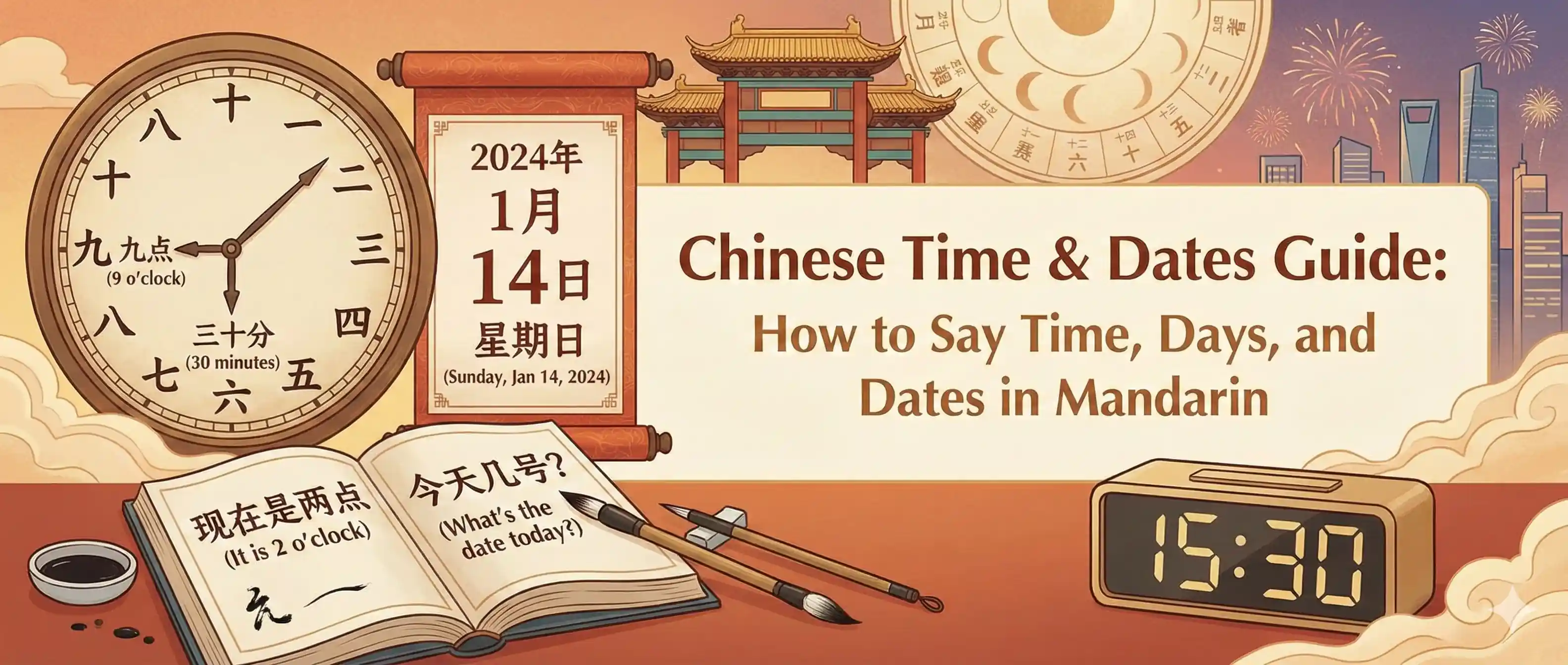
Time and dates are fundamental to daily conversation in any language — and Chinese is no exception. Whether you're scheduling a meeting, asking "What time is it?", or talking about your plans for tomorrow, mastering time expressions is essential. The good news? Chinese time expressions follow logical patterns that are easier to learn than English irregulars like "yesterday" and "tomorrow." This comprehensive guide teaches you how to express any time concept in Chinese, from basic words like "today" and "now" to complex phrases like "in a moment" and "next week." You'll learn the correct stroke order for key time-related characters and discover the cultural context behind traditional Chinese timekeeping.
Essential Time Characters
Basic Time Words: Today, Tomorrow, Yesterday
These six core characters form the foundation of Chinese time expressions. Master their stroke order, and you'll be able to talk about any day relative to now.
| Word | Character | Pinyin | Meaning | Key Characters |
|---|---|---|---|---|
| Today | 今天 | jīntiān | today | 今、天 |
| Tomorrow | 明天 | míngtiān | tomorrow | 明 |
| Yesterday | 昨天 | zuótiān | yesterday | 昨 |
| Now | 现在 | xiànzài | now | 现、在 |
Writing Tips:
- •今: 4 strokes. Start with the top horizontal stroke, then the vertical stroke, followed by the bottom components.
- •天: 4 strokes. The character for "sky" or "day" — write the top horizontal first, then the large character below.
- •明: 8 strokes. Combines 日 (sun) on the left and 月 (moon) on the right — "bright" or "clear."
- •昨: 9 strokes. Left side is 日 (sun), right side is 乍 — practice the stroke order carefully.
- •现: 8 strokes. Left side is 王 (king), right side is 见 (see) — "appear" or "present."
- •在: 6 strokes. A common character meaning "at" or "exist" — essential for time expressions.
Example Sentences:
- •今天天气很好。 (Jīntiān tiānqì hěn hǎo.) — Today the weather is very good.
- •明天见! (Míngtiān jiàn!) — See you tomorrow!
- •昨天我学习了中文。 (Zuótiān wǒ xuéxí le zhōngwén.) — Yesterday I studied Chinese.
- •现在几点了? (Xiànzài jǐ diǎn le?) — What time is it now?
Practice: Click any character above to see its animated stroke order and practice writing it correctly. These characters appear frequently in daily conversation, so mastering them early will boost your confidence.
Times of Day: Morning to Evening
Chinese divides the day into clear periods, each with its own character. Understanding these time periods helps you schedule meetings, describe your routine, and talk about when things happen.
| Period | Chinese | Pinyin | Meaning | Key Characters |
|---|---|---|---|---|
| Morning | 早上 | Zǎo shàng | morning | 早、上 |
| Late Morning | 上午 | shàngwǔ | late morning (9-11 AM) | 午 |
| Noon | 中午 | zhōngwǔ | noon (11 AM-1 PM) | 中 |
| Afternoon | 下午 | xiàwǔ | afternoon (1-5 PM) | 下 |
| Evening | 晚上 | Wǎn shàng | evening/night | 晚 |
Time Period Breakdown:
- •早上 (Zǎo shàng) — Morning (6-9 AM)
- •Used for early morning activities like breakfast, morning exercise, or commuting
- •Example: 早上好!(Zǎo shàng hǎo!) — Good morning!
- •上午 (shàngwǔ) — Late Morning (9-11 AM)
- •The "upper" part of the day before noon
- •Example: 上午十点开会。 (Shàngwǔ shí diǎn kāihuì.) — The meeting is at 10 AM.
- •中午 (zhōngwǔ) — Noon (11 AM-1 PM)
- •Literally "middle of the day" — lunchtime
- •Example: 中午吃什么? (Zhōngwǔ chī shénme?) — What are we eating for lunch?
- •下午 (xiàwǔ) — Afternoon (1-5 PM)
- •The "lower" part of the day after noon
- •Example: 下午三点见面。 (Xiàwǔ sān diǎn jiànmiàn.) — Let's meet at 3 PM.
- •晚上 (Wǎn shàng) — Evening/Night (6 PM-midnight)
- •Used for dinner, evening activities, and nighttime
- •Example: 晚上见! (Wǎn shàng jiàn!) — See you tonight!
Writing Tips:
- •早: 6 strokes. Top is 日 (sun), bottom is 十 (ten) — "early."
- •上: 3 strokes. Simple character meaning "up" or "above" — very common.
- •午: 4 strokes. Represents noon — the character looks like a clock at 12.
- •中: 4 strokes. A vertical line through a box — "middle" or "center."
- •下: 3 strokes. Opposite of 上 — "down" or "below."
- •晚: 11 strokes. Left side is 日 (sun), right side is 免 — "late" or "evening."
Cultural Note: Chinese time expressions follow a logical "up-down" system: 上午 (upper noon) for morning and 下午 (lower noon) for afternoon, with 中午 (middle noon) as the dividing point.
Days of the Week: Monday to Sunday
Learning the days of the week in Chinese is straightforward — you only need to master a few characters and combine them logically. Unlike English's irregular names (Monday, Tuesday, etc.), Chinese days follow a clear pattern.
| Day | Chinese | Pinyin | Literal Meaning | Key Characters |
|---|---|---|---|---|
| Monday | 星期一 | xīngqīyī | week-one | 星、期、一 |
| Tuesday | 星期二 | xīngqī'èr | week-two | 二 |
| Wednesday | 星期三 | xīngqīsān | week-three | 三 |
| Thursday | 星期四 | xīngqīsì | week-four | 四 |
| Friday | 星期五 | xīngqīwǔ | week-five | 五 |
| Saturday | 星期六 | xīngqīliù | week-six | 六 |
| Sunday | 星期日 or 星期天 | xīngqīrì/tiān | week-day/sky | 日、天 |
| Weekend | 周末 | zhōumò | week-end | 周、末 |
The Pattern:
All weekdays follow the same structure: 星期 + number (week + number). Sunday can be either 星期日 (xīngqīrì) or 星期天 (xīngqītiān), with 星期天 being more common in spoken Chinese.
Spoken Shortcuts:
In casual conversation, Chinese speakers often drop 星期 and just say the number:
| Full Form | Short Form | Pinyin |
|---|---|---|
| 星期一 | 周一 | zhōuyī |
| 星期二 | 周二 | zhōu'èr |
| 星期三 | 周三 | zhōusān |
| 星期四 | 周四 | zhōusì |
| 星期五 | 周五 | zhōuwǔ |
| 星期六 | 周六 | zhōuliù |
| 星期日/天 | 周日/周天 | zhōurì/zhōutiān |
This Week, Last Week, Next Week:
| Expression | Chinese | Pinyin |
|---|---|---|
| This week | 这周 | zhè zhōu |
| Last week | 上周 | shàng zhōu |
| Next week | 下周 | xià zhōu |
Writing Tips:
- •星: 9 strokes. Means "star" — the top part represents stars in the sky.
- •期: 12 strokes. Left side is 其, right side is 月 (moon) — "period" or "expect."
- •周: 8 strokes. Means "week" or "circumference" — a common character.
- •末: 5 strokes. Means "end" or "tip" — simple but important.
Example Sentences:
- •今天是星期一。 (Jīntiān shì xīngqīyī.) — Today is Monday.
- •我们周五见面。 (Wǒmen zhōuwǔ jiànmiàn.) — Let's meet on Friday.
- •下周末我要去北京。 (Xià zhōumò wǒ yào qù Běijīng.) — Next weekend I'm going to Beijing.
Practice: Start with 一 through 六 — these number characters are used throughout Chinese, not just for days of the week.
Months and Dates: January to December
Chinese months are beautifully simple — just combine numbers 1-12 with the character 月 (yuè, month). Dates follow a logical pattern too, though the format is different from English.
Months (月份, yuèfèn):
| Month | Chinese | Pinyin | Key Characters |
|---|---|---|---|
| January | 一月 | yīyuè | 一、月 |
| February | 二月 | èryuè | 二 |
| March | 三月 | sānyuè | 三 |
| April | 四月 | sìyuè | 四 |
| May | 五月 | wǔyuè | 五 |
| June | 六月 | liùyuè | 六 |
| July | 七月 | qīyuè | 七 |
| August | 八月 | bāyuè | 八 |
| September | 九月 | jiǔyuè | 九 |
| October | 十月 | shíyuè | 十 |
| November | 十一月 | shíyīyuè | 十、一 |
| December | 十二月 | shí'èryuè | 十、二 |
Dates (日期, rìqī):
Chinese date format follows the pattern: Year - Month - Day (年-月-日), which is the opposite of English's Month-Day-Year.
| Format | Example | Chinese | Pinyin | Key Characters |
|---|---|---|---|---|
| Year | 2024 | 二零二四 | èr líng èr sì | 二、零、四 |
| Month | January | 一月 | yīyuè | 一、月 |
| Day | 15th | 十五日 or 十五号 | shíwǔ rì/hào | 十、五、日、号 |
Complete Date Example:
- •English: January 15, 2024
- •Chinese: 2024年1月15日 (èr líng èr sì nián yī yuè shíwǔ rì)
- •Spoken: 二零二四年一月十五号 (èr líng èr sì nián yī yuè shíwǔ hào)
日 (rì) vs 号 (hào):
Both mean "day" or "date," but they're used differently:
- •日 (rì): More formal, used in written documents, calendars, and official contexts
- •号 (hào): More common in spoken Chinese and casual writing
- •Example:
- •Written: 今天是2024年1月15日。 (Jīntiān shì èr líng èr sì nián yī yuè shíwǔ rì.)
- •Spoken: 今天是一月十五号。 (Jīntiān shì yī yuè shíwǔ hào.)
Writing Tips:
- •月: 4 strokes. The character for "moon" or "month" — looks like a crescent moon.
- •日: 4 strokes. A box representing the sun — "day" or "sun."
- •号: 5 strokes. Means "number" or "day" in date context — very common in speech.
- •年: 6 strokes. The character for "year" — essential for dates.
Asking About Dates:
- •今天几号? (Jīntiān jǐ hào?) — What's the date today?
- •你的生日是几月几号? (Nǐ de shēngrì shì jǐ yuè jǐ hào?) — When is your birthday? (What month and day?)
Practice: Master 一 through 十二 first — these numbers are used for months, days, and many other contexts in Chinese.
Telling Time: Hours and Minutes
Telling time in Chinese is straightforward once you learn a few key characters. Chinese uses both 12-hour and 24-hour formats, with the 12-hour format being more common in daily conversation.
Basic Time Structure:
The pattern is: Hour + 点 (diǎn) + Minute + 分 (fēn)
| Time | Chinese | Pinyin | Breakdown | Key Characters |
|---|---|---|---|---|
| 3:00 | 三点 | sān diǎn | three o'clock | 三、点 |
| 3:10 | 三点十分 | sān diǎn shí fēn | three o'clock ten minutes | 十、分 |
| 3:30 | 三点半 | sān diǎn bàn | three o'clock half | 半 |
| 3:15 | 三点一刻 | sān diǎn yī kè | three o'clock one quarter | 一、刻 |
| 2:55 | 差五分三点 | chà wǔ fēn sān diǎn | short five minutes three o'clock | 差、五 |
Key Time Characters:
| Character | Pinyin | Meaning | Usage |
|---|---|---|---|
| 点 | diǎn | o'clock | Used after the hour |
| 分 | fēn | minute | Used after minutes |
| 半 | bàn | half | Used for :30 (half past) |
| 刻 | kè | quarter | Used for :15 or :45 (one quarter) |
| 差 | chà | short of | Used before minutes when saying "X minutes to Y o'clock" |
Common Time Expressions:
- •Half Past:
- •三点半 (sān diǎn bàn) — 3:30
- •十点半 (shí diǎn bàn) — 10:30
- •Quarter Past:
- •三点一刻 (sān diǎn yī kè) — 3:15
- •九点一刻 (jiǔ diǎn yī kè) — 9:15
- •Quarter To:
- •差一刻三点 (chà yī kè sān diǎn) — 2:45 (short one quarter to three)
- •差一刻十二点 (chà yī kè shí'èr diǎn) — 11:45
- •Minutes To:
- •差五分三点 (chà wǔ fēn sān diǎn) — 2:55
- •差十分八点 (chà shí fēn bā diǎn) — 7:50
12-Hour vs 24-Hour Format:
Chinese uses both formats, with 12-hour being more common in speech:
| Format | Example | Chinese | Pinyin |
|---|---|---|---|
| 12-hour (AM) | 9:00 AM | 上午九点 | shàngwǔ jiǔ diǎn |
| 12-hour (PM) | 3:00 PM | 下午三点 | xiàwǔ sān diǎn |
| 24-hour | 15:00 | 十五点 | shíwǔ diǎn |
Asking the Time:
- •现在几点? (Xiànzài jǐ diǎn?) — What time is it now?
- •几点了? (Jǐ diǎn le?) — What time is it? (casual)
- •你的会议是几点? (Nǐ de huìyì shì jǐ diǎn?) — What time is your meeting?
Writing Tips:
- •点: 9 strokes. The character for "point" or "o'clock" — essential for time.
- •分: 4 strokes. Means "minute" or "to divide" — simple but important.
- •半: 5 strokes. Means "half" — used frequently for :30 times.
- •刻: 8 strokes. Means "quarter" or "to carve" — used for :15 and :45.
- •差: 9 strokes. Means "short of" or "difference" — used for "X minutes to Y."
Example Sentences:
- •我每天早上七点起床。 (Wǒ měitiān zǎo shàng qī diǎn qǐchuáng.) — I wake up at 7 AM every day.
- •会议是下午三点半。 (Huìyì shì xiàwǔ sān diǎn bàn.) — The meeting is at 3:30 PM.
- •差一刻九点。 (Chà yī kè jiǔ diǎn.) — It's a quarter to nine.
Practice: Start with 点 and 分 — these are the most common time characters you'll use daily.
Common Time Phrases: Soon, Later, Before, After
Beyond basic time words, Chinese has many useful phrases for expressing relative time. These phrases help you talk about schedules, deadlines, and when things happen in relation to now.
| Phrase | Chinese | Pinyin | Meaning | Key Characters |
|---|---|---|---|---|
| Immediately | 马上 | mǎshàng | immediately/right away | 马、上 |
| In a moment | 一会儿 | yīhuìr | in a moment/a while | 会、儿 |
| Before | 以前 | yǐqián | before/in the past | 以、前 |
| After | 以后 | yǐhòu | after/in the future | 以、后 |
| Every day | 每天 | měitiān | every day | 每、天 |
Detailed Usage:
- •马上 (mǎshàng) — Immediately
- •Used when something happens right away or very soon
- •Example: 我马上到。 (Wǒ mǎshàng dào.) — I'll be there right away.
- •Example: 马上开始。 (Mǎshàng kāishǐ.) — Start immediately.
- •一会儿 (yīhuìr) — In a Moment
- •Indicates a short period of time (a few minutes to an hour)
- •Example: 等一会儿。 (Děng yīhuìr.) — Wait a moment.
- •Example: 我一会儿就来。 (Wǒ yīhuìr jiù lái.) — I'll come in a moment.
- •以前 (yǐqián) — Before/In the Past
- •Refers to time before now or before a specific event
- •Example: 以前我住在北京。 (Yǐqián wǒ zhù zài Běijīng.) — I used to live in Beijing.
- •Example: 三点以前到。 (Sān diǎn yǐqián dào.) — Arrive before 3 o'clock.
- •以后 (yǐhòu) — After/In the Future
- •Refers to time after now or after a specific event
- •Example: 以后再说。 (Yǐhòu zài shuō.) — We'll talk about it later.
- •Example: 吃饭以后学习。 (Chīfàn yǐhòu xuéxí.) — Study after eating.
- •每天 (měitiān) — Every Day
- •Used for daily routines and habits
- •Example: 我每天学习中文。 (Wǒ měitiān xuéxí zhōngwén.) — I study Chinese every day.
- •Example: 每天八点起床。 (Měitiān bā diǎn qǐchuáng.) — Wake up at 8 every day.
More Time Phrases:
| Phrase | Chinese | Pinyin | Meaning |
|---|---|---|---|
| Just now | 刚才 | gāngcái | just now/a moment ago |
| Soon | 很快 | hěn kuài | very soon |
| Later | 后来 | hòulái | later/afterwards |
| Always | 总是 | zǒngshì | always |
| Sometimes | 有时候 | yǒu shíhou | sometimes |
| Never | 从不 | cóngbù | never |
| Already | 已经 | yǐjīng | already |
| Still | 还 | hái | still/yet |
Writing Tips:
- •马: 3 strokes. The character for "horse" — used in 马上 (immediately).
- •会: 6 strokes. Means "meeting" or "can/will" — used in 一会儿.
- •儿: 2 strokes. Means "child" or used as a suffix — very common.
- •以: 4 strokes. A preposition meaning "with" or "by" — used in time phrases.
- •前: 9 strokes. Means "front" or "before" — essential for time expressions.
- •后: 6 strokes. Means "back" or "after" — opposite of 前.
- •每: 7 strokes. Means "every" or "each" — used for frequency.
Example Sentences:
- •我马上完成作业。 (Wǒ mǎshàng wánchéng zuòyè.) — I'll finish my homework right away.
- •一会儿见! (Yīhuìr jiàn!) — See you in a moment!
- •以前我不喜欢中文,现在很喜欢。 (Yǐqián wǒ bù xǐhuan zhōngwén, xiànzài hěn xǐhuan.) — I didn't like Chinese before, but now I like it very much.
- •以后我要去中国。 (Yǐhòu wǒ yào qù Zhōngguó.) — I'm going to China in the future.
- •我每天练习写汉字。 (Wǒ měitiān liànxí xiě hànzì.) — I practice writing Chinese characters every day.
Practice: These time phrases appear constantly in conversation. Master 马, 会, 以, 前, and 后 to express time relationships naturally.
Cultural Knowledge: Lunar Calendar & Traditional Time
Chinese culture has a rich tradition of timekeeping that goes beyond the modern calendar. Understanding these concepts helps you appreciate Chinese festivals, traditional practices, and cultural references.
农历 (Nónglì) — Lunar Calendar
The lunar calendar (农历, nónglì) is still used in China for traditional festivals and cultural events, even though the solar calendar (公历, gōnglì) is used for daily life.
Key Differences:
| Calendar Type | Chinese | Pinyin | Usage |
|---|---|---|---|
| Solar Calendar | 公历 | gōnglì | Daily life, business, official dates |
| Lunar Calendar | 农历 | nónglì | Traditional festivals, birthdays (sometimes) |
Traditional Festivals (Based on Lunar Calendar):
- •春节 (Chūnjié) — Spring Festival (Chinese New Year): First day of the first lunar month
- •中秋节 (Zhōngqiūjié) — Mid-Autumn Festival: 15th day of the 8th lunar month
- •端午节 (Duānwǔjié) — Dragon Boat Festival: 5th day of the 5th lunar month
十二时辰 (Shí'èr Shíchén) — Twelve Traditional Time Periods
Ancient China divided the day into 12 two-hour periods, each named after an animal from the Chinese zodiac. This system is still referenced in literature and traditional medicine.
| Period | Chinese | Pinyin | Time | Animal | Key Characters |
|---|---|---|---|---|---|
| 子时 | 子时 | zǐshí | 11 PM-1 AM | Rat | 子、时 |
| 丑时 | 丑时 | chǒushí | 1-3 AM | Ox | 丑 |
| 寅时 | 寅时 | yínshí | 3-5 AM | Tiger | 寅 |
| 卯时 | 卯时 | mǎoshí | 5-7 AM | Rabbit | 卯 |
| 辰时 | 辰时 | chénshí | 7-9 AM | Dragon | 辰 |
| 巳时 | 巳时 | sìshí | 9-11 AM | Snake | 巳 |
| 午时 | 午时 | wǔshí | 11 AM-1 PM | Horse | 午 |
| 未时 | 未时 | wèishí | 1-3 PM | Goat | 未 |
| 申时 | 申时 | shēnshí | 3-5 PM | Monkey | 申 |
| 酉时 | 酉时 | yǒushí | 5-7 PM | Rooster | 酉 |
| 戌时 | 戌时 | xūshí | 7-9 PM | Dog | 戌 |
| 亥时 | 亥时 | hàishí | 9-11 PM | Pig | 亥 |
Why Chinese Say "下个礼拜" (Next Week)
In addition to 下周 (xià zhōu), Chinese speakers also use 下个礼拜 (xià ge lǐbài) for "next week." 礼拜 (lǐbài) originally meant "worship" or "religious service" and was used by Christian communities in China. Over time, it became a common alternative to 星期 (xīngqī) for "week."
Common Variations:
| Expression | Chinese | Pinyin | Meaning |
|---|---|---|---|
| This week | 这周 / 这个礼拜 | zhè zhōu / zhè ge lǐbài | this week |
| Last week | 上周 / 上个礼拜 | shàng zhōu / shàng ge lǐbài | last week |
| Next week | 下周 / 下个礼拜 | xià zhōu / xià ge lǐbài | next week |
Writing Tips:
- •农: 6 strokes. Means "agriculture" or "farming" — used in 农历.
- •历: 4 strokes. Means "calendar" or "history" — essential for dates.
- •时: 7 strokes. Means "time" or "hour" — very common character.
- •辰: 7 strokes. One of the 12 earthly branches — used in traditional time.
Cultural Context:
- •Understanding the lunar calendar and traditional time periods helps you:
- •Know when Chinese festivals occur (they follow the lunar calendar)
- •Understand references in Chinese literature and historical dramas
- •Appreciate traditional Chinese medicine timing (some treatments are scheduled by 时辰)
- •Connect with older generations who may still reference traditional time
Practice: While modern Chinese primarily uses the solar calendar, learning about 农历 and 时辰 enriches your cultural understanding. Start with 时 — it's used in both modern and traditional time expressions.
Quick Reference Tables
Use these quick reference tables to look up time expressions when you need them. Print them out or bookmark this page for easy access.
Days of the Week:
| Day | Full Form | Short Form | Pinyin |
|---|---|---|---|
| Monday | 星期一 | 周一 | xīngqīyī / zhōuyī |
| Tuesday | 星期二 | 周二 | xīngqī'èr / zhōu'èr |
| Wednesday | 星期三 | 周三 | xīngqīsān / zhōusān |
| Thursday | 星期四 | 周四 | xīngqīsì / zhōusì |
| Friday | 星期五 | 周五 | xīngqīwǔ / zhōuwǔ |
| Saturday | 星期六 | 周六 | xīngqīliù / zhōuliù |
| Sunday | 星期日/天 | 周日/周天 | xīngqīrì/tiān / zhōurì/tiān |
| Weekend | 周末 | 周末 | zhōumò |
Months:
| Month | Chinese | Pinyin |
|---|---|---|
| January | 一月 | yīyuè |
| February | 二月 | èryuè |
| March | 三月 | sānyuè |
| April | 四月 | sìyuè |
| May | 五月 | wǔyuè |
| June | 六月 | liùyuè |
| July | 七月 | qīyuè |
| August | 八月 | bāyuè |
| September | 九月 | jiǔyuè |
| October | 十月 | shíyuè |
| November | 十一月 | shíyīyuè |
| December | 十二月 | shí'èryuè |
Times of Day:
| Period | Chinese | Pinyin | Time Range |
|---|---|---|---|
| Morning | 早上 | Zǎo shàng | 6-9 AM |
| Late Morning | 上午 | shàngwǔ | 9-11 AM |
| Noon | 中午 | zhōngwǔ | 11 AM-1 PM |
| Afternoon | 下午 | xiàwǔ | 1-5 PM |
| Evening | 晚上 | Wǎn shàng | 6 PM-midnight |
Common Time Words:
| Word | Chinese | Pinyin |
|---|---|---|
| Today | 今天 | jīntiān |
| Tomorrow | 明天 | míngtiān |
| Yesterday | 昨天 | zuótiān |
| Now | 现在 | xiànzài |
| This week | 这周 | zhè zhōu |
| Last week | 上周 | shàng zhōu |
| Next week | 下周 | xià zhōu |
| This month | 这个月 | zhè ge yuè |
| Last month | 上个月 | shàng ge yuè |
| Next month | 下个月 | xià ge yuè |
| This year | 今年 | jīnnián |
| Last year | 去年 | qùnián |
| Next year | 明年 | míngnián |
Time Phrases:
| Phrase | Chinese | Pinyin |
|---|---|---|
| Immediately | 马上 | mǎshàng |
| In a moment | 一会儿 | yīhuìr |
| Before | 以前 | yǐqián |
| After | 以后 | yǐhòu |
| Every day | 每天 | měitiān |
| Just now | 刚才 | gāngcái |
| Soon | 很快 | hěn kuài |
| Later | 后来 | hòulái |
| Always | 总是 | zǒngshì |
| Sometimes | 有时候 | yǒu shíhou |
| Never | 从不 | cóngbù |
| Already | 已经 | yǐjīng |
| Still | 还 | hái |
Practice Resources:
- •HSK 1 Characters — Many time-related characters are in HSK Level 1
- •HSK 2 Characters — More time expressions appear in HSK Level 2
- •Worksheet Generator — Practice writing time-related characters
- •Chinese Numbers Guide — Master numbers 1-12 for months and dates
Frequently Asked Questions
Q: What is the Chinese date format?
- •A: Chinese dates follow the pattern Year-Month-Day (年-月-日), which is the opposite of English's Month-Day-Year format. For example:
- •English: January 15, 2024
- •Chinese: 2024年1月15日 (èr líng èr sì nián yī yuè shíwǔ rì)
Q: What's the difference between 日 (rì) and 号 (hào) for dates?
- •A: Both mean "day" or "date," but:
- •日 (rì): More formal, used in written documents, calendars, and official contexts
- •号 (hào): More common in spoken Chinese and casual writing
- •Example:
- •Written: 今天是2024年1月15日。 (Jīntiān shì èr líng èr sì nián yī yuè shíwǔ rì.)
- •Spoken: 今天是一月十五号。 (Jīntiān shì yī yuè shíwǔ hào.)
Q: How do you say "10:30 AM" in Chinese?
- •A: 上午十点半 (shàngwǔ shí diǎn bàn). Breakdown:
- •上午 (shàngwǔ) — morning/AM
- •十点 (shí diǎn) — ten o'clock
- •半 (bàn) — half (for :30)
Q: What's the difference between 星期 (xīngqī) and 周 (zhōu) for "week"?
- •A: Both mean "week," but:
- •星期 (xīngqī): More formal, used in full day names (星期一, 星期二, etc.)
- •周 (zhōu): More casual, used in shortcuts (周一, 周二) and phrases (这周, 下周)
Q: How do you say "next Monday" in Chinese?
A: 下周一 (xià zhōuyī) or 下星期一 (xià xīngqīyī). Both are correct, with 下周一 being more common in speech.
Q: What is 农历 (nónglì)?
A: 农历 (nónglì) is the lunar calendar, still used in China for traditional festivals like Chinese New Year (春节) and Mid-Autumn Festival (中秋节). Daily life uses the solar calendar (公历, gōnglì).
Q: How do you ask "What time is it?" in Chinese?
A: 现在几点? (Xiànzài jǐ diǎn?) — What time is it now?
Or more casually: 几点了? (Jǐ diǎn le?)
Q: What does 马上 (mǎshàng) mean?
A: 马上 (mǎshàng) means "immediately" or "right away." It's used when something happens very soon. Example: 我马上到。 (Wǒ mǎshàng dào.) — I'll be there right away.
Q: How do you say "every day" in Chinese?
A: 每天 (měitiān). Example: 我每天学习中文。 (Wǒ měitiān xuéxí zhōngwén.) — I study Chinese every day.
Q: What's the difference between 以前 (yǐqián) and 以后 (yǐhòu)?
- •A:
- •以前 (yǐqián): "Before" or "in the past" — refers to time before now or before a specific event
- •以后 (yǐhòu): "After" or "in the future" — refers to time after now or after a specific event
- •Examples:
- •以前我住在北京。 (Yǐqián wǒ zhù zài Běijīng.) — I used to live in Beijing.
- •以后我要去中国。 (Yǐhòu wǒ yào qù Zhōngguó.) — I'm going to China in the future.
Q: How do you express "quarter past" and "quarter to" in Chinese?
- •A:
- •Quarter past: Use 一刻 (yī kè). Example: 三点一刻 (sān diǎn yī kè) — 3:15
- •Quarter to: Use 差一刻 (chà yī kè). Example: 差一刻三点 (chà yī kè sān diǎn) — 2:45
Q: What are the 12 traditional time periods (时辰)?
A: Ancient China divided the day into 12 two-hour periods, each named after a zodiac animal. While not commonly used in modern daily life, they appear in literature and traditional medicine. The most famous is 午时 (wǔshí, 11 AM-1 PM), which is why noon is called 中午 (zhōngwǔ, middle of 午时).
Q: How do you say "this week," "last week," and "next week"?
- •A:
- •This week: 这周 (zhè zhōu) or 这个礼拜 (zhè ge lǐbài)
- •Last week: 上周 (shàng zhōu) or 上个礼拜 (shàng ge lǐbài)
- •Next week: 下周 (xià zhōu) or 下个礼拜 (xià ge lǐbài)
Q: What's the best way to practice time expressions?
A: Start with the most common words: 今天, 明天, 现在, 点, 分. Practice writing them daily and use them in sentences. Try scheduling your day in Chinese: "我早上七点起床,上午九点工作,下午三点休息。" (I wake up at 7 AM, work at 9 AM, rest at 3 PM.)
Related Resources
Continue Learning
- Chinese Numbers 1-100 Guide
Master numbers for dates and time
- Chinese Pinyin Tones Guide
Master pronunciation for time words
- Basic Chinese Strokes
Foundation for writing time characters
Practice Tools
- HSK 1 Character Dictionary
Many time words are in HSK Level 1
- HSK 2 Character Dictionary
More time expressions in HSK Level 2
- Worksheet Generator
Practice writing time-related characters