
Chinese Family Members: How to Say Father, Mother & More

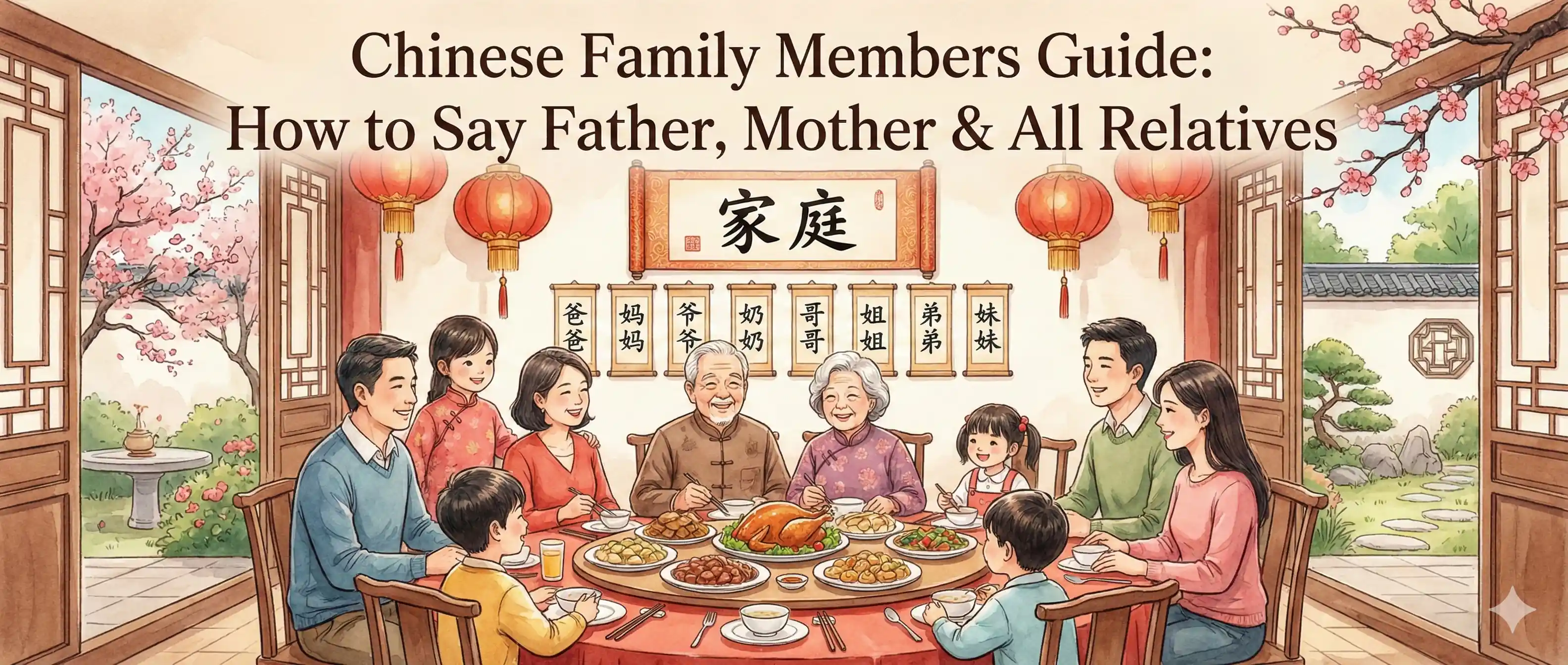
Chinese family terms are more precise than English — where English uses one word "uncle" for five different relationships, Chinese has distinct terms for each. This comprehensive guide teaches you how to correctly address every family member in Chinese, from your immediate family (爸爸, 妈妈) to extended relatives (伯伯, 舅舅, 姑姑, 姨). You'll learn the cultural importance of distinguishing between paternal and maternal relatives, understand why age matters (哥哥 vs 弟弟), and master the stroke order for 30+ essential family characters. Whether you're meeting your Chinese in-laws or just want to understand Chinese family culture, this guide will help you navigate family relationships with confidence.
Introduction: Why Chinese Family Terms Are Unique
Chinese family terminology is far more detailed than English. Understanding these distinctions is essential for showing respect and building relationships in Chinese culture.
Key Differences:
- •English: One word "uncle" = 5 different relationships (father's older brother, father's younger brother, mother's brother, father's sister's husband, mother's sister's husband)
- •Chinese: Each relationship has its own specific term, distinguishing:
- • - Paternal vs Maternal: 爷爷 (father's father) vs 外公 (mother's father)
- • - Age: 哥哥 (older brother) vs 弟弟 (younger brother)
- • - Gender: 姐姐 (older sister) vs 哥哥 (older brother)
Why This Matters:
- •Respect: Using the correct term shows respect for family hierarchy
- •Clarity: No confusion about which relative you're referring to
- •Cultural Understanding: Family relationships are central to Chinese culture
- •Practical: Essential for conversations about family, holidays, and relationships
What You'll Learn:
- •This guide covers 30+ essential family characters, organized by relationship level:
- •Core family (parents, siblings)
- •Grandparents (paternal and maternal)
- •Aunts and uncles (with age distinctions)
- •In-laws and spouses
- •Children and grandchildren
Each section includes stroke order tips, example sentences, and cultural context to help you master Chinese family terms.
Core Family: Parents and Self
These six characters form the foundation of Chinese family vocabulary. Master these first, and you'll be able to talk about your immediate family.
| Chinese | Pinyin | English | Key Characters |
|---|---|---|---|
| 爸爸 | bàba | dad | 爸 |
| 妈妈 | māma | mom | 妈 |
| 父亲 | fùqīn | father (formal) | 父、亲 |
| 母亲 | mǔqīn | mother (formal) | 母 |
| 家 | jiā | family/home | 家 |
| 家人 | jiārén | family members | 人 |
Writing Tips:
- •爸: 8 strokes. Top is 父 (father), bottom is 巴 — write the 父 component first, then 巴 below.
- •妈: 6 strokes. Left side is 女 (woman), right side is 马 (horse) — the 女 radical should be narrow.
- •父: 4 strokes. Two strokes crossing — represents a father figure.
- •母: 5 strokes. The character for "mother" — note the two dots inside.
- •家: 10 strokes. Top is 宀 (roof), bottom is 豕 (pig) — represents a home with livestock.
- •人: 2 strokes. Simple character meaning "person" — very common.
Example Sentences:
- •我爸爸是老师。 (Wǒ bàba shì lǎoshī.) — My dad is a teacher.
- •我爱我的家人。 (Wǒ ài wǒ de jiārén.) — I love my family.
- •这是我的母亲。 (Zhè shì wǒ de mǔqīn.) — This is my mother. (formal)
Cultural Note: 爸爸 and 妈妈 are the most common terms for parents in daily conversation. 父亲 and 母亲 are more formal and used in written contexts or formal introductions.
Siblings: Older and Younger
Chinese requires you to distinguish between older and younger siblings — a concept that doesn't exist in English. This reflects the importance of age hierarchy in Chinese culture.
| Chinese | Pinyin | English | Explanation |
|---|---|---|---|
| 哥哥 | gēge | older brother | Male sibling older than you |
| 姐姐 | jiějie | older sister | Female sibling older than you |
| 弟弟 | dìdi | younger brother | Male sibling younger than you |
| 妹妹 | mèimei | younger sister | Female sibling younger than you |
Key Cultural Points:
- •Age Matters: Chinese culture emphasizes respect for elders, so distinguishing older from younger siblings is essential
- •English Limitation: English's "brother" and "sister" don't convey age — Chinese has 4 distinct terms
- •One-Child Policy: Many Chinese people born after 1980 don't have siblings, but still need to know these terms for cousins and friends
Writing Tips:
- •哥: 10 strokes. Two 可 characters stacked — write the top 可 first, then the bottom 可.
- •姐: 8 strokes. Left side is 女 (woman), right side is 且 — the 女 radical should be narrow.
- •弟: 7 strokes. Note the vertical stroke in the middle — practice the stroke order carefully.
- •妹: 8 strokes. Left side is 女 (woman), right side is 未 — similar structure to 姐.
Example Sentences:
- •我有一个哥哥和一个妹妹。 (Wǒ yǒu yī ge gēge hé yī ge mèimei.) — I have one older brother and one younger sister.
- •这是我的姐姐。 (Zhè shì wǒ de jiějie.) — This is my older sister.
- •我的弟弟很小。 (Wǒ de dìdi hěn xiǎo.) — My younger brother is very young.
Practice: These four characters appear frequently in daily conversation. Master their stroke order, and you'll be able to talk about siblings naturally.
Grandparents: Paternal and Maternal
Chinese distinguishes between grandparents on your father's side (paternal) and mother's side (maternal). This distinction is crucial — calling your maternal grandfather 爷爷 instead of 外公 would be incorrect.
Paternal Grandparents (Father's Side):
| Chinese | Pinyin | English | Relationship |
|---|---|---|---|
| 爷爷 | yéye | grandpa (paternal) | Father's father |
| 奶奶 | nǎinai | grandma (paternal) | Father's mother |
Maternal Grandparents (Mother's Side):
| Chinese | Pinyin | English | Relationship |
|---|---|---|---|
| 外公 | wàigōng | grandpa (maternal) | Mother's father |
| 外婆 | wàipó | grandma (maternal) | Mother's mother |
Key Distinction:
- •爷奶奶 = 爸爸的父母 (Father's parents) — the "inside" family
- •外公外婆 = 妈妈的父母 (Mother's parents) — the "outside" family (外 = outside/external)
Regional Variations:
- •In Northern China, people often use different terms:
- •姥姥 (lǎolao) = 外婆 (maternal grandmother)
- •姥爷 (lǎoye) = 外公 (maternal grandfather)
Writing Tips:
- •爷: 6 strokes. Top is 父 (father), bottom is 卩 — represents an elder father figure.
- •奶: 5 strokes. Left side is 女 (woman), right side is 乃 — the 女 radical should be narrow.
- •外: 5 strokes. Left side is 夕 (evening), right side is 卜 — means "outside" or "external."
- •公: 4 strokes. Top is 八 (eight), bottom is 厶 — means "public" or "grandfather."
- •婆: 11 strokes. Top is 波 (wave), bottom is 女 (woman) — the 女 is at the bottom.
Example Sentences:
- •我的爷爷很老。 (Wǒ de yéye hěn lǎo.) — My paternal grandfather is very old.
- •外婆做饭很好吃。 (Wàipó zuò fàn hěn hǎochī.) — Maternal grandmother cooks very well.
- •今天我去看外公。 (Jīntiān wǒ qù kàn wàigōng.) — Today I'm going to visit my maternal grandfather.
Cultural Note: The distinction between paternal and maternal grandparents reflects traditional Chinese family structure, where the father's family line was considered the primary lineage.
Aunts and Uncles: The Most Complex Part
- •This is where Chinese family terms get really detailed! You need to distinguish between:
- •Father's side vs Mother's side
- •Older vs Younger (for father's brothers)
- •Gender (brother vs sister)
Father's Side (Paternal Relatives):
| Chinese | Pinyin | English | Explanation |
|---|---|---|---|
| 伯伯 | bóbo | uncle | Father's older brother |
| 叔叔 | shūshu | uncle | Father's younger brother |
| 姑姑 | gūgu | aunt | Father's sister |
Mother's Side (Maternal Relatives):
Memory Tips:
- •Father's brothers: 伯伯 (older) / 叔叔 (younger)
- •Father's sisters: 姑姑
- •Mother's brothers: 舅舅
- •Mother's sisters: 姨/阿姨
Spouses of Aunts and Uncles:
Writing Tips:
- •伯: 7 strokes. Left side is 亻 (person), right side is 白 — means "elder" or "uncle."
- •叔: 8 strokes. Left side is 尗, right side is 又 — means "younger uncle."
- •姑: 8 strokes. Left side is 女 (woman), right side is 古 — father's sister.
- •舅: 13 strokes. Top is 臼, bottom is 男 — mother's brother.
- •姨: 9 strokes. Left side is 女 (woman), right side is 夷 — mother's sister.
Example Sentences:
- •我的伯伯是医生。 (Wǒ de bóbo shì yīshēng.) — My father's older brother is a doctor.
- •舅舅从美国来。 (Jiùjiu cóng Měiguó lái.) — Maternal uncle came from America.
- •今天我去看姑姑。 (Jīntiān wǒ qù kàn gūgu.) — Today I'm going to visit my father's sister.
Common Mistakes:
Spouses and In-Laws
Learn how to refer to your spouse and your spouse's family members — essential for married life in Chinese culture.
Spouse Terms:
| Chinese | Pinyin | English | Context |
|---|---|---|---|
| 丈夫 | zhàngfu | husband | Formal |
| 老公 | lǎogōng | hubby | Casual |
| 妻子 | qīzi | wife | Formal |
| 老婆 | lǎopo | wifey | Casual |
| 爱人 | àirén | spouse | Neutral/Formal |
Husband's Parents (In-Laws):
| Chinese | Pinyin | English |
|---|---|---|
| 公公 | gōnggong | father-in-law (husband's father) |
| 婆婆 | pópo | mother-in-law (husband's mother) |
Wife's Parents (In-Laws):
Writing Tips:
- •丈: 3 strokes. Simple character meaning "unit of measurement" or "husband."
- •夫: 4 strokes. Represents a man or husband — note the two horizontal strokes.
- •妻: 8 strokes. Top is 一, middle is 丨, bottom is 女 — represents a wife.
- •老: 6 strokes. Means "old" — used as a prefix in casual terms.
- •岳: 8 strokes. Top is 丘 (hill), bottom is 山 (mountain) — means "mountain" or "wife's parents."
Example Sentences:
- •这是我的丈夫。 (Zhè shì wǒ de zhàngfu.) — This is my husband. (formal)
- •我的老婆很好。 (Wǒ de lǎopo hěn hǎo.) — My wife is very good. (casual)
- •今天我去看公公婆婆。 (Jīntiān wǒ qù kàn gōnggong pópo.) — Today I'm going to visit my in-laws (husband's parents).
Cultural Note: In Chinese culture, relationships with in-laws are very important. Using the correct terms shows respect and helps maintain harmonious family relationships.
Children and Grandchildren
Learn how to refer to your children and their children — essential for family conversations.
| Chinese | Pinyin | English | Key Characters |
|---|---|---|---|
| 儿子 | érzi | son | 儿、子 |
| 女儿 | nǚ'ér | daughter | 女 |
| 孩子 | háizi | child | 孩 |
| 孙子 | sūnzi | grandson | 孙 |
| 孙女 | sūnnǚ | granddaughter | - |
| 外孙 | wàisūn | grandson (daughter's son) | - |
Writing Tips:
- •儿: 2 strokes. Simple character — just a vertical stroke with a hook at the bottom.
- •女: 3 strokes. Represents a woman — note the horizontal stroke that crosses through.
- •子: 3 strokes. Means "child" or "son" — very common character.
- •孩: 9 strokes. Left side is 子 (child), right side is 亥 — means "child."
- •孙: 6 strokes. Left side is 子 (child), right side is 小 (small) — means "grandson."
Example Sentences:
- •我有一个儿子和一个女儿。 (Wǒ yǒu yī ge érzi hé yī ge nǚ'ér.) — I have one son and one daughter.
- •我的孙子很可爱。 (Wǒ de sūnzi hěn kě'ài.) — My grandson is very cute.
- •孩子们在学校。 (Háizi men zài xuéxiào.) — The children are at school.
Cultural Note: The term 外孙 (wàisūn) is used for a grandson from your daughter's side, reflecting the traditional distinction between paternal and maternal lines.
How to Address People Correctly
Master these practical tips to avoid embarrassing mistakes when addressing family members and strangers.
1. How to Address Strangers:
When talking to people you don't know, use respectful family terms:
- •年长男性 (Older male): 叔叔 (shūshu) or 大爷 (dàye)
- •年长女性 (Older female): 阿姨 (āyí) or 大妈 (dàmā)
- •年轻人 (Young person): 哥/姐 (gē/jiě) — polite and friendly
2. How to Introduce Family:
Use these patterns when introducing your family members:
- •爸爸。** (Zhè shì wǒ bàba.) — This is my dad.
- •姐姐。** (Zhè shì wǒ jiějie.) — This is my older sister.
- •我外婆。** (Zhè shì wǒ de wàipó.) — This is my maternal grandmother.
3. Common Mistakes to Avoid:
- •❌ Calling maternal grandparents 爷奶奶 (should be 外公外婆)
- •❌ Confusing 伯伯 and 叔叔 (remember: 伯伯 = older, 叔叔 = younger)
- •❌ Using "你" (nǐ) to address elders (should use "您" nín for respect)
- •❌ Not distinguishing between older and younger siblings
4. Using "您" (nín) for Respect:
When addressing elders or people you respect, use 您 (nín) instead of 你 (nǐ):
- •✅ 好 (Nín hǎo!) — Hello! (respectful)
- •✅ 是我的爷爷吗?** (Nín shì wǒ de yéye ma?) — Are you my grandfather? (respectful)
- •❌ 好 (Nǐ hǎo!) — OK for peers, but not for elders
5. Practice Scenarios:
- •Scenario 1: Meeting Your Friend's Family
- •Friend's father: 叔叔好! (Shūshu hǎo!) — Hello, uncle!
- •Friend's mother: 阿姨好! (Āyí hǎo!) — Hello, aunt!
- •Scenario 2: Introducing Your Family
- •是我的家人。** (Zhè shì wǒ de jiārén.) — These are my family members.
- •是我爸爸,这是我妈妈。** (Zhè shì wǒ bàba, zhè shì wǒ māma.) — This is my dad, this is my mom.
Cultural Tip: In Chinese culture, showing respect through correct family terms is crucial. Taking time to learn and use the right terms will be greatly appreciated by Chinese speakers.
Quick Reference: Family Tree
Use this visual family tree and quick reference table to look up any family term.
Family Tree Visualization:
爷爷 ─── 奶奶          外公 ─── 外婆
                │                      │
      ┌────┬────┼────┬────┐    ┌────┬────┼────┐
     伯伯  爸爸  叔叔  姑姑    舅舅  妈妈  姨
                │                      │
                └──────┬───────────┘
                           │
                ┌────┬─────┼─────┬────┐
               哥哥  姐姐   我   弟弟  妹妹
Complete Family Terms Reference:
| Relationship | Chinese | Pinyin | HSK Level |
|---|---|---|---|
| Father | 爸爸 | bàba | HSK 1 |
| Mother | 妈妈 | māma | HSK 1 |
| Older Brother | 哥哥 | gēge | HSK 1 |
| Older Sister | 姐姐 | jiějie | HSK 1 |
| Younger Brother | 弟弟 | dìdi | HSK 1-2 |
| Younger Sister | 妹妹 | mèimei | HSK 1-2 |
| Paternal Grandfather | 爷爷 | yéye | HSK 2 |
| Paternal Grandmother | 奶奶 | nǎinai | HSK 2 |
| Maternal Grandfather | 外公 | wàigōng | HSK 2-3 |
| Maternal Grandmother | 外婆 | wàipó | HSK 2-3 |
| Father's Older Brother | 伯伯 | bóbo | HSK 3 |
| Father's Younger Brother | 叔叔 | shūshu | HSK 3 |
| Father's Sister | 姑姑 | gūgu | HSK 3 |
| Mother's Brother | 舅舅 | jiùjiu | HSK 3-4 |
| Mother's Sister | 姨/阿姨 | yí/āyí | HSK 3-4 |
| Husband | 丈夫/老公 | zhàngfu/lǎogōng | HSK 3-4 |
| Wife | 妻子/老婆 | qīzi/lǎopo | HSK 3-4 |
| Son | 儿子 | érzi | HSK 2 |
| Daughter | 女儿 | nǚ'ér | HSK 2 |
| Grandson | 孙子 | sūnzi | HSK 2-3 |
| Granddaughter | 孙女 | sūnnǚ | HSK 2-3 |
Practice Resources:
- •HSK 1 Characters — Many family terms start here
- •HSK 2 Characters — More family relationships
- •HSK 3 Characters — Extended family terms
- •Worksheet Generator — Practice writing family characters
Frequently Asked Questions
Q: Why are Chinese family terms so complex?
A: Chinese culture places great importance on family relationships and hierarchy. Precise terms show respect and clarify relationships. Traditional Chinese society was organized around extended families, so distinguishing between different types of relatives was essential for social organization.
Q: Can I use "阿姨" to address any woman?
A: Yes! 阿姨 (āyí) can be used to politely address any middle-aged or older woman you don't know, similar to "ma'am" in English. It's a respectful and friendly term.
Q: How do I say "I'm an only child" in Chinese?
- •A: You can say:
- •独生子。** (Wǒ shì dúshēngzǐ.) — I'm an only son.
- •独生女。** (Wǒ shì dúshēngnǚ.) — I'm an only daughter.
- •没有兄弟姐妹。** (Wǒ méiyǒu xiōngdì jiěmèi.) — I don't have siblings.
Q: What's the difference between 堂兄弟姐妹 and 表兄弟姐妹?
- •A:
- •堂兄弟姐妹 (táng xiōngdì jiěmèi) = Paternal cousins (children of father's brothers/sisters)
- •表兄弟姐妹 (biǎo xiōngdì jiěmèi) = Maternal cousins (children of mother's brothers/sisters)
The distinction reflects the traditional importance of the paternal family line.
Q: How do I address my friend's parents?
- •A: Use respectful terms:
- •Friend's father: 叔叔 (shūshu) or 伯伯 (bóbo) depending on their age relative to your own father
- •Friend's mother: 阿姨 (āyí)
Q: What's the difference between 爸爸 and 父亲?
- •A: Both mean "father," but:
- •爸爸 (bàba) = Casual, used in daily conversation
- •父亲 (fùqīn) = Formal, used in written contexts or formal introductions
Q: How do I say "family" in Chinese?
- •A: The most common term is 家 (jiā), which means both "home" and "family." You can also say:
- •家人 (jiārén) — family members
- •家庭 (jiātíng) — family (more formal)
Q: Why do Chinese distinguish between paternal and maternal grandparents?
A: Traditional Chinese culture emphasized the paternal family line as the primary lineage. The term 外 (wài, meaning "outside") in 外公 and 外婆 reflects that maternal relatives were considered part of the "external" family line. While this distinction is less important in modern times, the terms remain in use.
Q: How do I practice these family terms?
A: Start with the core family (爸爸, 妈妈, 哥哥, 姐姐) and practice introducing your family. Then move on to extended family terms. Use the Worksheet Generator to practice writing the characters, and try to use these terms in daily conversation whenever possible.
Related Resources
Continue Learning
- Chinese Time & Dates Guide
Master time expressions and dates
- Chinese Numbers Guide
Learn numbers 1-100 with stroke order
- Authentic Chinese Greetings
How to greet people respectfully
Practice Tools
- HSK 1 Character Dictionary
Many family terms start here
- HSK 2 Character Dictionary
More family relationships
- Worksheet Generator
Practice writing family characters