
10 Hardest HSK 1 Characters: Stroke Order Mistakes & Fixes

HanziStroke TeamNative Chinese speakers & language educators
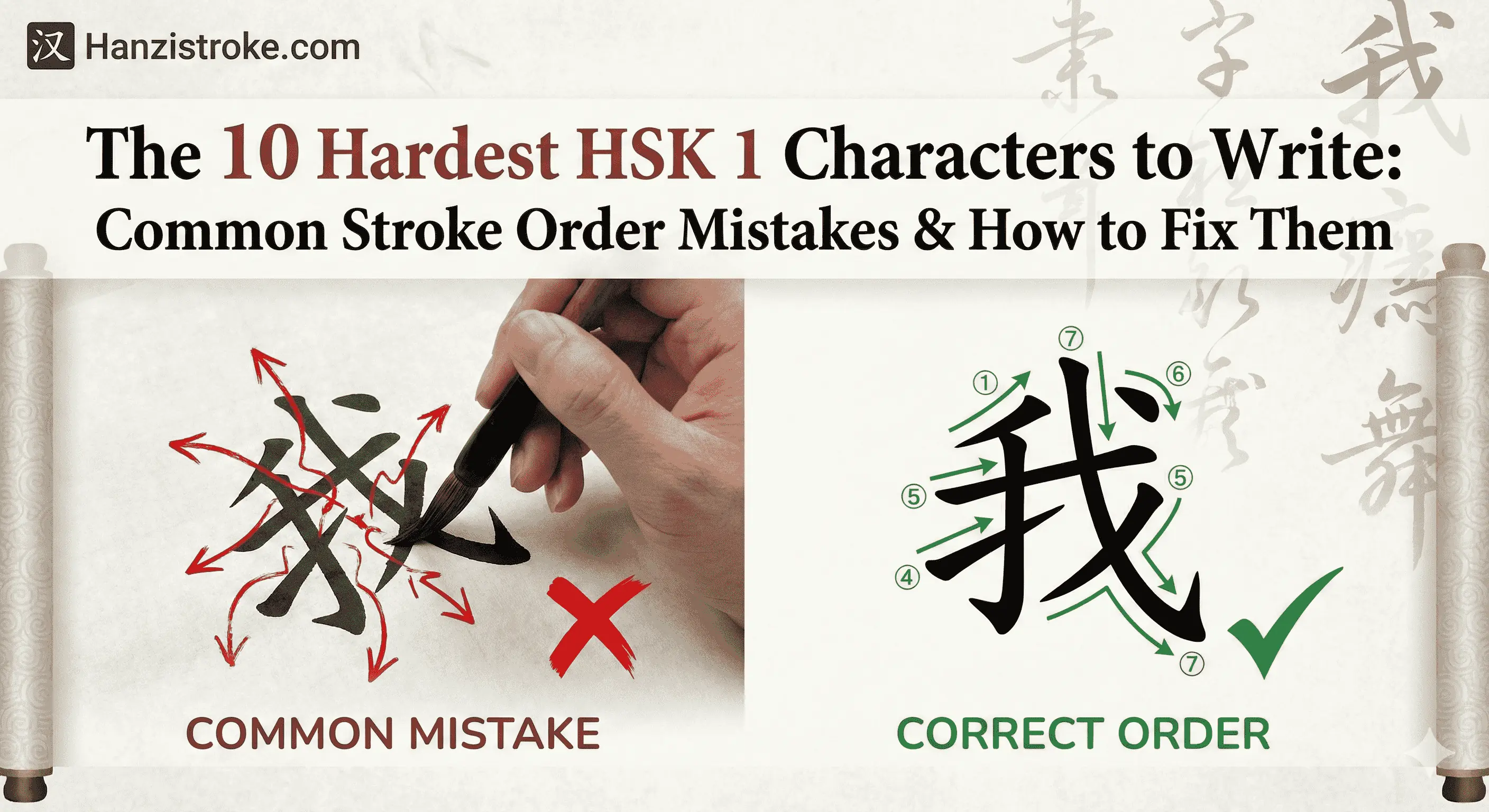
Many beginners think HSK 1 is easy—until they start writing characters by hand. Wrong stroke order doesn't just make your characters look ugly; it makes them nearly impossible to remember. Muscle memory works against you when you practice incorrectly. This article reveals the 10 most "deceptive" characters in HSK Level 1 and teaches you the correct way to write them.
Table of Contents
1. 我 (wǒ) - I, Me
The Character: 我 (wǒ)
The Trap: Many learners write the final stroke as a left-falling stroke (撇), but it's actually a dot (点). The character 我 has a complex structure with multiple components, and the last stroke—a small dot on the right side—is often overlooked or written incorrectly.
The Fix: The correct stroke order for 我 is: 1) Left-falling stroke (撇), 2) Horizontal stroke (横), 3) Vertical hook (竖钩), 4) Left-falling stroke (撇), 5) Horizontal stroke (横), 6) Vertical stroke (竖), 7) Horizontal stroke (横), 8) Dot (点). Remember: the final stroke is a dot, not a left-falling stroke. This dot completes the character and gives it balance.
Check the animation for 我 here: View 我 (wǒ) stroke animation
The Trap: Many learners write the final stroke as a left-falling stroke (撇), but it's actually a dot (点). The character 我 has a complex structure with multiple components, and the last stroke—a small dot on the right side—is often overlooked or written incorrectly.

The Fix: The correct stroke order for 我 is: 1) Left-falling stroke (撇), 2) Horizontal stroke (横), 3) Vertical hook (竖钩), 4) Left-falling stroke (撇), 5) Horizontal stroke (横), 6) Vertical stroke (竖), 7) Horizontal stroke (横), 8) Dot (点). Remember: the final stroke is a dot, not a left-falling stroke. This dot completes the character and gives it balance.
Check the animation for 我 here: View 我 (wǒ) stroke animation
2. 没 (méi) - Not, Without
The Character: 没 (méi)
The Trap: The most common mistake is writing the water radical (氵) incorrectly. Learners often write the three dots as separate disconnected strokes, or they write them in the wrong order. Additionally, the right side component (殳) has a specific stroke sequence that's easy to confuse.
The Fix: For the water radical (氵) on the left: 1) First dot (点), 2) Second dot (点), 3) Vertical stroke with hook (竖提). The dots should be aligned vertically and connected visually. For the right side: follow the correct order—horizontal, vertical, left-falling, and right-falling strokes in sequence. The key is maintaining the vertical alignment of the water radical.
Check the animation for 没 here: View 没 (méi) stroke animation
The Trap: The most common mistake is writing the water radical (氵) incorrectly. Learners often write the three dots as separate disconnected strokes, or they write them in the wrong order. Additionally, the right side component (殳) has a specific stroke sequence that's easy to confuse.

The Fix: For the water radical (氵) on the left: 1) First dot (点), 2) Second dot (点), 3) Vertical stroke with hook (竖提). The dots should be aligned vertically and connected visually. For the right side: follow the correct order—horizontal, vertical, left-falling, and right-falling strokes in sequence. The key is maintaining the vertical alignment of the water radical.
Check the animation for 没 here: View 没 (méi) stroke animation
3. 很 (hěn) - Very, Quite
The Character: 很 (hěn)
The Trap: The left side radical (彳) is often written incorrectly. Learners confuse it with the person radical (亻) and write it with the wrong stroke count or order. The right side (艮) also has a tricky sequence, especially the final stroke.
The Fix: The double-person radical (彳) on the left requires: 1) Left-falling stroke (撇), 2) Vertical stroke (竖), 3) Left-falling stroke (撇), 4) Vertical stroke (竖). Notice it's two "person" radicals stacked. The right side (艮) follows: horizontal, vertical, left-falling, horizontal, and finally a dot. The final dot is crucial—don't forget it or turn it into a longer stroke.
Check the animation for 很 here: View 很 (hěn) stroke animation
The Trap: The left side radical (彳) is often written incorrectly. Learners confuse it with the person radical (亻) and write it with the wrong stroke count or order. The right side (艮) also has a tricky sequence, especially the final stroke.

The Fix: The double-person radical (彳) on the left requires: 1) Left-falling stroke (撇), 2) Vertical stroke (竖), 3) Left-falling stroke (撇), 4) Vertical stroke (竖). Notice it's two "person" radicals stacked. The right side (艮) follows: horizontal, vertical, left-falling, horizontal, and finally a dot. The final dot is crucial—don't forget it or turn it into a longer stroke.
Check the animation for 很 here: View 很 (hěn) stroke animation
4. 九 (jiǔ) - Nine
The Character: 九 (jiǔ)
The Trap: The biggest confusion is whether to write the left-falling stroke (撇) or the horizontal-turning stroke (横折弯钩) first. Many learners start with the horizontal part, but that's incorrect.
The Fix: The correct order is: 1) Left-falling stroke (撇) first, 2) Then the horizontal-turning-hook stroke (横折弯钩). Always write the left-falling stroke before the complex turning stroke. This follows the "left-falling before right-falling" rule, but in this case, it's left-falling before the turning stroke. The character should feel balanced with the left-falling stroke providing the foundation.
Check the animation for 九 here: View 九 (jiǔ) stroke animation
The Trap: The biggest confusion is whether to write the left-falling stroke (撇) or the horizontal-turning stroke (横折弯钩) first. Many learners start with the horizontal part, but that's incorrect.

The Fix: The correct order is: 1) Left-falling stroke (撇) first, 2) Then the horizontal-turning-hook stroke (横折弯钩). Always write the left-falling stroke before the complex turning stroke. This follows the "left-falling before right-falling" rule, but in this case, it's left-falling before the turning stroke. The character should feel balanced with the left-falling stroke providing the foundation.
Check the animation for 九 here: View 九 (jiǔ) stroke animation
5. 四 (sì) - Four
The Character: 四 (sì)
The Trap: Learners often write the outer frame incorrectly, either starting from the wrong corner or not completing the enclosure properly. The inside strokes (儿) are also frequently written in the wrong sequence.
The Fix: Follow the "outside before inside" rule: 1) Left vertical stroke (竖), 2) Horizontal-turning stroke (横折), 3) Bottom horizontal stroke (横), completing the frame. Then write the inside: 4) Left-falling stroke (撇), 5) Right-falling stroke (捺). The key is completing the outer frame first, then adding the internal components. Don't start the inside strokes until the frame is closed.
Check the animation for 四 here: View 四 (sì) stroke animation
The Trap: Learners often write the outer frame incorrectly, either starting from the wrong corner or not completing the enclosure properly. The inside strokes (儿) are also frequently written in the wrong sequence.

The Fix: Follow the "outside before inside" rule: 1) Left vertical stroke (竖), 2) Horizontal-turning stroke (横折), 3) Bottom horizontal stroke (横), completing the frame. Then write the inside: 4) Left-falling stroke (撇), 5) Right-falling stroke (捺). The key is completing the outer frame first, then adding the internal components. Don't start the inside strokes until the frame is closed.
Check the animation for 四 here: View 四 (sì) stroke animation
6. 里 (lǐ) - Inside, Li (unit of distance)
The Character: 里 (lǐ)
The Trap: The top component (田) and bottom component (土) are often written as if they're separate, or learners write the bottom horizontal stroke before completing the top enclosure. The connection between top and bottom is also frequently mishandled.
The Fix: Write the top enclosure (田) first: 1) Left vertical (竖), 2) Horizontal-turning (横折), 3) Horizontal (横), 4) Vertical (竖), 5) Horizontal (横). Then write the bottom (土): 6) Horizontal (横), 7) Vertical (竖), 8) Horizontal (横). The top and bottom should feel connected, not floating apart. The vertical stroke in the middle helps connect them visually.
Check the animation for 里 here: View 里 (lǐ) stroke animation
The Trap: The top component (田) and bottom component (土) are often written as if they're separate, or learners write the bottom horizontal stroke before completing the top enclosure. The connection between top and bottom is also frequently mishandled.

The Fix: Write the top enclosure (田) first: 1) Left vertical (竖), 2) Horizontal-turning (横折), 3) Horizontal (横), 4) Vertical (竖), 5) Horizontal (横). Then write the bottom (土): 6) Horizontal (横), 7) Vertical (竖), 8) Horizontal (横). The top and bottom should feel connected, not floating apart. The vertical stroke in the middle helps connect them visually.
Check the animation for 里 here: View 里 (lǐ) stroke animation
7. 水 (shuǐ) - Water
The Character: 水 (shuǐ)
The Trap: The middle vertical stroke with hook (竖钩) is often written incorrectly, and learners struggle with the order of the left and right strokes. Many write the side strokes before the center, which breaks the "middle before sides" rule.
The Fix: Follow "middle before sides": 1) Vertical stroke with hook (竖钩) in the center first—this is your anchor. Then add the left side: 2) Horizontal-turning-left-falling stroke (横撇) on the left. Finally, add the right side: 3) Right-falling stroke (捺) on the right. The center vertical hook is written first, establishing the character's foundation. The left side uses a combined horizontal-turning-left-falling stroke (横撇), not separate strokes. This creates the flowing appearance of water.
Check the animation for 水 here: View 水 (shuǐ) stroke animation
The Trap: The middle vertical stroke with hook (竖钩) is often written incorrectly, and learners struggle with the order of the left and right strokes. Many write the side strokes before the center, which breaks the "middle before sides" rule.

The Fix: Follow "middle before sides": 1) Vertical stroke with hook (竖钩) in the center first—this is your anchor. Then add the left side: 2) Horizontal-turning-left-falling stroke (横撇) on the left. Finally, add the right side: 3) Right-falling stroke (捺) on the right. The center vertical hook is written first, establishing the character's foundation. The left side uses a combined horizontal-turning-left-falling stroke (横撇), not separate strokes. This creates the flowing appearance of water.
Check the animation for 水 here: View 水 (shuǐ) stroke animation
8. 那 (nà) - That
The Character: 那 (nà)
The Trap: The left side radical (阝) is a complex radical that's often simplified incorrectly. Learners may write it as two separate strokes or confuse it with other similar-looking radicals. The right side component also has a specific stroke order that's easy to mix up.
The Fix: For the left radical (阝): 1) Horizontal-turning stroke (横折折折钩), which is actually one continuous stroke—practice it slowly to master the turning points. For the right side: 2) Left-falling (撇), 3) Horizontal (横), 4) Horizontal (横), 5) Vertical (竖), 6) Horizontal-turning (横折), 7) Horizontal (横). The left radical looks complex but is actually one flowing stroke. The key is maintaining smooth transitions between the turning points without breaking the stroke.
Check the animation for 那 here: View 那 (nà) stroke animation
The Trap: The left side radical (阝) is a complex radical that's often simplified incorrectly. Learners may write it as two separate strokes or confuse it with other similar-looking radicals. The right side component also has a specific stroke order that's easy to mix up.

The Fix: For the left radical (阝): 1) Horizontal-turning stroke (横折折折钩), which is actually one continuous stroke—practice it slowly to master the turning points. For the right side: 2) Left-falling (撇), 3) Horizontal (横), 4) Horizontal (横), 5) Vertical (竖), 6) Horizontal-turning (横折), 7) Horizontal (横). The left radical looks complex but is actually one flowing stroke. The key is maintaining smooth transitions between the turning points without breaking the stroke.
Check the animation for 那 here: View 那 (nà) stroke animation
9. 做 (zuò) - To Do, To Make
The Character: 做 (zuò)
The Trap: This character combines the person radical (亻) on the left with a complex right side (故). Learners often write the person radical incorrectly (it should be two strokes, not one), and the right side has multiple components that are easy to confuse.
The Fix: Left side person radical (亻): 1) Left-falling stroke (撇), 2) Vertical stroke (竖). Right side (故): 3) Horizontal (横), 4) Vertical (竖), 5) Left-falling (撇), 6) Horizontal (横), 7) Vertical (竖), 8) Horizontal-turning (横折), 9) Horizontal (横), 10) Left-falling (撇), 11) Right-falling (捺). The person radical is simple but crucial—don't combine it into one stroke. The right side requires careful attention to the order of the bottom component.
Check the animation for 做 here: View 做 (zuò) stroke animation
The Trap: This character combines the person radical (亻) on the left with a complex right side (故). Learners often write the person radical incorrectly (it should be two strokes, not one), and the right side has multiple components that are easy to confuse.

The Fix: Left side person radical (亻): 1) Left-falling stroke (撇), 2) Vertical stroke (竖). Right side (故): 3) Horizontal (横), 4) Vertical (竖), 5) Left-falling (撇), 6) Horizontal (横), 7) Vertical (竖), 8) Horizontal-turning (横折), 9) Horizontal (横), 10) Left-falling (撇), 11) Right-falling (捺). The person radical is simple but crucial—don't combine it into one stroke. The right side requires careful attention to the order of the bottom component.
Check the animation for 做 here: View 做 (zuò) stroke animation
10. 这 (zhè) - This
The Character: 这 (zhè)
The Trap: The walking radical (辶) at the bottom is frequently written incorrectly. Learners may write it as separate strokes or in the wrong order. The top component (文) also needs careful attention to stroke sequence.
The Fix: Write the top component (文) first: 1) Dot (点), 2) Horizontal (横), 3) Left-falling (撇), 4) Right-falling (捺). Then the walking radical (辶): 5) Dot (点), 6) Horizontal-turning stroke (横折折撇), 7) Right-falling stroke (捺). The walking radical is one continuous stroke that flows smoothly. The key is the horizontal-turning part—it should feel like one motion, not separate strokes.
Check the animation for 这 here: View 这 (zhè) stroke animation
The Trap: The walking radical (辶) at the bottom is frequently written incorrectly. Learners may write it as separate strokes or in the wrong order. The top component (文) also needs careful attention to stroke sequence.

The Fix: Write the top component (文) first: 1) Dot (点), 2) Horizontal (横), 3) Left-falling (撇), 4) Right-falling (捺). Then the walking radical (辶): 5) Dot (点), 6) Horizontal-turning stroke (横折折撇), 7) Right-falling stroke (捺). The walking radical is one continuous stroke that flows smoothly. The key is the horizontal-turning part—it should feel like one motion, not separate strokes.
Check the animation for 这 here: View 这 (zhè) stroke animation
Why Handwriting Still Matters for HSK
While HSK 1-2 exams may not require extensive handwriting, the new HSK 3.0 standards place greater emphasis on writing ability as you advance. More importantly, understanding stroke order isn't just about passing tests—it's about building a solid foundation.
The Cognitive Science of Stroke Order:
Research in cognitive science shows that correct stroke order helps your brain form stronger memory connections. When you write characters following the proper sequence:
• Muscle Memory Develops Faster: Your hand learns the "dance" of each character, making recall automatic
• Pattern Recognition Improves: You start recognizing similar stroke patterns across different characters
• Writing Speed Increases: Once memorized, correct stroke order becomes second nature, allowing you to write faster
• Character Recognition Enhances: Understanding how characters are built helps you read them more accurately
The Foundation Principle:
Think of stroke order as the foundation of a building. If the foundation is wrong, everything built on top will be unstable. Characters learned with incorrect stroke order are harder to remember, slower to write, and more difficult to recognize later.
Building Good Habits Early:
Starting with HSK 1 characters and learning correct stroke order from the beginning saves you countless hours of unlearning bad habits later. Every character you learn correctly makes the next one easier.
For comprehensive stroke order rules and practice techniques, see our guide: The Ultimate Guide to Chinese Handwriting
The Cognitive Science of Stroke Order:
Research in cognitive science shows that correct stroke order helps your brain form stronger memory connections. When you write characters following the proper sequence:
• Muscle Memory Develops Faster: Your hand learns the "dance" of each character, making recall automatic
• Pattern Recognition Improves: You start recognizing similar stroke patterns across different characters
• Writing Speed Increases: Once memorized, correct stroke order becomes second nature, allowing you to write faster
• Character Recognition Enhances: Understanding how characters are built helps you read them more accurately
The Foundation Principle:
Think of stroke order as the foundation of a building. If the foundation is wrong, everything built on top will be unstable. Characters learned with incorrect stroke order are harder to remember, slower to write, and more difficult to recognize later.
Building Good Habits Early:
Starting with HSK 1 characters and learning correct stroke order from the beginning saves you countless hours of unlearning bad habits later. Every character you learn correctly makes the next one easier.
For comprehensive stroke order rules and practice techniques, see our guide: The Ultimate Guide to Chinese Handwriting
Master the Basics, Build the Foundation
Don't underestimate the importance of getting stroke order right from the start. These 10 characters may seem simple, but they're the building blocks for hundreds of more complex characters you'll learn later. Each correct stroke order you master now makes future learning easier.
Your Action Plan:
1. Review each character using the animations linked above
2. Practice writing each character 10 times following the correct stroke order
3. Compare your writing with the animation to catch mistakes early
4. Focus on one character at a time—don't rush through all 10 in one session
5. Return to practice regularly—muscle memory needs reinforcement
Remember: Every expert was once a beginner. The difference between struggling learners and successful ones isn't talent—it's attention to fundamentals. Master these 10 characters correctly, and you'll have a solid foundation for your entire HSK journey.
Want to check your stroke order? Search any HSK character on Hanzistroke.com now. Our interactive animations show you the exact stroke order for every character, with practice tools to help you master each one.
Start with HSK Level 1 characters and build your foundation one stroke at a time.
Your Action Plan:
1. Review each character using the animations linked above
2. Practice writing each character 10 times following the correct stroke order
3. Compare your writing with the animation to catch mistakes early
4. Focus on one character at a time—don't rush through all 10 in one session
5. Return to practice regularly—muscle memory needs reinforcement
Remember: Every expert was once a beginner. The difference between struggling learners and successful ones isn't talent—it's attention to fundamentals. Master these 10 characters correctly, and you'll have a solid foundation for your entire HSK journey.
Want to check your stroke order? Search any HSK character on Hanzistroke.com now. Our interactive animations show you the exact stroke order for every character, with practice tools to help you master each one.
Start with HSK Level 1 characters and build your foundation one stroke at a time.