
Chinese Pinyin Tones: Complete Guide to the 4 Tones & Pronunciation

Have you ever said something in Chinese and received a confused look? You might have used the wrong tone. In Mandarin Chinese, the same syllable can have completely different meanings depending on its tone. Master the four tones, and you'll unlock the key to being understood. This comprehensive guide breaks down each tone with clear examples, practical tips, and interactive demonstrations to help you speak Chinese with confidence.
Why Tones Matter: The Key to Being Understood
Unlike English, where tone mainly conveys emotion, Chinese uses tones to distinguish meaning. The same sound with different tones becomes completely different words.
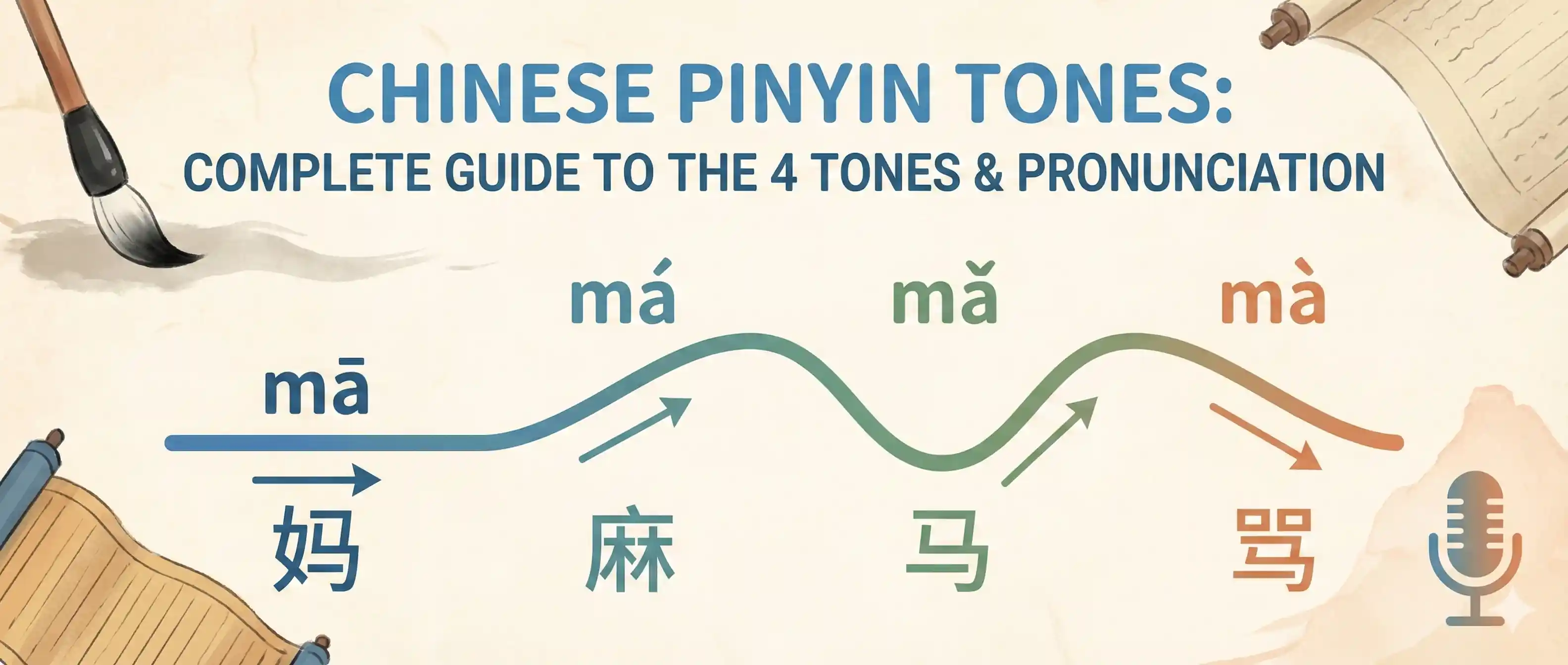
The Classic Example: mā, má, mǎ, mà
Consider the syllable "ma" with four different tones:
| Tone | Pinyin | Character | Meaning |
|---|---|---|---|
| 1st (high level) | mā | 妈 | mother |
| 2nd (rising) | má | 麻 | hemp/numb |
| 3rd (dipping) | mǎ | 马 | horse |
| 4th (falling) | mà | 骂 | to scold |
Imagine saying "I want to buy books" (mǎi shū) but accidentally saying "I want to sell books" (mài shū) — that's the power of tones!
Real-World Impact
Getting tones wrong doesn't just cause confusion — it can completely change your message:
| Wrong Tone | Intended | Actual Meaning |
|---|---|---|
| wǒ xiǎng wèn nǐ | I want to ask you | I want to kiss you (吻) |
| mǎi dōngxi | buy things | sell things (卖) |
| shuì jiào | sleep | pay taxes (税) |
The Good News
While tones may seem daunting at first, they follow consistent patterns. With practice, your brain will naturally recognize and produce them. Let's start by understanding each tone in detail.
The 4 Tones Explained
Mandarin Chinese has four main tones, each with a distinct pitch pattern. Think of them as musical notes that give each syllable its identity.
First Tone (ˉ) — High Level
- •Pitch: High and flat, like singing a sustained note
- •Mark: ā, ē, ī, ō, ū, ǖ
- •Description: Start high and stay high throughout
Tip: Imagine you're at the doctor saying "Ahhh" — that's the first tone!
---
Second Tone (ˊ) — Rising
- •Pitch: Starts mid-low and rises up, like asking a question
- •Mark: á, é, í, ó, ú, ǘ
- •Description: Your voice goes up, similar to "What?" in English
Tip: Think of how you say "Huh?" when surprised — that rising intonation is the second tone.
---
Third Tone (ˇ) — Dipping
- •Pitch: Starts mid, dips down, then rises slightly
- •Mark: ǎ, ě, ǐ, ǒ, ǔ, ǚ
- •Description: Like a valley — down then up (but often just low in connected speech)
Tip: Imagine you're skeptically saying "Reeeally?" — that dipping sound is the third tone.
---
Fourth Tone (ˋ) — Falling
- •Pitch: Starts high and drops sharply, like giving a command
- •Mark: à, è, ì, ò, ù, ǜ
- •Description: Short, sharp, and decisive — like saying "No!"
Tip: Think of how you firmly say "Stop!" — that sharp falling tone is the fourth tone.
The Neutral Tone (轻声)
Beyond the four main tones, Mandarin has a neutral tone (also called the fifth tone or light tone). It's shorter, lighter, and unstressed.
- •Characteristics:
- •No tone mark in pinyin (or sometimes marked with a dot)
- •Shorter duration than other tones
- •Pitch depends on the preceding tone
Common Patterns:
| Pattern | Example | Pinyin | Meaning |
|---|---|---|---|
| Repeated characters | 妈妈 | māma | mom |
| Repeated characters | 爸爸 | bàba | dad |
| Question particles | 吗 | ma | (question marker) |
| Possessive particle | 的 | de | (possessive marker) |
| Aspect particles | 了, 着, 过 | le, zhe, guo | (grammar particles) |
Examples in Context:
- •你好吗?(Nǐ hǎo ma?) — How are you?
- •我的书 (Wǒ de shū) — My book
- •谢谢 (Xièxie) — Thank you (second 谢 is neutral)
- •东西 (Dōngxi) — Thing (西 is neutral)
Tip: Don't stress about the neutral tone too much at first. Focus on mastering the four main tones, and neutral tones will come naturally with exposure.
Tone Marks: How to Read & Write Pinyin
Tone marks are placed above vowels in pinyin to indicate which tone to use. But which vowel gets the mark when there are multiple vowels?
The Rule: a > e > o > i/u (last one)
- Follow this priority order:
- 1.If there's an a or e, put the mark on it
- 2.If there's an ou, put the mark on the o
- 3.For iu or ui, put the mark on the second vowel
Examples:
| Pinyin | Rule Applied | Result |
|---|---|---|
| hao | "a" gets the mark | hǎo |
| mei | "e" gets the mark | méi |
| gou | "ou" → mark on "o" | gǒu |
| liu | "iu" → mark on "u" | liú |
| gui | "ui" → mark on "i" | guì |
| nü | only one vowel | nǚ |
Special Case: ü (u with umlaut)
- •The letter ü appears after j, q, x, y but is written as u (without dots):
- •女 = nǚ (but written as nv in some systems)
- •绿 = lǜ
- •去 = qù (the u is actually ü)
Practice Characters:
Common Tone Mistakes & How to Fix Them
English speakers often struggle with specific tone patterns. Here are the most common mistakes and how to overcome them.
Mistake 1: Treating Tones as Optional
Many beginners focus on consonants and vowels while neglecting tones. But in Chinese, tones are as important as the sounds themselves.
Fix: Practice tones from day one. When learning a new word, always learn it with its tone.
---
Mistake 2: Confusing Second and Third Tones
The rising second tone and the dipping third tone can sound similar to untrained ears.
- •Fix:
- •Second tone: Think "asking a question" — voice goes UP
- •Third tone: Think "skeptical" — voice goes DOWN then slightly up
- •Practice minimal pairs: 麻 (má) vs 马 (mǎ)
---
Mistake 3: Making Third Tone Too "Bouncy"
The textbook third tone dips and rises, but in natural speech, it's often just low and flat (especially before other tones).
Fix: In connected speech, focus on keeping the third tone LOW rather than making it bounce up at the end.
---
Mistake 4: Fourth Tone Not Sharp Enough
English speakers often make the fourth tone too gentle. It should be short and decisive.
Fix: Practice saying "No!" or "Stop!" firmly — that sharp, falling energy is what you need.
---
Mistake 5: Ignoring Tone Changes (Sandhi)
Tones change in certain combinations (covered in the next section). Ignoring these rules makes speech sound unnatural.
Fix: Learn the tone sandhi rules and practice common combinations.
Practice Pairs:
Tone Sandhi: When Tones Change
In connected speech, certain tone combinations cause tones to change. This is called tone sandhi (变调). Understanding these rules is essential for natural-sounding Chinese.
Rule 1: Third Tone + Third Tone → Second Tone + Third Tone
When two third tones appear together, the first one changes to a second tone.
| Written | Spoken | Example |
|---|---|---|
| nǐ + hǎo | ní hǎo | 你好 (hello) |
| wǒ + yě | wó yě | 我也 (I also) |
| hěn + hǎo | hén hǎo | 很好 (very good) |
Note: The pinyin is still written with the original tones, but pronounced with the changed tone.
---
Rule 2: 不 (bù) Tone Changes
The character 不 (bù, "not") changes tone based on what follows:
| Before | Change | Example |
|---|---|---|
| 4th tone | bù → bú | 不是 (bú shì) — is not |
| 1st, 2nd, 3rd tone | stays bù | 不好 (bù hǎo) — not good |
---
Rule 3: 一 (yī) Tone Changes
The character 一 (yī, "one") has complex tone changes:
| Context | Tone | Example |
|---|---|---|
| Alone or counting | yī (1st) | 一、二、三 |
| Before 4th tone | yí (2nd) | 一个 (yí gè) |
| Before 1st, 2nd, 3rd | yì (4th) | 一天 (yì tiān) |
Practice Sentences:
- •我不去 (Wǒ bú qù) — I'm not going
- •一起 (Yì qǐ) — together
- •你好吗?(Nǐ hǎo ma?) — How are you?
- •我们都很好 (Wǒmen dōu hěn hǎo) — We're all fine
Practice Strategies & Tools
Mastering tones requires consistent practice. Here are proven strategies to improve your tone accuracy.
1. Listen and Repeat
- •Use our character pages to hear native pronunciation
- •Repeat each word multiple times, focusing on the tone
- •Record yourself and compare to the original
2. Tone Pair Drills
Practice all 16 possible tone combinations:
| 1st | 2nd | 3rd | 4th | |
|---|---|---|---|---|
| 1st | 今天 | 中国 | 飞机 | 工作 |
| 2nd | 学生 | 人民 | 时间 | 学习 |
| 3rd | 北京 | 美国 | 你好 | 可以 |
| 4th | 电话 | 汉语 | 大米 | 再见 |
3. Exaggerate at First
When practicing, exaggerate the tones. Make the first tone extra high, the second tone really rise, the third tone dip deeply, and the fourth tone fall sharply. You can tone it down later.
4. Use Visual Aids
- •Draw the tone contours as you practice:
- •1st tone: ——— (flat line at top)
- •2nd tone: / (rising line)
- •3rd tone: ∨ (dipping curve)
- •4th tone: \ (falling line)
5. Practice with Characters
Use our interactive stroke order tool to learn characters with their tones:
- •HSK Level 1 Characters — 150 essential characters
- •HSK Level 2 Characters — 150 more characters
- •Search by Pinyin — Find characters by sound
6. Daily Practice Routine
- Spend 10-15 minutes daily on tone practice:
- 1.Warm-up (2 min): Say the four tones with "ma"
- 2.New words (5 min): Learn 5 new characters with correct tones
- 3.Review (5 min): Practice yesterday's characters
- 4.Sentences (3 min): Read simple sentences aloud
Start Your Tone Practice Today
You now have all the knowledge you need to master Chinese tones. The key is consistent practice. Here's your action plan:
- •Week 1: Foundation
- •Master the four tones with "ma" (妈麻马骂)
- •Learn 10 HSK 1 characters with correct tones
- •Practice tone pairs daily
- •Week 2: Expansion
- •Learn tone sandhi rules
- •Practice 不 and 一 tone changes
- •Add 20 more characters
- •Week 3: Application
- •Read simple sentences aloud
- •Record yourself and compare
- •Focus on problem areas
Recommended Starting Characters:
| Character | Pinyin | Meaning | Tone |
|---|---|---|---|
| 一 | yī | one | 1st |
| 人 | rén | person | 2nd |
| 你 | nǐ | you | 3rd |
| 是 | shì | is | 4th |
| 我 | wǒ | I/me | 3rd |
| 好 | hǎo | good | 3rd |
| 大 | dà | big | 4th |
| 中 | zhōng | middle | 1st |
Ready to begin? Start with the character 妈 (mā, mother) — it's the perfect character to practice the first tone. Click to see the stroke order animation and hear the pronunciation.
Remember: Every Chinese speaker learned tones the same way you will — through practice. With consistent effort, you'll develop an ear for tones and produce them naturally. Start today, and you'll be amazed at your progress!
- •For more foundational guides, check out:
- •Basic Strokes of Chinese Characters
- •Master Chinese Handwriting
- •HSK 1 Stroke Order Mistakes to Avoid
Related Resources
Continue Learning
- Master the 8 Basic Chinese Strokes
Essential foundation for character writing
- Chinese Handwriting Guide
Master stroke order with daily practice
- Common HSK 1 Stroke Order Mistakes
Fix these errors before they become habits
Practice Tools
- Chinese to Pinyin Converter
Convert any text to pinyin with tone marks
- HSK 1 Character Dictionary
150 essential beginner characters
- Search Characters by Pinyin
Find characters by pronunciation
- Worksheet Generator
Create custom practice sheets
Ready to Practice Tones?
Start with the classic tone practice character 妈 (mā) and master all four tones.