
Top 100 Chinese Characters: Stroke Order Chart & PDF

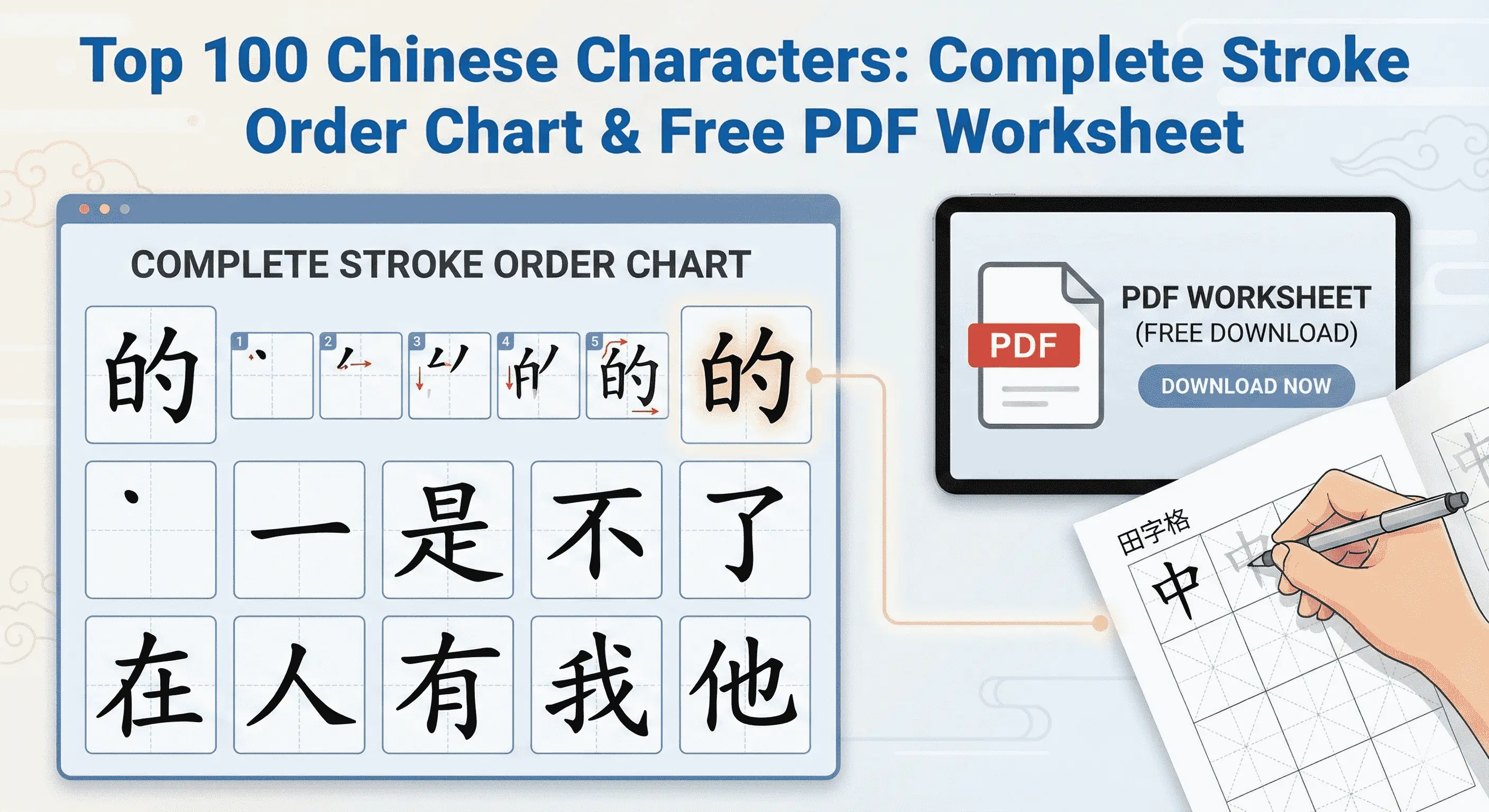
Each character includes interactive stroke order animations, pinyin pronunciation, English meaning, and direct links to practice tools. Learn the correct stroke sequence for the most frequently used characters in Chinese writing. Download our free PDF worksheet to practice offline, or use our online tool for real-time feedback.
Practice These 100 Characters
Download our free Top 100 Chinese Characters PDF worksheet with stroke order, pinyin, and practice grids — or create custom sheets with any characters you choose.
The Definitive Top 100 Hanzi Stroke Order Chart
Characters 1-20
Characters 21-40
Characters 41-60
Characters 61-80
Characters 81-100
Why These 100 Characters Matter
The 80/20 Principle in Action:
• These 100 characters appear in 42% of all written Chinese
• Combined with the next 400 characters, you reach 75% coverage
• Mastering stroke order for these foundational characters builds muscle memory that transfers to thousands of related characters
Learning Benefits:
• Reading: Recognize nearly half of all characters in newspapers, books, and signs
• Writing: Build correct stroke patterns that make learning new characters easier
• Typing: Faster character input with proper component knowledge
• Memory: Stroke order creates kinesthetic memory pathways
Example: The character 一 (yī - one) appears in over 1,000 compound characters. Master its simple horizontal stroke, and you've learned a component that appears everywhere.
How to Practice Effectively
The 5-Day Mastery System:
Day 1-2: Foundation (Characters 1-20)
1. Watch the [stroke order animation](/order/的) for each character
2. Write each character 15 times following the exact sequence
3. Focus on stroke direction and order, not speed
4. Use our [worksheet generator](/tools/chinese-worksheet-generator) for structured practice
Day 3-4: Building (Characters 21-60)
1. Practice 20 characters per day
2. Self-test: Write from memory before checking
3. Note characters that share stroke patterns (e.g., 口, 日, 目)
4. Review previous day's characters (5 minutes)
Day 5+: Mastery (Characters 61-100)
1. Speed up writing while maintaining correct stroke order
2. Practice character combinations and simple words
3. Use spaced repetition: Review Day 1 characters on Day 5
Pro Tips:
• Grid paper: Use 田字格 (tián zì gé) practice sheets for proper proportions
• Slow first: Speed comes after correctness
• Daily practice: 20 minutes daily beats 2 hours weekly
• Write, don't trace: Active recall builds stronger memory
Common Stroke Patterns in Top 100
Pattern 1: Enclosures (口-based characters)
Characters with 口 (mouth) component: 和, 国, 可
Stroke rule: Left → Top → Right → Bottom (closure stroke last)
Pattern 2: Top-Bottom Structures
Characters: 是, 要, 字
Stroke rule: Always top component first, then bottom
Pattern 3: Left-Right Structures
Characters: 他, 们, 时
Stroke rule: Left radical first, then right component
Pattern 4: Horizontal vs. Vertical Priority
Horizontal first: 十 (shí - ten), 工 (gōng - work)
Vertical first: 川 (chuān - river)
Exception to learn: 王 (wáng - king) - Horizontal, vertical, horizontal, horizontal (not all horizontals first!)
Pattern Recognition Exercise:
Group characters by structure type from our Top 100 list. You'll find about 30% are left-right, 25% top-bottom, and 15% enclosure types.
Recommended Learning Sequence
Stage 1: Simple Strokes (Week 1)
Start with these fundamental characters:
• Single-stroke: 一 (one)
• 2-3 strokes: 二 (two), 三 (three), 十 (ten), 人 (person)
• 4-5 strokes: 大 (big), 小 (small), 上 (up), 下 (down)
*Why this order?* Build confidence with simple characters while learning basic stroke types.
Stage 2: Common Radicals (Week 2)
Learn characters with these radicals:
• 人 (person): 他, 们, 个
• 口 (mouth): 和, 可, 吗
• 木 (wood): 本, 来
*Why this order?* Radical recognition accelerates learning of complex characters.
Stage 3: Complex Structures (Week 3-4)
Tackle multi-component characters:
• 10+ strokes: 国 (country), 学 (study), 说 (speak)
*Why this order?* By now, you recognize components and can break down complex characters.
Download our optimized learning sequence: [Get Custom Practice Worksheet](/tools/chinese-worksheet-generator)
Quick Reference: Stroke Order Rules
1. Top to Bottom
三 (three): Write all three horizontals from top to bottom
2. Left to Right
八 (eight): Left stroke first, then right stroke
3. Horizontal Before Vertical (Usually)
十 (ten): Horizontal first, then vertical
*Exception*: When vertical is a central axis: 中 (middle) starts with vertical
4. Outside Before Inside
月 (moon): Write the left vertical, top and right side, then inside strokes
5. Enter the Room Before Closing the Door
国 (country): Write 口 (mouth), then 玉, then bottom closure
6. Middle Before Sides
小 (small): Vertical hook first, then two sides
7. Penetrating Strokes Last
母 (mother): Write the character, then the two horizontal strokes that cut through
Practice Test:
Can you apply these rules to write 本 (origin) correctly? Answer: Horizontal, vertical,撇, 捺 (following rules #1, #2, #3)
Master these rules and you'll know how to write thousands of characters, not just 100.
Continue Your Learning
Explore more related resources to further enhance your Chinese writing skills:
Basic Strokes of Chinese Characters: A Complete Guide
Have you ever looked at a Chinese character and felt overwhelmed? You see complex shapes, but don't know where to start? The secret to mastering Chinese writing lies in understanding the eight basic strokes that form the foundation of every character. In this comprehensive guide, we'll break down each stroke with clear examples and interactive demonstrations, giving you the tools you need to write Chinese characters with confidence.
Read MoreChinese Handwriting Guide: Stroke Order Rules & Practice
You've mastered Pinyin, but when you open a Chinese book, you still feel like you're staring at a wall of impenetrable symbols. It's frustrating to recognize the sound but not the meaning. The problem? You're treating reading as a passive skill. The solution? **Active stroke-by-stroke writing practice**. This guide covers the best graded resources and a proven 20-minute routine that uses **interactive stroke order animations** to lock characters into your long-term memory through muscle memory. **What You'll Learn:** - Why handwriting outperforms passive recognition by 3x for retention - A proven 20-minute daily routine backed by cognitive science - Common mistakes that create bad habits (and how to fix them) - The best tools and resources for systematic practice
Read More