
Learn Chinese Through Poetry: 5 Tang Poems for Beginners

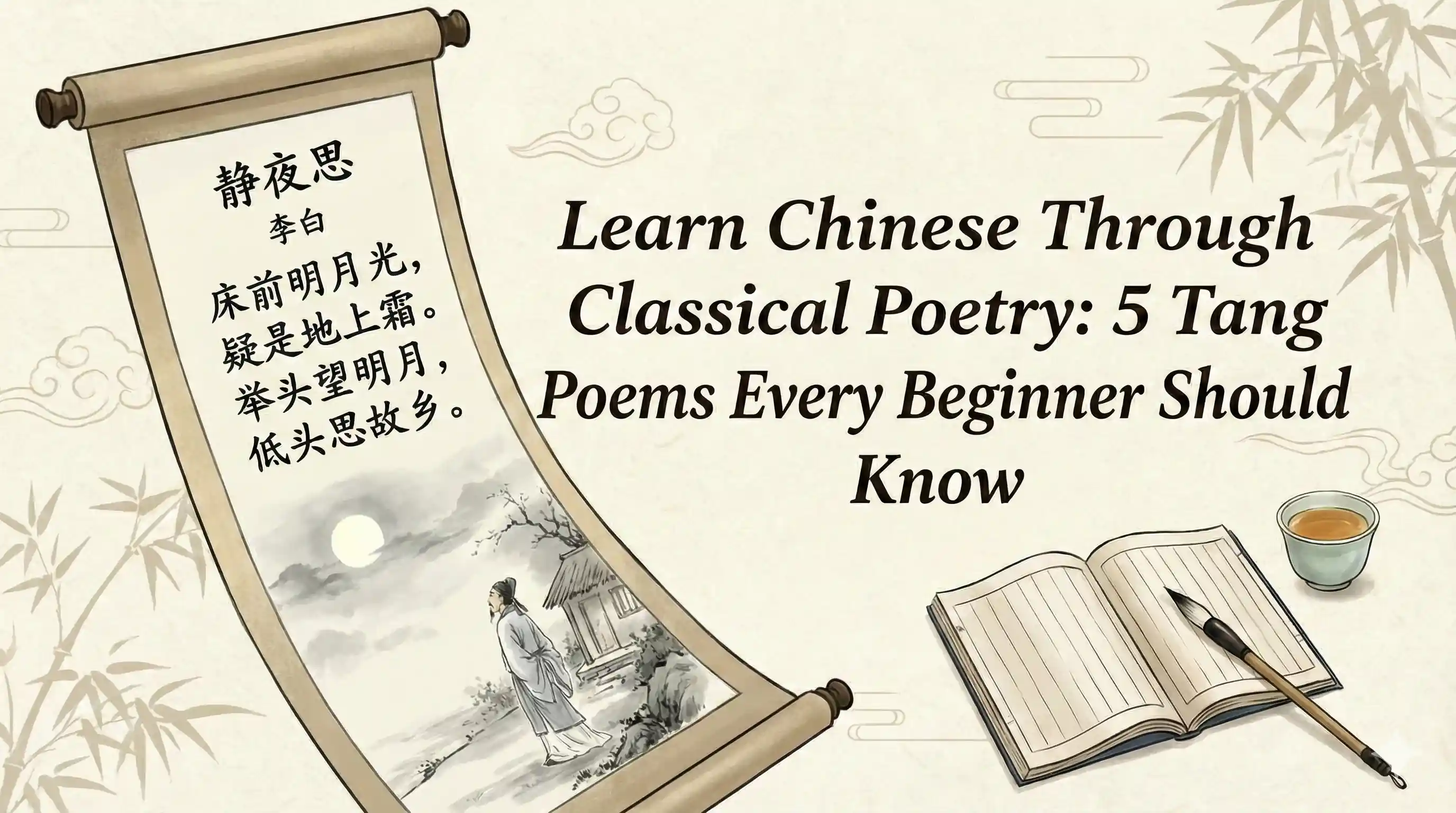
Master Chinese characters through classical poetry. Each poem is 20 characters or less, yet teaches vocabulary, grammar, and culture.
Classical Chinese poetry offers one of the most beautiful and effective ways to learn Chinese characters. These short, memorable poems have been teaching Chinese children to read for over a thousand years — and they can do the same for you. In this guide, we introduce 5 essential Tang Dynasty poems that are perfect for beginners: 静夜思 (Quiet Night Thoughts), 春晓 (Spring Dawn), 登鹳雀楼 (Climbing Stork Tower), 悯农 (Pity the Farmers), and 咏鹅 (Ode to the Goose). Each poem is just 20-28 characters long, yet teaches vocabulary, grammar patterns, and cultural insights that will accelerate your Chinese learning journey.
Why Learn Chinese Through Poetry?
Learning Chinese through classical poetry isn't just romantic — it's practical. Here's why millions of Chinese children start their literacy journey with these ancient verses:
1. Perfect Length for Memorization
Most Tang poems are just 20-28 characters. That's short enough to memorize in one sitting, yet substantial enough to teach real vocabulary and grammar.
2. High-Frequency Characters
- •Classical poems use many of the same characters you'll need for daily conversation:
- •月 (moon) — appears in 静夜思
- •日 (sun/day) — appears in 悯农
- •水 (water) — appears in 咏鹅
- •花 (flower) — appears in 春晓
3. Built-in Mnemonics
Poetry creates vivid mental images. When you learn 床前明月光 (bright moonlight before my bed), you're not just memorizing characters — you're painting a picture that makes the words stick.
4. Cultural Foundation
These poems are referenced constantly in Chinese media, conversation, and literature. Knowing them gives you cultural literacy that textbooks can't provide.
5. Pronunciation Practice
Classical poems follow strict tonal patterns. Reciting them helps train your ear for Mandarin's four tones.
The 5 Essential Beginner Poems
- •We've selected 5 poems that form the perfect "Tang Poetry Starter Pack." Each one is:
- •Short (20-28 characters)
- •Famous (every Chinese person knows them)
- •Beginner-friendly (mostly HSK 1-4 vocabulary)
- •Thematically diverse (nature, homesickness, ambition, gratitude, childhood)
| Poem | Characters | Theme | Difficulty |
|---|---|---|---|
| 静夜思 | 20 | Homesickness & Moon | ⭐ Easiest |
| 咏鹅 | 18 | Childhood & Nature | ⭐ Easiest |
| 春晓 | 20 | Spring & Nature | ⭐⭐ Easy |
| 悯农 | 20 | Gratitude & Labor | ⭐⭐ Easy |
| 登鹳雀楼 | 20 | Ambition & Vision | ⭐⭐⭐ Medium |
Let's explore each poem and what makes it special for learners.
1. 静夜思 (Jìng Yè Sī) — Quiet Night Thoughts
By Li Bai (李白) • The Most Famous Chinese Poem
床前明月光,疑是地上霜。
举头望明月,低头思故乡。
*Bright moonlight before my bed,*
*I wonder if it's frost on the ground.*
*I raise my head to gaze at the moon,*
*Then lower it, thinking of home.*
Why Learn This Poem:
This is THE most famous Chinese poem. Li Bai wrote it while traveling far from home, capturing the universal feeling of homesickness. Every Chinese person can recite it from memory.
Key Characters to Learn:
- •月 (yuè) — moon (HSK 1)
- •明 (míng) — bright (HSK 2)
- •头 (tóu) — head (HSK 1)
- •思 (sī) — think/miss (HSK 3)
Grammar Pattern:
The poem uses parallel structure: 举头 (raise head) / 低头 (lower head). This pattern is common in Chinese and helps you understand how verbs and objects work together.
2. 咏鹅 (Yǒng É) — Ode to the Goose
By Luo Binwang (骆宾王) • Written at Age 7
鹅鹅鹅,曲项向天歌。
白毛浮绿水,红掌拨清波。
*Goose, goose, goose,*
*Bending its neck, singing to the sky.*
*White feathers float on green water,*
*Red feet paddle through clear waves.*
Why Learn This Poem:
This poem was written by a 7-year-old prodigy! It's often the very first poem Chinese children learn because of its simple vocabulary and vivid imagery. The repetition of 鹅鹅鹅 mimics a goose's honking.
Key Characters to Learn:
Color Vocabulary:
This poem is perfect for learning colors! It mentions 白 (white), 绿 (green), and 红 (red) — three of the most common color words in Chinese.
3. 春晓 (Chūn Xiǎo) — Spring Dawn
By Meng Haoran (孟浩然) • A Peaceful Morning
春眠不觉晓,处处闻啼鸟。
夜来风雨声,花落知多少。
*In spring sleep, I don't notice the dawn,*
*Everywhere I hear birds singing.*
*Last night came the sound of wind and rain,*
*How many flowers have fallen, I wonder?*
Why Learn This Poem:
This poem captures the lazy pleasure of sleeping in on a spring morning. It's beloved for its gentle imagery and the bittersweet awareness that beautiful things (like spring flowers) don't last forever.
Key Characters to Learn:
Nature Vocabulary:
This poem is excellent for learning nature words: 春 (spring), 鸟 (bird), 风 (wind), 雨 (rain), 花 (flower). These are all high-frequency characters you'll use constantly.
4. 悯农 (Mǐn Nóng) — Pity the Farmers
By Li Shen (李绅) • A Moral Lesson
锄禾日当午,汗滴禾下土。
谁知盘中餐,粒粒皆辛苦。
*Hoeing grain under the midday sun,*
*Sweat drips onto the soil below.*
*Who knows that the food on our plates,*
*Every grain comes from hard work.*
Why Learn This Poem:
This poem teaches one of China's most important values: respect for farmers and food. Chinese parents often recite the last line (粒粒皆辛苦) when children don't finish their meals. It's a cornerstone of moral education.
Key Characters to Learn:
- •日 (rì) — sun/day (HSK 1)
- •土 (tǔ) — soil/earth (HSK 2)
- •知 (zhī) — know (HSK 1)
- •苦 (kǔ) — bitter/hard (HSK 3)
Cultural Insight:
The phrase 粒粒皆辛苦 (every grain comes from hard work) is used in daily life. If you understand this poem, you'll recognize this reference when Chinese people use it.
5. 登鹳雀楼 (Dēng Guàn Què Lóu) — Climbing Stork Tower
By Wang Zhihuan (王之涣) • Ambition & Vision
白日依山尽,黄河入海流。
欲穷千里目,更上一层楼。
*The white sun sets behind the mountains,*
*The Yellow River flows into the sea.*
*If you want to see a thousand miles further,*
*Climb one more level of the tower.*
Why Learn This Poem:
This poem is famous for its inspiring message: to see further, you must climb higher. The last line (更上一层楼) has become a common Chinese idiom meaning "to reach new heights" or "keep improving."
Key Characters to Learn:
- •山 (shān) — mountain (HSK 1)
- •河 (hé) — river (HSK 2)
- •海 (hǎi) — sea (HSK 2)
- •千 (qiān) — thousand (HSK 2)
Idiom Alert:
更上一层楼 is used constantly in Chinese. When someone gets a promotion, graduates, or achieves something, people say this phrase to encourage them to keep going. Knowing this poem gives you instant cultural literacy.
How to Study These Poems
Here's a proven method for learning Chinese through poetry:
Step 1: Listen First
Before reading, listen to a native speaker recite the poem. This trains your ear for the tones and rhythm. Each of our poem pages has an audio button.
Step 2: Read Character by Character
Go through each character slowly. Look up the meaning, pinyin, and stroke order. Our poem guides break down every character with links to stroke order animations.
Step 3: Understand the Grammar
- •Classical Chinese grammar is simpler than modern Chinese. Notice patterns like:
- •Subject + Verb + Object (床前明月光)
- •Parallel structures (举头/低头)
- •Question words (谁知, 多少)
Step 4: Memorize Through Recitation
Read the poem aloud 10 times. Then try to recite it from memory. The rhythm and rhyme make this easier than memorizing prose.
Step 5: Practice Writing
Use our worksheet generator to create practice sheets for the characters in each poem. Writing reinforces memory.
Step 6: Review Regularly
Add the poems to your review rotation. Even 5 minutes of recitation per day will cement them in your long-term memory.
Characters You'll Learn
Across these 5 poems, you'll encounter approximately 70 unique characters. Here are the most valuable ones for beginners:
HSK 1 Characters (Easiest):
| Character | Pinyin | Meaning | Appears In |
|---|---|---|---|
| 月 | yuè | moon | 静夜思 |
| 日 | rì | sun/day | 悯农, 登鹳雀楼 |
| 水 | shuǐ | water | 咏鹅 |
| 山 | shān | mountain | 登鹳雀楼 |
| 花 | huā | flower | 春晓 |
| 白 | bái | white | 咏鹅, 登鹳雀楼 |
| 红 | hóng | red | 咏鹅 |
| 头 | tóu | head | 静夜思 |
| 知 | zhī | know | 春晓, 悯农 |
HSK 2 Characters:
| Character | Pinyin | Meaning | Appears In |
|---|---|---|---|
| 春 | chūn | spring | 春晓 |
| 鸟 | niǎo | bird | 春晓 |
| 风 | fēng | wind | 春晓 |
| 雨 | yǔ | rain | 春晓 |
| 河 | hé | river | 登鹳雀楼 |
| 海 | hǎi | sea | 登鹳雀楼 |
| 绿 | lǜ | green | 咏鹅 |
These characters appear in countless other contexts. Learning them through poetry gives you a head start on HSK vocabulary.
Next Steps: Continue Your Poetry Journey
Once you've mastered these 5 poems, you're ready to explore more classical Chinese literature. Here are some suggestions:
Intermediate Poems to Try Next:
- •江雪 (Jiāng Xuě) — River Snow by Liu Zongyuan
- •望庐山瀑布 (Wàng Lúshān Pùbù) — Watching the Waterfall at Mount Lu by Li Bai
- •绝句 (Jué Jù) — Quatrain by Du Fu
Resources on HanziStroke:
- •Poetry Collection — All our poem guides with character breakdowns
- •Worksheet Generator — Create practice sheets for any characters
- •HSK Vocabulary — Structured learning path from HSK 1-9
Tips for Continued Learning:
- 1.Set a goal: Learn one new poem per month
- 2.Use spaced repetition: Review old poems while learning new ones
- 3.Find recordings: Listen to professional recitations on YouTube
- 4.Join a community: Share your progress with other learners
Classical poetry is a gateway to deeper Chinese language and culture. These 5 poems are just the beginning — there are thousands more waiting for you to discover.
Ready to start? Pick a poem and begin your journey:
Ready to Start Learning?
Pick a poem and begin your journey into classical Chinese poetry.