
Top 10 Chinese Surnames: Meanings, Origins & Writing

HanziStroke TeamNative Chinese speakers & language educators
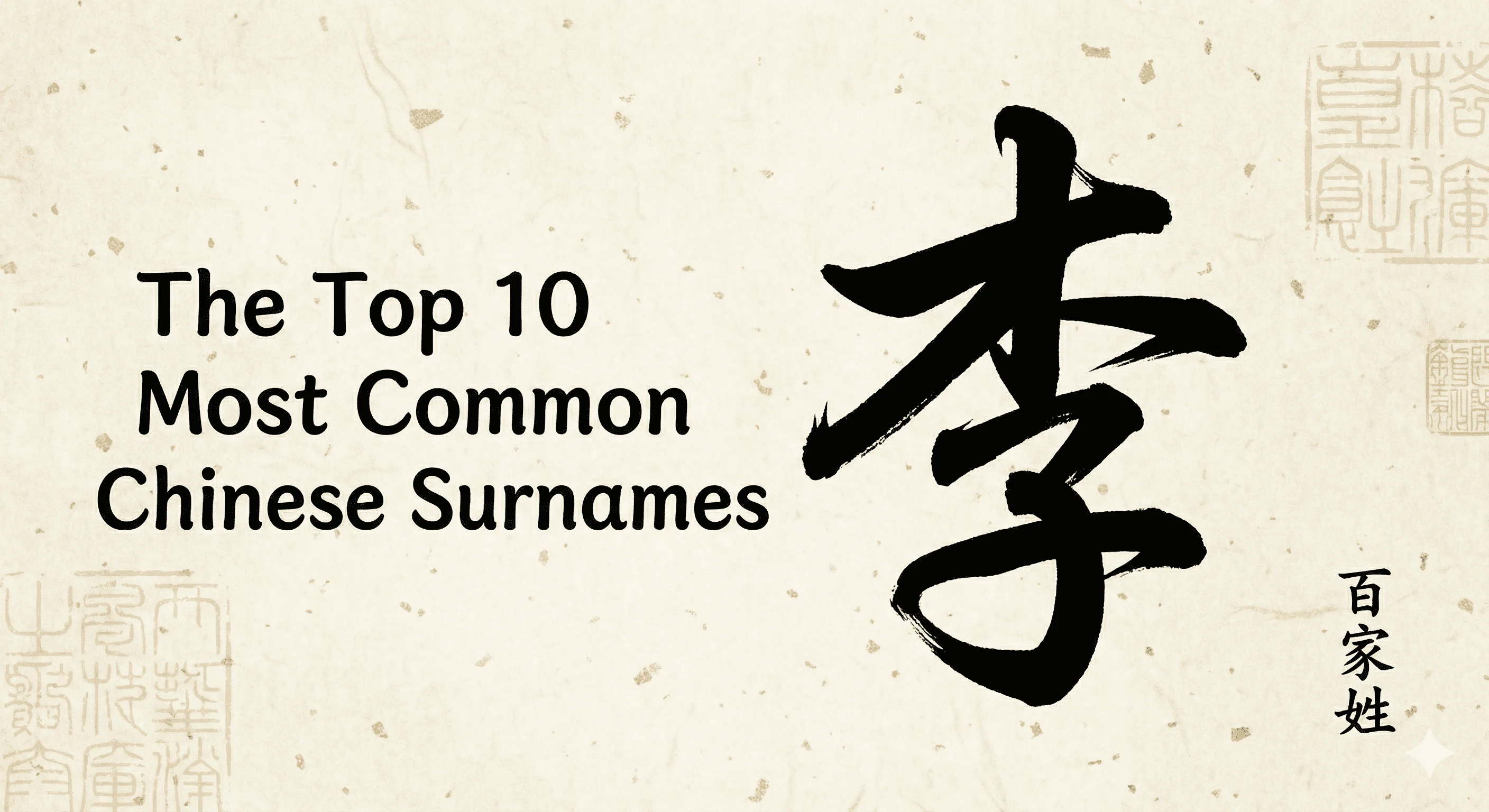
Have you ever wondered why so many people share surnames like "Lee" (李), "Wang" (王), or "Zhang" (张)? In China, there is a famous expression: "Lǎobǎixìng" (老百姓), which literally means "The Old Hundred Names." This term refers to ordinary Chinese people and reflects a fascinating linguistic reality—a small group of surnames dominates the entire population.
Unlike Western naming systems where surnames like Smith, Johnson, García, and Müller show incredible diversity, Chinese surnames follow a concentrated pattern. The top 100 Chinese surnames cover approximately 85% of China's 1.4 billion population. Even more remarkably, these 10 surnames alone represent over 500 million people worldwide!
Whether you're learning Mandarin Chinese, studying Chinese culture, preparing for the HSK exam, or simply curious about Chinese names, understanding these common surnames is essential. In this comprehensive 2025 guide, we'll explore:
• The exact stroke order for each surname (with visual SVG guides)
• Historical origins and cultural significance
• Famous people who bear these surnames
• Practical tips for writing Chinese names correctly
• Free downloadable practice worksheets
Quick Facts About Chinese Surnames
- The top 100 surnames cover ~85% of China's population
- These 10 surnames alone represent over 500 million people
- The surname always comes first in Chinese names
Table of Contents
Why Stroke Order Matters for Names
Your name is often the first thing you learn to write in a new language. In Chinese culture, handwriting (Calligraphy) reflects one's character. Writing a surname like Wang (王) with the wrong stroke sequence is immediately noticeable to a native speaker.
Let's dive into the "Big 5" and other common surnames.
Let's dive into the "Big 5" and other common surnames.
1. Li (李) - "The Plum"

Click to learn stroke order →
Pinyin: Lǐ
Ranking: #1 or #2 (Fluctuates with Wang (王))
Population: ~100 million people
Meaning & Origin: Literally means "Plum" or "Plum Tree" (木 + 子). This surname gained prominence as the imperial surname of the Tang Dynasty (618-907 AD), one of China's most prosperous periods. The Tang emperors' family name being Li contributed significantly to its widespread adoption.
Famous Bearers:
• Bruce Lee (李小龙 - Li Xiaolong) - Martial arts legend
• Li Bai (李白) - Tang Dynasty poet, one of the greatest in Chinese history
• Li Ka-shing (李嘉诚) - Hong Kong business magnate
Writing Guide:
The character consists of two parts:
• Top: "Wood" (木) - Horizontal, Vertical, Left falling, Right falling
• Bottom: "Child" (子) - Horizontal hook, Horizontal curve, Horizontal
Practice: Master the stroke order for Li (李)
Ranking: #1 or #2 (Fluctuates with Wang (王))
Population: ~100 million people
Meaning & Origin: Literally means "Plum" or "Plum Tree" (木 + 子). This surname gained prominence as the imperial surname of the Tang Dynasty (618-907 AD), one of China's most prosperous periods. The Tang emperors' family name being Li contributed significantly to its widespread adoption.
Famous Bearers:
• Bruce Lee (李小龙 - Li Xiaolong) - Martial arts legend
• Li Bai (李白) - Tang Dynasty poet, one of the greatest in Chinese history
• Li Ka-shing (李嘉诚) - Hong Kong business magnate
Writing Guide:
The character consists of two parts:
• Top: "Wood" (木) - Horizontal, Vertical, Left falling, Right falling
• Bottom: "Child" (子) - Horizontal hook, Horizontal curve, Horizontal
Practice: Master the stroke order for Li (李)
2. Wang (王) - "The King"

Click to learn stroke order →
Pinyin: Wáng
Ranking: #1 or #2
Population: ~100 million people
Meaning & Origin: Means "King" or "Monarch." The character beautifully represents the ancient Chinese cosmology: the ruler who connects Heaven (天 - top line), Humanity (人 - middle line), and Earth (地 - bottom line) with a single vertical stroke of authority.
Historically, many royal families and nobility adopted this surname, contributing to its prevalence.
Famous Bearers:
• Wang Xizhi (王羲之) - "Sage of Calligraphy" from the Jin Dynasty
• Wang Anshi (王安石) - Song Dynasty reformer and poet
• Vera Wang (王薇薇) - Fashion designer
Common Mistake Alert: Many beginners write all three horizontal lines first. This is incorrect!
The correct stroke order is:
1. Top Horizontal →
2. Middle Horizontal →
3. Vertical ↓ (connecting all three)
4. Bottom Horizontal →
Practice: See the animation for Wang (王)
Ranking: #1 or #2
Population: ~100 million people
Meaning & Origin: Means "King" or "Monarch." The character beautifully represents the ancient Chinese cosmology: the ruler who connects Heaven (天 - top line), Humanity (人 - middle line), and Earth (地 - bottom line) with a single vertical stroke of authority.
Historically, many royal families and nobility adopted this surname, contributing to its prevalence.
Famous Bearers:
• Wang Xizhi (王羲之) - "Sage of Calligraphy" from the Jin Dynasty
• Wang Anshi (王安石) - Song Dynasty reformer and poet
• Vera Wang (王薇薇) - Fashion designer
Common Mistake Alert: Many beginners write all three horizontal lines first. This is incorrect!
The correct stroke order is:
1. Top Horizontal →
2. Middle Horizontal →
3. Vertical ↓ (connecting all three)
4. Bottom Horizontal →
Practice: See the animation for Wang (王)
3. Zhang (张) - "The Archer"

Click to learn stroke order →
Pinyin: Zhāng
Ranking: #3
Population: ~95 million people
Meaning & Origin: Composed of "Bow" (弓) + "Long" (长). The original meaning relates to drawing/stretching a bow or expanding. As a surname, it traces back to the Yellow Emperor's grandson, who was known for inventing the bow and arrow.
Famous Bearers:
• Zhang Heng (张衡) - Eastern Han astronomer and inventor
• Zhang Yimou (张艺谋) - Renowned film director
• Zhang Ziyi (章子怡) - International actress
Writing Tip: The left side "Bow" (弓) is deceptively simple - it's only 3 strokes, not 4 or 5! Keep the flow smooth and curved.
Practice: Learn Zhang (张) stroke order
Ranking: #3
Population: ~95 million people
Meaning & Origin: Composed of "Bow" (弓) + "Long" (长). The original meaning relates to drawing/stretching a bow or expanding. As a surname, it traces back to the Yellow Emperor's grandson, who was known for inventing the bow and arrow.
Famous Bearers:
• Zhang Heng (张衡) - Eastern Han astronomer and inventor
• Zhang Yimou (张艺谋) - Renowned film director
• Zhang Ziyi (章子怡) - International actress
Writing Tip: The left side "Bow" (弓) is deceptively simple - it's only 3 strokes, not 4 or 5! Keep the flow smooth and curved.
Practice: Learn Zhang (张) stroke order
4. Liu (刘) - "To Conquer"

Click to learn stroke order →
Pinyin: Liú
Ranking: #4
Population: ~70 million people
Meaning & Origin: Historically associated with a weapon (battle axe). This surname was made illustrious by Liu Bang (刘邦), founder of the Han Dynasty (206 BC - 220 AD), one of the longest and most influential dynasties in Chinese history.
Famous Bearers:
• Liu Bei (刘备) - Founding emperor of Shu Han (Three Kingdoms period)
• Liu Xiang (刘翔) - Olympic gold medalist hurdler
• Liu Yifei (刘亦菲) - Actress (Mulan)
Character Structure:
• Left: Variant form of "文" (culture/pattern)
• Right: "刂" Knife radical (刂) - 2 strokes
Practice: Master Liu (刘) stroke order
Ranking: #4
Population: ~70 million people
Meaning & Origin: Historically associated with a weapon (battle axe). This surname was made illustrious by Liu Bang (刘邦), founder of the Han Dynasty (206 BC - 220 AD), one of the longest and most influential dynasties in Chinese history.
Famous Bearers:
• Liu Bei (刘备) - Founding emperor of Shu Han (Three Kingdoms period)
• Liu Xiang (刘翔) - Olympic gold medalist hurdler
• Liu Yifei (刘亦菲) - Actress (Mulan)
Character Structure:
• Left: Variant form of "文" (culture/pattern)
• Right: "刂" Knife radical (刂) - 2 strokes
Practice: Master Liu (刘) stroke order
5. Chen (陈) - "To Display"

Click to learn stroke order →
Pinyin: Chén
Ranking: #5
Population: ~60 million people
Meaning & Origin: Can mean "to display/arrange" or "old/ancient." As a surname, it originates from the ancient State of Chen (present-day Henan province), which existed during the Zhou Dynasty.
Famous Bearers:
• Chen Kaige (陈凯歌) - Film director
• Jackie Chan (陈港生 - Chen Gangsheng) - Martial arts actor
• Chen Jingrun (陈景润) - Renowned mathematician
Writing Tip: The left side is the "阝" (mound/hill) radical - a common component in place names. Write it in 2 strokes:
1. The "3-like" curved shape ⌒
2. The vertical line |
Practice: Learn Chen (陈) stroke order
Ranking: #5
Population: ~60 million people
Meaning & Origin: Can mean "to display/arrange" or "old/ancient." As a surname, it originates from the ancient State of Chen (present-day Henan province), which existed during the Zhou Dynasty.
Famous Bearers:
• Chen Kaige (陈凯歌) - Film director
• Jackie Chan (陈港生 - Chen Gangsheng) - Martial arts actor
• Chen Jingrun (陈景润) - Renowned mathematician
Writing Tip: The left side is the "阝" (mound/hill) radical - a common component in place names. Write it in 2 strokes:
1. The "3-like" curved shape ⌒
2. The vertical line |
Practice: Learn Chen (陈) stroke order
6. Yang (杨) - "Poplar Tree"

Click to learn stroke order →
Pinyin: Yáng
Ranking: #6
Population: ~40 million people
Meaning & Origin: Means "Poplar" or "Aspen tree." Composed of the Wood radical (木) + 昜 (phonetic component meaning "sun rising").
Famous Bearers:
• Yang Liwei (杨利伟) - First Chinese astronaut in space
• Yang Zhenning (杨振宁) - Nobel Prize-winning physicist
• Michelle Yeoh (杨紫琼) - Oscar-winning actress (Everything Everywhere All at Once)
Practice: Learn Yang (杨) stroke order
Ranking: #6
Population: ~40 million people
Meaning & Origin: Means "Poplar" or "Aspen tree." Composed of the Wood radical (木) + 昜 (phonetic component meaning "sun rising").
Famous Bearers:
• Yang Liwei (杨利伟) - First Chinese astronaut in space
• Yang Zhenning (杨振宁) - Nobel Prize-winning physicist
• Michelle Yeoh (杨紫琼) - Oscar-winning actress (Everything Everywhere All at Once)
Practice: Learn Yang (杨) stroke order
7. Zhao (赵) - "Ancient Kingdom"

Click to learn stroke order →
Pinyin: Zhào
Ranking: #7
Population: ~30 million people
Meaning & Origin: Named after the ancient State of Zhao, one of the Seven Warring States. Notably, this is the first surname listed in the classic "Hundred Family Surnames" (百家姓) poem because it was the emperor's surname during the Song Dynasty when the poem was written.
Famous Bearers:
• Zhao Kuangyin (赵匡胤) - Founder of Song Dynasty
• Zhao Wei (赵薇) - Actress and director
Practice: Learn Zhao (赵) stroke order
Ranking: #7
Population: ~30 million people
Meaning & Origin: Named after the ancient State of Zhao, one of the Seven Warring States. Notably, this is the first surname listed in the classic "Hundred Family Surnames" (百家姓) poem because it was the emperor's surname during the Song Dynasty when the poem was written.
Famous Bearers:
• Zhao Kuangyin (赵匡胤) - Founder of Song Dynasty
• Zhao Wei (赵薇) - Actress and director
Practice: Learn Zhao (赵) stroke order
8. Huang (黄) - "Yellow"

Click to learn stroke order →
Pinyin: Huáng
Ranking: #8
Population: ~30 million people
Meaning & Origin: Means "Yellow" - the imperial color in ancient China, representing the earth and the center. The Yellow Emperor (黄帝 Huáng Dì) is considered the ancestor of all Chinese people.
Cultural Note: Yellow was reserved exclusively for the emperor in imperial times.
Famous Bearers:
• Huang Feihong (黄飞鸿) - Legendary martial artist and folk hero
• Huang Bo (黄渤) - Award-winning actor and director
• Huang Xiaoming (黄晓明) - Actor and singer
Practice: Learn Huang (黄) stroke order
Ranking: #8
Population: ~30 million people
Meaning & Origin: Means "Yellow" - the imperial color in ancient China, representing the earth and the center. The Yellow Emperor (黄帝 Huáng Dì) is considered the ancestor of all Chinese people.
Cultural Note: Yellow was reserved exclusively for the emperor in imperial times.
Famous Bearers:
• Huang Feihong (黄飞鸿) - Legendary martial artist and folk hero
• Huang Bo (黄渤) - Award-winning actor and director
• Huang Xiaoming (黄晓明) - Actor and singer
Practice: Learn Huang (黄) stroke order
9. Zhou (周) - "Complete Circle"

Click to learn stroke order →
Pinyin: Zhōu
Ranking: #9
Population: ~25 million people
Meaning & Origin: Means "circumference," "cycle," or "week." The surname derives from the Zhou Dynasty (1046-256 BC), the longest-lasting dynasty in Chinese history.
Famous Bearers:
• Zhou Enlai (周恩来) - First Premier of the People's Republic of China
• Jay Chou (周杰伦) - Pop singer and actor
• Lu Xun (real name Zhou Shuren 周树人) - Father of modern Chinese literature
Practice: Learn Zhou (周) stroke order
Ranking: #9
Population: ~25 million people
Meaning & Origin: Means "circumference," "cycle," or "week." The surname derives from the Zhou Dynasty (1046-256 BC), the longest-lasting dynasty in Chinese history.
Famous Bearers:
• Zhou Enlai (周恩来) - First Premier of the People's Republic of China
• Jay Chou (周杰伦) - Pop singer and actor
• Lu Xun (real name Zhou Shuren 周树人) - Father of modern Chinese literature
Practice: Learn Zhou (周) stroke order
10. Wu (吴) - "Ancient Kingdom of Wu"

Click to learn stroke order →
Pinyin: Wú
Ranking: #10
Population: ~25 million people
Meaning & Origin: Named after the ancient State of Wu in the Yangtze River Delta region (present-day Jiangsu/Zhejiang). The character originally depicted a person speaking loudly or calling out.
Cultural Note: The Wu region is famous for its distinctive Wu dialect, cuisine (like Shanghainese food), and refined culture.
Famous Bearers:
• Wu Cheng'en (吴承恩) - Author of "Journey to the West" (西游记)
• John Woo (吴宇森) - Renowned film director
• Daniel Wu (吴彦祖) - Actor and model
Practice: Learn Wu (吴) stroke order
Ranking: #10
Population: ~25 million people
Meaning & Origin: Named after the ancient State of Wu in the Yangtze River Delta region (present-day Jiangsu/Zhejiang). The character originally depicted a person speaking loudly or calling out.
Cultural Note: The Wu region is famous for its distinctive Wu dialect, cuisine (like Shanghainese food), and refined culture.
Famous Bearers:
• Wu Cheng'en (吴承恩) - Author of "Journey to the West" (西游记)
• John Woo (吴宇森) - Renowned film director
• Daniel Wu (吴彦祖) - Actor and model
Practice: Learn Wu (吴) stroke order
Understanding Chinese Surname Culture
Why Are There So Few Chinese Surnames?
Historically, Chinese surnames originated from a limited number of sources:
• Ancient tribal clan names from 5,000+ years ago
• Imperial family surnames that spread through dynasties
• Geographic origins (state names, regions)
• Occupational or social status markers
Unlike European surnames which developed independently across different regions and time periods, Chinese surnames consolidated early in history and remained relatively stable.
The "Hundred Family Surnames" Poem (百家姓)
Written during the Song Dynasty (960-1279 AD), this famous Chinese text lists 438 surnames in rhyming verse. Chinese children traditionally memorized this poem to learn character writing and cultural heritage. The poem starts with Zhao (赵) because it was the Song emperor's surname.
Chinese vs. Western Name Structure
Chinese naming follows a distinct pattern:
• Surname + Given Name (e.g., 李明 = Li Ming)
• Surname comes FIRST (family before individual)
• Given names are usually 1-2 characters
• Names often carry aspirational meanings
Compare this to Western names:
• Given Name + Surname (e.g., John Smith)
• Individual comes first
• Middle names are common
• Surnames often indicate occupation or geography
Historically, Chinese surnames originated from a limited number of sources:
• Ancient tribal clan names from 5,000+ years ago
• Imperial family surnames that spread through dynasties
• Geographic origins (state names, regions)
• Occupational or social status markers
Unlike European surnames which developed independently across different regions and time periods, Chinese surnames consolidated early in history and remained relatively stable.
The "Hundred Family Surnames" Poem (百家姓)
Written during the Song Dynasty (960-1279 AD), this famous Chinese text lists 438 surnames in rhyming verse. Chinese children traditionally memorized this poem to learn character writing and cultural heritage. The poem starts with Zhao (赵) because it was the Song emperor's surname.
Chinese vs. Western Name Structure
Chinese naming follows a distinct pattern:
• Surname + Given Name (e.g., 李明 = Li Ming)
• Surname comes FIRST (family before individual)
• Given names are usually 1-2 characters
• Names often carry aspirational meanings
Compare this to Western names:
• Given Name + Surname (e.g., John Smith)
• Individual comes first
• Middle names are common
• Surnames often indicate occupation or geography
Frequently Asked Questions About Chinese Surnames
Why does the surname come first in Chinese names?
In Chinese culture, the family/collective is placed before the individual. This reflects Confucian values emphasizing family hierarchy and social order. So "Li Xiaolong" (李小龙) means the family is "Li" (李), and the given name is "Xiaolong" (小龙). Always write Chinese surnames first!
Do Chinese women change their surname after marriage?
Generally, no. In mainland China, women keep their father's surname after marriage. They do not legally become "Mrs. [Husband's Name]" like in Western tradition. However, their children usually take the father's surname. In Taiwan and Hong Kong, some women may adopt their husband's surname in social contexts.
How many Chinese surnames exist in total?
Historically, there are over 5,000 documented Chinese surnames, though many are extremely rare. The "Hundred Family Surnames" poem lists 438 surnames. Today, approximately 100 surnames cover 85% of the Chinese population, making surname diversity much lower than in Western countries.
What's the most common Chinese surname in the world?
Wang (王) and Li (李) compete for #1, each representing approximately 100 million people globally. Combined, these two surnames account for roughly 15% of all ethnic Chinese people worldwide.
How do I choose a Chinese name as a foreigner?
Don't just phonetically translate your English name (e.g., "David" → "Da Wei" 大卫). Instead:
1. Choose a common Chinese surname from this list
2. Select a given name with positive meaning
3. Consult with a native speaker or teacher
4. Consider names with cultural significance
5. Ensure the characters work well together phonetically
Many foreigners choose names related to their personality, values, or aspirations. For example, "Peace" → 和平 (Hépíng), "Wisdom" → 智慧 (Zhìhuì).
Can Chinese people recognize handwriting mistakes?
Yes, absolutely! Native Chinese speakers can immediately spot incorrect stroke order, missing strokes, or improper character proportions. While they'll still understand the character, proper handwriting demonstrates cultural respect and language proficiency—especially important for business cards, formal documents, and calligraphy.
Are these surnames pronounced the same in Mandarin and Cantonese?
No. While the written characters are identical, pronunciation differs significantly:
• Li (李) = "Lee" in Cantonese
• Wang (王) = "Wong" in Cantonese
• Chen (陈) = "Chan" in Cantonese
• Huang (黄) = "Wong" in Cantonese (same as 王!)
This explains why you see spelling variations like "Lee" vs. "Li" or "Wong" vs. "Wang" in English.
In Chinese culture, the family/collective is placed before the individual. This reflects Confucian values emphasizing family hierarchy and social order. So "Li Xiaolong" (李小龙) means the family is "Li" (李), and the given name is "Xiaolong" (小龙). Always write Chinese surnames first!
Do Chinese women change their surname after marriage?
Generally, no. In mainland China, women keep their father's surname after marriage. They do not legally become "Mrs. [Husband's Name]" like in Western tradition. However, their children usually take the father's surname. In Taiwan and Hong Kong, some women may adopt their husband's surname in social contexts.
How many Chinese surnames exist in total?
Historically, there are over 5,000 documented Chinese surnames, though many are extremely rare. The "Hundred Family Surnames" poem lists 438 surnames. Today, approximately 100 surnames cover 85% of the Chinese population, making surname diversity much lower than in Western countries.
What's the most common Chinese surname in the world?
Wang (王) and Li (李) compete for #1, each representing approximately 100 million people globally. Combined, these two surnames account for roughly 15% of all ethnic Chinese people worldwide.
How do I choose a Chinese name as a foreigner?
Don't just phonetically translate your English name (e.g., "David" → "Da Wei" 大卫). Instead:
1. Choose a common Chinese surname from this list
2. Select a given name with positive meaning
3. Consult with a native speaker or teacher
4. Consider names with cultural significance
5. Ensure the characters work well together phonetically
Many foreigners choose names related to their personality, values, or aspirations. For example, "Peace" → 和平 (Hépíng), "Wisdom" → 智慧 (Zhìhuì).
Can Chinese people recognize handwriting mistakes?
Yes, absolutely! Native Chinese speakers can immediately spot incorrect stroke order, missing strokes, or improper character proportions. While they'll still understand the character, proper handwriting demonstrates cultural respect and language proficiency—especially important for business cards, formal documents, and calligraphy.
Are these surnames pronounced the same in Mandarin and Cantonese?
No. While the written characters are identical, pronunciation differs significantly:
• Li (李) = "Lee" in Cantonese
• Wang (王) = "Wong" in Cantonese
• Chen (陈) = "Chan" in Cantonese
• Huang (黄) = "Wong" in Cantonese (same as 王!)
This explains why you see spelling variations like "Lee" vs. "Li" or "Wong" vs. "Wang" in English.
Tips for Learning and Writing Chinese Surnames
Start with These Simple Surnames
If you're just beginning to learn Chinese characters, start with the structurally simpler surnames:
1. Wang (王) - Only 4 strokes, very regular pattern
2. Li (李) - Clear two-part structure
3. Zhou (周) - Medium complexity, common character
Common Mistakes to Avoid
• Writing horizontal strokes before the vertical (especially in Wang 王)
• Forgetting the correct number of strokes (count before you write!)
• Improper stroke direction (left-to-right, top-to-bottom rule)
• Wrong component placement in compound characters
Practice Strategies
1. Use Grid Paper: Traditional Chinese practice paper (田字格) helps maintain proper proportions
2. Follow Stroke Order Rules: Learn the 8 fundamental stroke order principles
3. Write Repeatedly: Chinese students write each character 20-50 times when learning
4. Use the Correct Tools: Try brush pens or calligraphy pens for authentic practice
5. Download Worksheets: Use our free practice worksheets for structured practice
Resources for Continued Learning
• Study all HSK vocabulary with stroke order animations
• Practice with our interactive character dictionary
• Learn fundamental Chinese strokes first
• Master handwriting techniques
If you're just beginning to learn Chinese characters, start with the structurally simpler surnames:
1. Wang (王) - Only 4 strokes, very regular pattern
2. Li (李) - Clear two-part structure
3. Zhou (周) - Medium complexity, common character
Common Mistakes to Avoid
• Writing horizontal strokes before the vertical (especially in Wang 王)
• Forgetting the correct number of strokes (count before you write!)
• Improper stroke direction (left-to-right, top-to-bottom rule)
• Wrong component placement in compound characters
Practice Strategies
1. Use Grid Paper: Traditional Chinese practice paper (田字格) helps maintain proper proportions
2. Follow Stroke Order Rules: Learn the 8 fundamental stroke order principles
3. Write Repeatedly: Chinese students write each character 20-50 times when learning
4. Use the Correct Tools: Try brush pens or calligraphy pens for authentic practice
5. Download Worksheets: Use our free practice worksheets for structured practice
Resources for Continued Learning
• Study all HSK vocabulary with stroke order animations
• Practice with our interactive character dictionary
• Learn fundamental Chinese strokes first
• Master handwriting techniques
Ready to Write Your Name?
Knowing your surname is just the beginning. Whether you are prepping for the HSK exam or just want to sign a greeting card, correct stroke order makes all the difference.
Want to learn the rest of your name?
👉 Search for any Chinese character in our Dictionary to see its animation, pinyin, and meaning instantly.
Want to learn the rest of your name?
👉 Search for any Chinese character in our Dictionary to see its animation, pinyin, and meaning instantly.
Want to practice writing these common Chinese surnames?
Download a free printable worksheet to master the stroke order of all 10 surnames.
Related Tools & Articles
Chinese Name Generator
Get your own Chinese name based on your English name and personality
12 Chinese Zodiac Animals: Characters & Meanings
Learn the zodiac characters that often appear in Chinese names
Chinese Family Members: How to Say All Relatives
Learn family terms — important context for understanding Chinese names
8 Basic Strokes of Chinese Characters
Master the fundamental strokes before writing surname characters