
Chinese Measure Words for Beginners: Rules and Examples

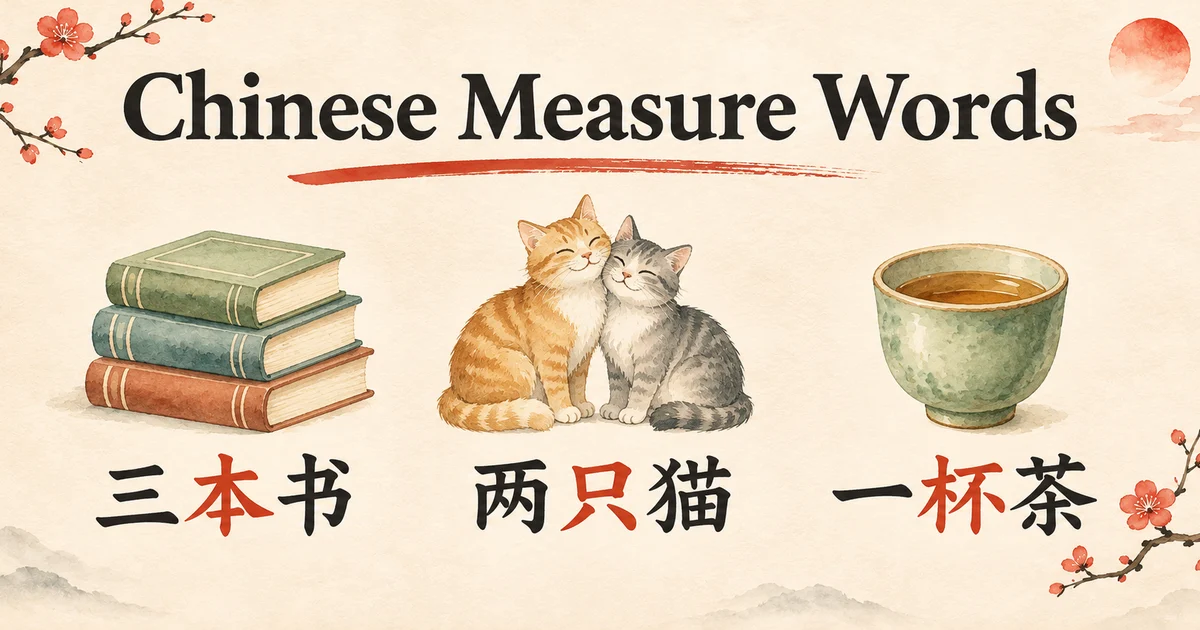
Chinese measure words (量词, liàngcí) are words used between a number and a noun. To say “three books,” for example, you normally say 三本书 (sān běn shū). 本 is the measure word for books and other bound volumes.
English has similar expressions: “two sheets of paper” and “a cup of tea.” Mandarin uses this kind of structure much more widely, including when counting people, animals, and everyday objects.
You do not need to memorize a huge list to get started. Learn a few common measure words together with the nouns they usually accompany.
How do Chinese measure words work?
The basic pattern is:
Number + measure word + noun
- 三个人 (sān gè rén) — three people
- 两本书 (liǎng běn shū) — two books
- 两杯茶 (liǎng bēi chá) — two cups of tea
You also use measure words after 这 (zhè, this), 那 (nà, that), and in many questions with 几 (jǐ, how many):
- 这本书 (zhè běn shū) — this book
- 那只猫 (nà zhī māo) — that cat
- 几张票?(jǐ zhāng piào?) — How many tickets?
This is the everyday pattern to practice first. You may see shorter forms such as 三人 in signs or written Chinese, so a missing measure word is not automatically an error in every context.
Pinyin note: Examples use dictionary tones. 一 is written yī and 个 is written gè; in natural speech, 一 often changes tone and 个 is often unstressed.
10 common Chinese measure words
| Character | Pinyin | Common uses | Example | Meaning |
|---|---|---|---|---|
| 个 | gè | People and many everyday things | 三个人 — sān gè rén | Three people |
| 只 | zhī | Many animals; individual items from a pair | 两只猫 — liǎng zhī māo | Two cats |
| 本 | běn | Books, notebooks, magazines | 三本书 — sān běn shū | Three books |
| 张 | zhāng | Paper, tickets, photos, tables | 两张票 — liǎng zhāng piào | Two tickets |
| 条 | tiáo | Roads, rivers, fish, trousers | 三条鱼 — sān tiáo yú | Three fish |
| 杯 | bēi | Cupfuls of drinks | 两杯茶 — liǎng bēi chá | Two cups of tea |
| 瓶 | píng | Bottles of liquids | 三瓶水 — sān píng shuǐ | Three bottles of water |
| 件 | jiàn | Items of clothing; matters | 两件衣服 — liǎng jiàn yīfu | Two items of clothing |
| 辆 | liàng | Vehicles such as cars and bicycles | 两辆车 — liǎng liàng chē | Two vehicles |
| 位 | wèi | People, politely | 三位老师 — sān wèi lǎoshī | Three teachers |
These examples use simplified characters. 个, 本, and 只 are examples of classifiers, which count individual things. 杯 and 瓶 describe a serving or container. Beginner guides commonly group both types under “measure words” because they fit the same basic sentence pattern.
Is 个 a universal measure word?
个 is a very common measure word. It is the normal choice in phrases such as:
- 两个苹果 (liǎng gè píngguǒ) — two apples
- 三个人 (sān gè rén) — three people
- 两个问题 (liǎng gè wèntí) — two questions
If you forget a more specific classifier, using 个 may still help someone understand you. But it does not replace every other measure word naturally.
For a book, learn 一本书, not 一个书. For a sheet of paper, learn 一张纸, not 一个纸.
Sometimes more than one choice works, with a difference in tone or meaning. 三个老师 is an ordinary way to say “three teachers.” 三位老师 sounds more polite.
The useful question is not “Can I always use 个?” It is “Which phrase would people normally use for this noun?”
本, 张, and 条: learn the contrast
These three measure words often reflect the shape or form of an object, but shape is a helpful clue—not a rule that predicts every pairing.
本: books and bound volumes
Use 本 for books, notebooks, and magazines:
- 三本书 (sān běn shū) — three books
- 两本杂志 (liǎng běn zázhì) — two magazines
- 一本词典 (yī běn cídiǎn) — a dictionary
A book is counted as a volume. A loose sheet of paper takes a different measure word.
张: sheets and flat surfaces
Use 张 for things such as paper, tickets, photos, and tables:
- 一张纸 (yī zhāng zhǐ) — a sheet of paper
- 两张照片 (liǎng zhāng zhàopiàn) — two photos
- 一张桌子 (yī zhāng zhuōzi) — a table
The contrast between 一本书 and 一张纸 is a useful starting point: a bound book versus a separate sheet.
条: long or strip-like things
Use 条 in common combinations such as:
- 两条路 (liǎng tiáo lù) — two roads
- 三条鱼 (sān tiáo yú) — three fish
- 一条裤子 (yī tiáo kùzi) — a pair of trousers
Notice that English and Chinese do not always count things in the same way. English says “a pair of trousers,” while Chinese uses 一条裤子.
只 is pronounced zhī as a measure word
只 has more than one reading. As a measure word, it is zhī:
- 这只猫 (zhè zhī māo) — this cat
- 两只鸟 (liǎng zhī niǎo) — two birds
In 只有 (zhǐ yǒu, only have), it is pronounced zhǐ instead. Learning the character inside a phrase helps you choose the right reading.
只 can also count an individual item from a pair:
- 一只鞋 (yī zhī xié) — one shoe
- 一双鞋 (yī shuāng xié) — a pair of shoes
Do not extend “只 is for animals” to every animal. Fish commonly take 条, horses take 匹, and cattle commonly take 头. Learn these pairings with the animal names.
一杯水 and 一瓶水 mean different things
A noun can work with different measure words when you are counting different units:
- 一杯水 (yī bēi shuǐ) — a cup of water
- 一瓶水 (yī píng shuǐ) — a bottle of water
- 一升水 (yī shēng shuǐ) — a liter of water
These are not competing answers to “What is the classifier for water?” They describe different quantities or ways of serving it.
When choosing a measure word, ask what you mean to count: individual objects, containers, servings, or another unit.
两 vs 二 before measure words
For the everyday phrases in this guide, use 两 for a stand-alone “two” before a measure word:
- 两本书 (liǎng běn shū) — two books
- 两只猫 (liǎng zhī māo) — two cats
- 两辆车 (liǎng liàng chē) — two vehicles
Use 二 when counting 一、二、三, naming the digit, or forming numbers such as 十二 and 二十二:
- 二十二本书 (èr shí èr běn shū) — twenty-two books
- 第二 (dì èr) — second
There are other uses, including polite expressions such as 二位 and some measurement expressions. For now, 两本书 is the everyday form to learn.
For a broader explanation, see our Chinese numbers guide.
Practice reading and writing measure words together
Do not study 本, 张, and 只 only as isolated characters. Practice complete phrases:
- Read 三本书 and say its meaning.
- Look at each character and check its stroke order.
- Write the phrase while looking at the model.
- Cover it and try writing it again.
- Change the number: 三本书 becomes 两本书.
Pay attention to both pronunciation and character shape. For example, 本 resembles 木 with an extra horizontal stroke near the bottom. That is a useful visual distinction, while 一本书 gives you a practical context for the character.
You can follow character models in Writing Practice, or use the worksheet generator for paper practice. Keep the measure word and noun together rather than filling a page with a classifier you cannot yet use.
Quick practice
Choose the missing word or the usual expression.
- 三___书 — three books
- 两___纸 — two sheets of paper
- ___只猫 — two cats: 两 or 二?
- A pair of trousers: 一条裤子 or 一张裤子?
- What is the difference between 一杯水 and 一瓶水?
Answers:
- 本 — 三本书.
- 张 — 两张纸.
- 两 — 两只猫.
- 一条裤子.
- 一杯水 is a cup of water; 一瓶水 is a bottle of water.
Frequently asked questions
Does every Chinese noun always need a measure word?
No. Measure words are commonly needed when counting ordinary objects or specifying them with words such as 这 and 那. A bare noun does not need one: 我喜欢书 (wǒ xǐhuan shū) means “I like books.” 很多书 means “many books,” also without a classifier.
What is the difference between 几 and 多少?
Both ask about quantity. 几 commonly asks about an expected small number and usually needs a measure word: 几本书? means “How many books?”
多少 can ask about an unknown or potentially larger number. A measure word is often optional: 多少学生 and 多少个学生 can both mean “how many students.” The choice depends on context; it is not a strict small-number versus large-number boundary.
What is the best way to remember Chinese measure words?
Learn a useful phrase with each noun: 一本书, 一张纸, 一只猫, 一杯茶. Read it, understand it, and practice writing it. When another measure word appears with the same noun, check whether it changes the unit, meaning, or level of politeness.