
Chinese Alphabet Explained: Pinyin & Your First Characters

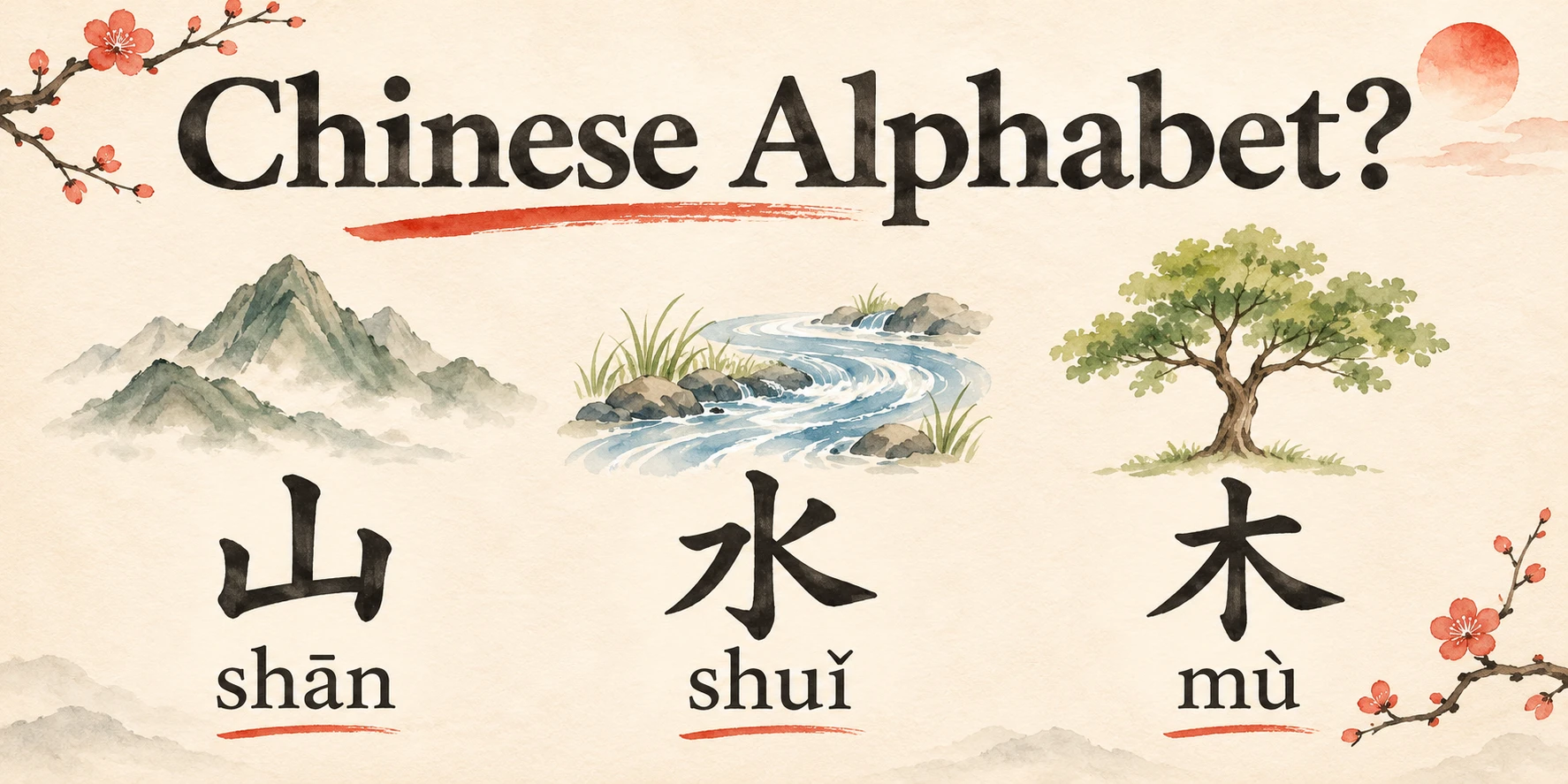
Chinese does not have an alphabet like English. It is written with characters called hanzi. Pinyin uses Latin letters to show how Mandarin sounds, helping you connect a written character with its pronunciation.
Does Chinese have an alphabet?
English combines letters to spell words. Chinese combines characters to write words and sentences. A character usually represents a syllable and a unit of meaning, but it is not necessarily a complete word on its own.
For example, 你 (nǐ) means “you”, while 你好 (nǐ hǎo) is a greeting meaning “hello”. The characters are the written form; the pinyin tells you the pronunciation; the English explains the meaning. Learning one layer does not automatically teach you the other two.
There is no A–Z list of Chinese characters to memorize. A chart that assigns a random character to each English letter will not let you write Chinese words or translate a name. Instead, start with a small group of useful words and learn their sound, meaning and written form together.
What is pinyin?
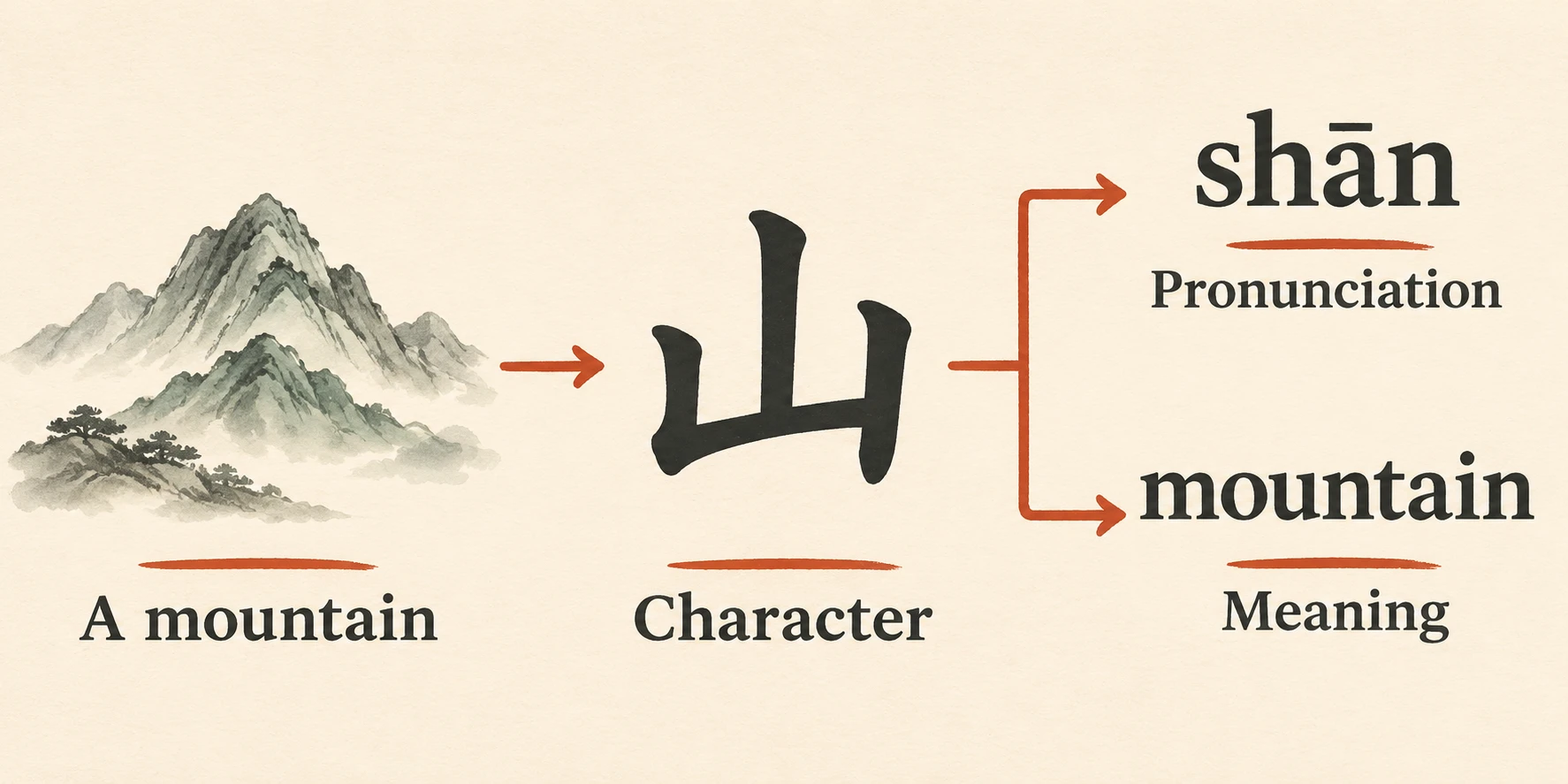
Pinyin is a romanization system for Mandarin. It uses Latin letters, but their sounds do not always match English. Treat a spelling as a reminder of a sound you have heard, rather than reading it with English pronunciation rules.
A syllable can have an initial, a final and a tone. In mā, m is the initial, a is the final and the mark above a indicates the first tone. Some syllables have no consonant initial. The letters tell you part of the pronunciation; the tone matters too.
Try the four examples below. Listen to each, then repeat it. These are complete syllables spoken as individual characters, not recordings of isolated consonants. Mandarin also has a neutral tone: it is unstressed and does not have one fixed pitch contour.
The third tone often stays low in connected speech. Before another third tone, it changes: 你好 is conventionally written nǐ hǎo, while the first syllable is pronounced with a rising tone. Our pinyin tones guide explains this in more detail.
Four tones, one syllable: ma
Each panel shows one tone on the same scale. Read left to right: up means a higher voice pitch, not a louder voice.
Tone 1 · High & level
Tone 2 · Rising
Tone 3 · Dipping
Tone 4 · Falling
A beginner’s pinyin reference chart
Use the groups below as a reference, not a list you must memorize before learning your first word. The 21 initials are grouped into manageable sets. The six basic finals are only a starting point: combined and nasal finals add further spellings. This is not a full syllable chart.
| Initial group | Spellings |
|---|---|
| First group | b p m f |
| Second group | d t n l |
| Third group | g k h |
| Fourth group | j q x |
| Fifth group | zh ch sh r |
| Sixth group | z c s |
| Basic finals | What to notice |
|---|---|
| a o e | Listen before applying English vowel sounds |
| i u ü | ü is a different vowel from u |
The combinations zh, ch and sh work as initials; do not pronounce the h separately. The letters y and w also appear in pinyin spellings. An initial cannot combine freely with every final, and some combinations have spelling changes.
Compare mā in the tone examples with mù in the character cards below. They share an initial but have different finals and tones. Once you know a pronunciation, find characters by pinyin to compare their meanings. That directory is a lookup tool, not a lesson you need to complete.
How are Chinese characters built?
mù · wood
mù · wood
lín · woods
Characters are written with strokes. Groups of strokes form components, and components can recur in different characters. A radical is a component used to classify a character in a dictionary; “component” and “radical” are not interchangeable names for every part.
Look at 木 (mù, wood) and 林 (lín, woods). Recognizing the repeated 木 makes the shape of 林 easier to remember. Other components can suggest pronunciation: 马 (mǎ) is a sound component in 妈 (mā). The tone is different, which shows why a clue is not a guarantee.
Not all characters are pictures, and you cannot reliably pronounce every unfamiliar character by looking at its parts. Check the reading and learn it in a word. Avoid making up a historical origin from a modern shape.
Stroke order gives you a repeatable way to build a character. See 木 below, then open its page for the animation and practice. Learn the basic Chinese strokes when you want a closer look at the individual movements.
1. Horizontal
2. Vertical
3. Left-falling
4. Right-falling
Learn your first Chinese characters
These eight characters have approachable shapes and useful meanings. They are a starting selection, not an alphabet or a ranked list of the most frequent characters. Each card includes a word or usage example: the meaning of a compound can differ from a literal translation of its individual parts.
First, choose one card and listen. Say the sound while looking at the character. Next, read its example and open the character’s stroke order. If you want to write, follow the strokes slowly once or twice, then try again without looking. You do not need to master all eight today.
When a character feels familiar, try recalling its meaning before looking at the pinyin. Keep audio available to check yourself. Short review sessions with useful words will give these shapes a context beyond a chart.
shān
mountain
shuǐ
water
Frequently asked questions
How many letters are in the Chinese alphabet?
Chinese writing does not have a fixed alphabet of letters. Pinyin uses Latin letters to represent Mandarin pronunciation; these letters are not Chinese characters.
Is there a Chinese alphabet from A to Z?
There is no standard table that replaces each English letter with a Chinese character. Such charts cannot translate your name or an English sentence into Chinese.
Is pinyin the same as Chinese characters?
No. Pinyin shows pronunciation. Characters are the symbols used to write Chinese. Different characters can share a pronunciation, so the letters alone do not always identify the meaning.
How do people type Chinese?
With a pinyin input method, you can type nihao and select 你好 from the suggestions. Handwriting and voice input are other options. A keyboard helps you enter characters; it does not replace them with an alphabet.
Should I learn pinyin or characters first?
Start with a few sounds and useful words, and look at their characters alongside the pinyin. Add more gradually. Recognizing a character and writing it from memory are different skills: you can begin reading before mastering handwriting.
Are Chinese characters and words the same thing?
Not always. Some words use one character, such as 水 (shuǐ, water). Many use two or more, such as 人口 (rénkǒu, population). Learn characters through useful words rather than assuming every character is a separate word.