Hanzi Stroke Logo
Hanzi Stroke

Making Chinese characters easy to write.

HanziStroke for your phone

iOS available · Android coming soon

Sister Sites
Five Elements TestKanjiStroke
AboutProduct UpdatesPrivacy PolicyTerms of Service
DICTIONARY
  • Chinese Dictionary
  • Pinyin Index
  • Radical Index
  • Character Components
  • HSK Dictionary
  • Character Compare
DICTIONARY
  • Chinese Dictionary
  • Pinyin Index
  • Radical Index
  • Character Components
  • HSK Dictionary
  • Character Compare
TOOLS

Practice & Review

  • Writing Practice
  • Flashcard Review
  • Dictation Practice
  • Worksheet Generator
  • Sentence Practice
  • Hanzi Sticker Match

Resources & Utilities

  • Worksheet Library
  • Chinese Writing Paper
  • HSK Level Checker
  • Pinyin Converter

Fun & Culture

  • Name Generator
  • Zodiac Calculator
LEARN
  • Learning Center
  • Courses
  • Blog
  • Chinese Stroke Rules
  • Chinese Poetry
  • Pro Membership ✨
LEARN
  • Learning Center
  • Courses
  • Blog
  • Chinese Stroke Rules
  • Chinese Poetry
  • Pro Membership ✨

© 2026 Hanzi Stroke. All rights reserved.

Made with♥for Chinese learners.
HanziStroke Logo
Hanzi Stroke
By CharacterBrowse all characters A-Z
By PinyinSearch by pronunciation
By RadicalFind by radical component
By ComponentsLearn meaning and sound clues
HSK ListsAll HSK versions overview
HSK 2.0
Level 1Level 2Level 3
HSK Standard CourseHSK 2.0
Practice & Review
Writing PracticePractice HSK and saved words
  1. Home
  2. Dictionary
  3. 坦然

坦然 (tǎn rán): Calm / composed (Adjective) — Meaning & Stroke Order

HSK 3.0Level 7-9
1.

Animated Stroke Order

Stroke order animation for 坦然
2.

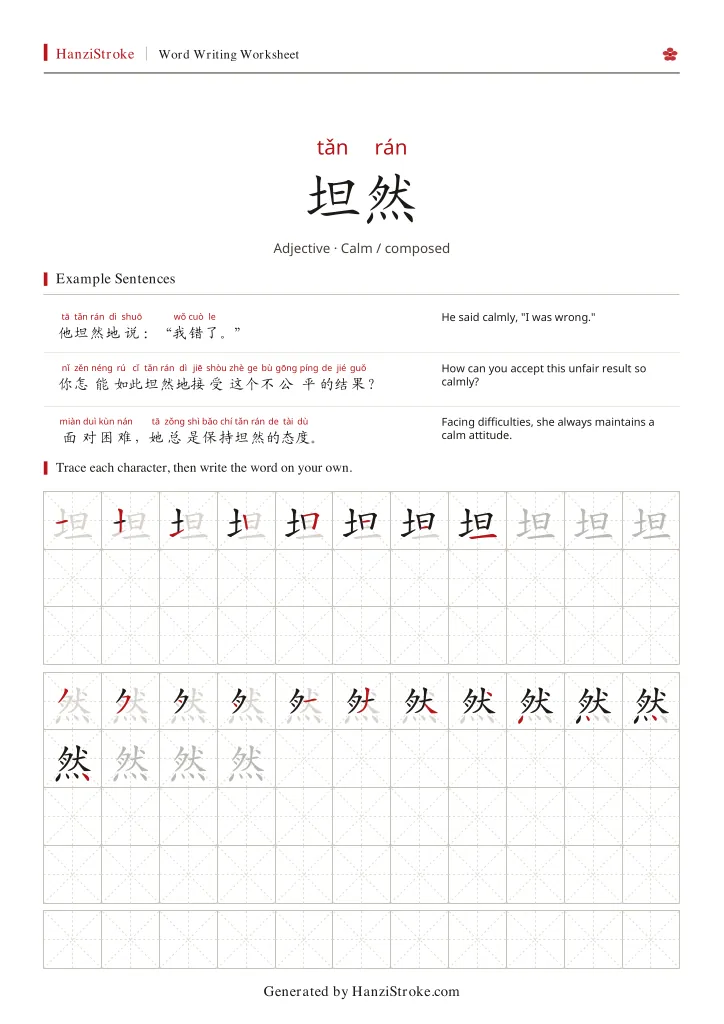
Free Printable Worksheet: 坦然

Level 4
Level 5
Level 6
HSK 3.0
Level 1Level 2Level 3Level 4Level 5Level 6Level 7-9
New HSK CourseHSK 3.0
Integrated ChineseFourth Edition
Hanyu JiaochengThird Edition
Developing ChineseSecond Edition
BCT Standard Course
Kuaile HanyuSecond Edition
Browse all courses
Flashcard ReviewSRS review for HSK and custom decks
Dictation PracticeListen and write characters
Worksheet GeneratorCreate practice sheets for free
Sentence PracticeWrite complete sentences in context
Hanzi Sticker MatchFree pinyin–hanzi matching game
Resources & Utilities
Worksheet LibraryHSK, Top 100 & themed PDFs
Chinese Writing PaperCustomize and print blank grids
HSK Level CheckerCheck HSK level of any text
Pinyin ConverterConvert Chinese to Pinyin
Fun & Culture
Name GeneratorCreate your Chinese name
Zodiac CalculatorFind your zodiac animal
View All Tools
坦然 writing worksheet PDF preview
Download Worksheet
Download full HSK 3.0 Level 7-9 PDF pack
3.

Character Breakdown

坦 • tǎn • flat, level, smooth; open, candid
tǎn坦

flat, level, smooth; open, candid

然 • rán • correct; to be so; like that
rán然

correct; to be so; like that

Word Info

Pinyintǎn rán
MeaningCalm / composed
Characters2
SyntaxAdjective

Words Sharing Characters

More common words that include characters from 坦然.

Words with 坦

  • 坦率tǎn shuàicandid; frank; outspoken
  • 坦白tǎn báihonest; frank; candid
  • 平坦píng tǎneven; smooth; level
  • 坦克tǎn kèTank (military vehicle)
  • 坦言tǎn yánfrankly say ; frank statement
  • 坦诚tǎn chéngFrank / sincere
  • 舒坦shū tǎncomfortable, at ease
  • 斯坦福sī tǎn fúLeland Stanford
4.

How to Use 坦然 in Sentences

Adverb + Adjectivewith十分
shí十
fēn分
tǎn坦
rán然
neutral
very calm
Adverb + Verbwith面对
tǎn坦
rán然
miàn面
duì对
Subject + Verbwith态度
tài态
dù度
tǎn坦
rán然
Idiomwith自若
tǎn坦
rán然
zì自
ruò若
5.

Example Sentences with 坦然

他tā坦然tǎnrán

neutral
face calmly
neutral
calm attitude
formal
Written
calm and composed
地
de
说shuō:
“我wǒ
错cuò
了le。”
He said calmly, "I was wrong."

面对miànduì困难kùnnan,她tā总是zǒngshì保持bǎochí坦然tǎnrán的de态度tàidù。

Facing difficulties, she always maintains a calm attitude.

他tā并bìng未wèi坦然tǎnrán面对miànduì自己zìjǐ的de错误cuòwù,反而fǎnér试图shìtú推卸tuīxiè责任zérèn。

He did not calmly face his own mistakes; instead, he tried to shirk responsibility.