烂泥 (làn ní): Meaning, Examples & Usage
Hanzi Stroke
Dictionary
By Character
Browse all characters A-Z
By Pinyin
Search by pronunciation
By Radical
Find by radical component
By Components
Learn meaning and sound clues
HSK
HSK Lists
All HSK versions overview
HSK 2.0
Courses
HSK Standard Course
HSK 2.0
Tools
Practice & Review
Home
Dictionary
烂泥
烂泥
(làn ní): Mud (noun) — Meaning & Stroke Order
1.
Animated Stroke Order
Practice Writing
2.
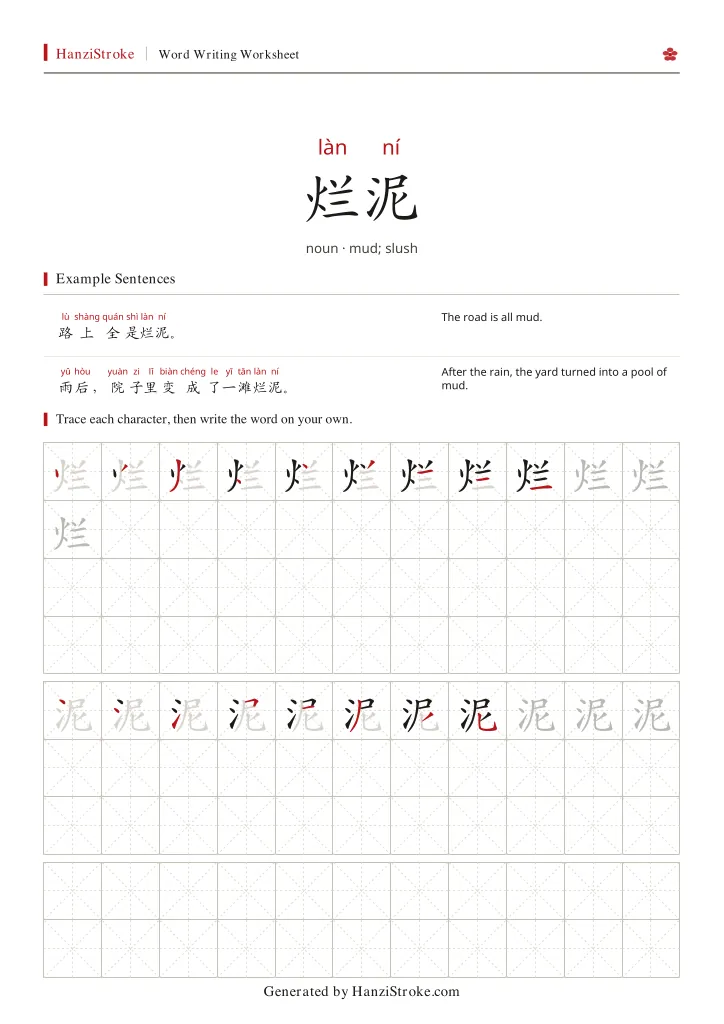
Free Printable Worksheet: 烂泥
Download Worksheet
Level 1
Level 2
Level 3
Level 4
Level 5
Level 6
HSK 3.0
Level 1
Level 2
Level 3
Level 4
Level 5
Level 6
Level 7-9
New HSK Course
HSK 3.0
Integrated Chinese
Fourth Edition
Hanyu Jiaocheng
Third Edition
Developing Chinese
Second Edition
BCT Standard Course
Kuaile Hanyu
Second Edition
Browse all courses
Writing Practice
Practice HSK and saved words
Flashcard Review
SRS review for HSK and custom decks
Dictation Practice
Listen and write characters
Worksheet Generator
Create practice sheets for free
Sentence Practice
Write complete sentences in context
Hanzi Sticker Match
Free pinyin–hanzi matching game
Resources & Utilities
Worksheet Library
HSK, Top 100 & themed PDFs
HSK Level Checker
Check HSK level of any text
Pinyin Converter
Convert Chinese to Pinyin
Fun & Culture
Name Generator
Create your Chinese name
Zodiac Calculator
Find your zodiac animal
View All Tools
3.
Character Breakdown
烂 • làn • mashed; mushy; sodden • HSK 2.0 L5
HSK 5
làn
烂
mashed; mushy; sodden
泥 • ní • mud, clay, earth • HSK 3.0 · L6
HSK 3.0 · L6
ní
泥
mud, clay, earth
Words Sharing Characters
More common words that include characters from 烂泥.
烂
泥
Words with
烂
灿烂
càn làn
magnificent; splendid; resplendent
腐烂
fǔ làn
become putrid; decompose; corrupt
沤烂
òu làn
to rot or decompose due to prolonged soaking
破烂
pò làn
tattered; worn-out; junk
砸烂
zá làn
to smash to pieces
糜烂
mílàn
rotten; corrupted; eroded
绚烂
xuàn làn
gorgeous; brilliant
烂摊子
làn tān zi
a mess, a shambles, a difficult situation left by others
4.
Example Sentences with 烂泥
lù
路
shang
上
quán
全
shì
是
làn
烂
ní
泥
。
The road is all mud.
yǔ
雨
hòu
后
,
yuàn
院
zi
子
lǐ
里
biàn
变
chéng
成
le
了
xié
鞋
dǐ
底
zhān
沾
mǎn
满
le
了
làn
烂
ní
泥
,
tā
yì
一
tān
滩
làn
烂
ní
泥
。
After the rain, the yard turned into a pool of mud.
他
zhǐ
只
hǎo
好
zài
在
mén
门
kǒu
口
bǎ
把
xié
鞋
cā
擦
gān
干
jìng
净
。
His soles were covered in mud, so he had to clean his shoes at the door.